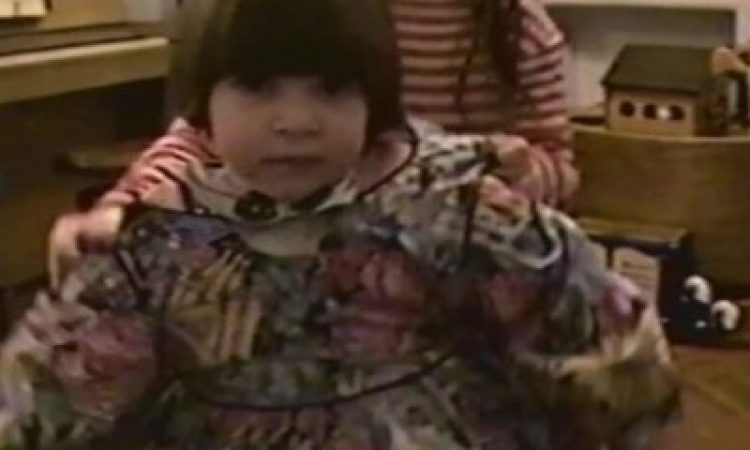
Naked Dances In My Basement starts with home video footage of the artist, Miryam Coppersmith*, as a child, twirling and laughing with her older sister while her mother records. She is layered in a baffling amount of dresses. Her mother repeats, “How did you get those on?” but also laughingly asks the young Coppersmith to stay in the camera or “make the face.” She giggles as she is unlayered.
The scene switches to a basement where Coppersmith is live streaming, again layered in clothing, standing and facing the camera. She slowly lifts the skirts to her knees as she begins improvising. The clothing is a collection from others; items they want to part with for reasons good, neutral, or painful. Coppersmith tasks herself with shedding the items piece by piece. The implications here are larger than the mimicry of the home video, though I see that as a place of departure. The simple act of undressing is imbued with more significance when it is performed with careful attention.
The sound design overlaps the audio from the beginning excerpts with live bass improvisation from artist James Vitz-Wong. It plays a major role in connecting Coppersmith’s dance to her recorded memories.
The improvised movement, aside from the careful undressing, mimics a child’s playful dance of embodying found shapes and angles and clockwise spirals. Once the sound fades, Coppersmith speaks about the clothing she is wearing, who gave it to her, and the experience she has in the room. Her movement becomes more quotidien in gesture. I wonder how much of the lives and the stories of others held in the clothing are used by Coppersmith in the design of the piece. Because everything seems so purposeful, I am uncertain of the basement’s significance. It is the only stark element; it feels outside of home or intimacy.
Overall it is a tender piece, blanketed lightly with meaning, that uses improvisation and vulnerability to shed the layers that were hers/ours/yours. Undressed and dropping gathered clothes into a pile, Coppersmith hopes this action releases whatever they carried.
*Miryam Coppersmith is a writer, editor, and member of the editorial board with thINKingDANCE.
Naked Dances In My Basement, Miryam Coppersmith, The Internet, Fringe Festival, Sept. 24-26.