This is real:
Everyone dies now and then.
Dancers glitglitglitch and repeat.
Megan Mazarick’s deprogram soars through intergalactic portals of brohood, catwalks, tampon commercials, and [can’t yet admit it] femme boys.
This is fake:
Four dancers, each wearing polo tank tops in red, pink, blue, and green glide Pacman-style around the stage.
In this world, everyone’s name is Chad. All Chads are gay for all other Chads.
I’m playing Minecraft.
And sometimes this is:
Mazarick is standing center stage, elbows locked and ready for battle, face stuck in a strained grin. She performs a fighting sequence, repeating “weapon, weapon, weapon” as she slices and swivel kicks through the air. Electronic synth-pop crescendos and I understand, the pixels become clearer, she’s inside a video game.
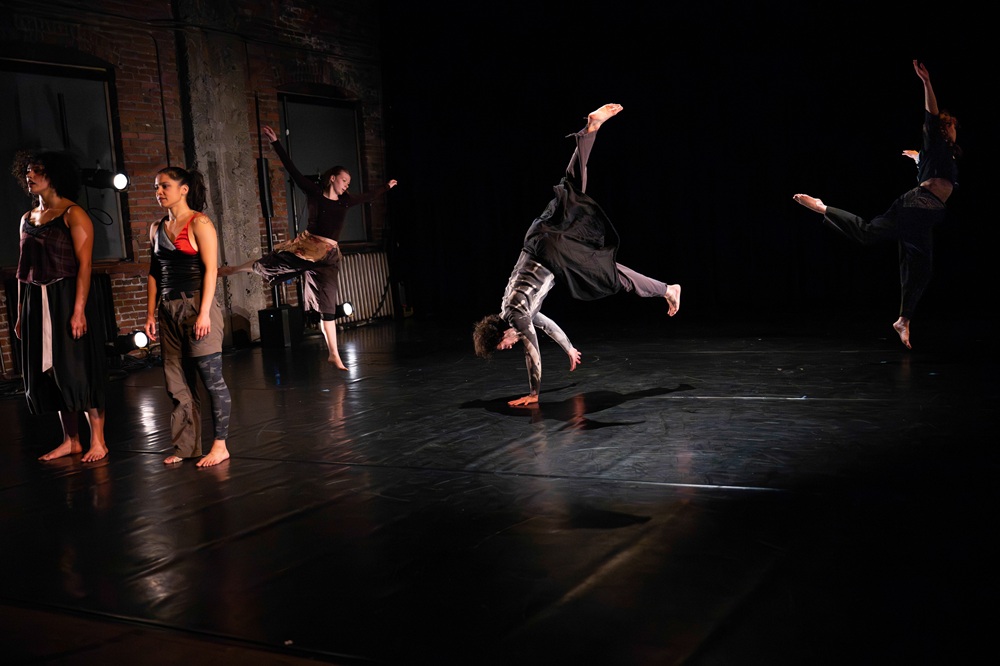
The dance ebbs and flows between vignettes, some that dive deep into characterizations, some that stay abstract as the dancers jolt, fly, and carry one another across the floor. At times, when it seems that the cast is in an improvisational score, they suddenly link into unison, perhaps wired with the same electrical impulse or maybe just by the energy they share.
The performers announce opposites:
“This is plant-based, this is animal-based”;
“This is natural, this is artificial”;
“I love, I hate”.
Their bodies flow through movement phrases that don’t appear to change in relation to these binaries.
This is:
Weaved throughout the piece are performances of widely recognizable tropes. A duet between buffed-up bros yo-ing at their go-pros sends the audience cackling. Ellie Goulding’s Top 40 hit “Love Me Like You Do” blasts as Mazarick and Alonzo Magsino break into a dramatic duet. At one time, Tyler Rivera stands with hands on hips, their palms facing backward. Hidden behind them, Danielle Curica threads her arms forward through their elbows, making one (mismatched) body from two. Together, they become a highly insecure femme-y person. Hips swayed, expressive hands in constant movement, and unconfidence spilling out of each utterance, the character Curica and Rivera become struggles to admit their own gender identity. At this moment the lines between their bodies are unclear. Is there yet another binary in this two-body person?
What’s real and what’s not?
What’s to love and what’s to hate?
And how many of these things can be true at once?
Mazarick’s choreography exaggerates these binaries to make them absurd. In a way, the dancers perform drag of all these roles – enacting the fullest characterization of “video game avatar” or “bro” to show just how foolish these distinctions are. Though references to explicitly queer content were scarce, the vignettes created in deprogram challenge all sorts of dualities. Using a video game format to confront the real and the fake, the love and the hate, the sometimes this and sometimes that, Mazarick makes a spectrum of all things.
deprogram, Megan Mazarick, Maas Building, Philadelphia, Fringe Festival and Cannonball Festival 2021, Sept. 29- Oct.1