Understandably, social activist artists have engaged climate change in their artistic practices even as the pandemic has reinforced disengagement and isolation. In the visual arts, Philadelphia-based painter, photographer, and climate activist Diane Burko has produced compelling images of frightening environmental degradation from her expeditions to Antarctica, the Arctic Circle, and the Great Barrier Reef. Her global exhibition, Seeing Climate Change, just closed at American University in Washington, D.C.
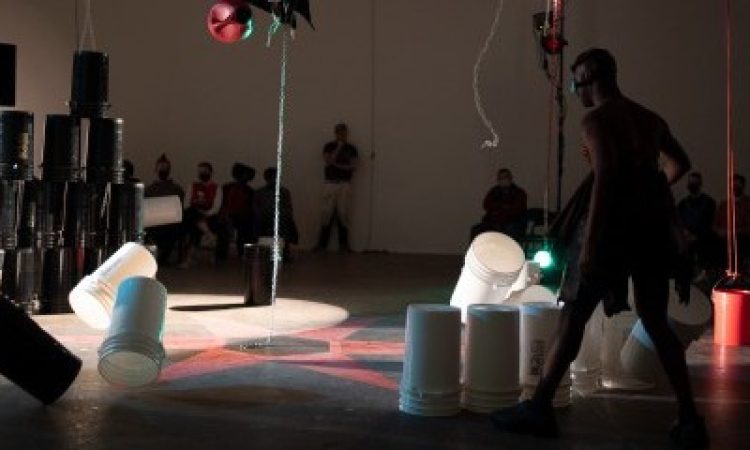
But rather than documenting climate change, Arien Wilkerson’s EQUATORS, a performance art and dance installation solo work created with their multidisciplinary collective Tnmot Aztro, seeks to address the social effects of climate change especially, as explained in their statement, through the lens of historically racist practices. The Icebox Project Space’s darkly lit setting has two hemisphere groupings of white and black plastic buckets on the floor, the white facing the black. From ceiling to floor, a dozen chains hang in a circular arrangement, a few of which support red plastic containers. In the center, an ominous compiling of black plastic segments is suspended over a painted red star on the floor. Images of white on black drawings, by David Boranski, of prison cells, barbed wire fences, and netting appear on a screen at one end.
Into this environment of metaphorical objects Wilkerson bursts forth in many guises. They strike the air with frenzied arms and then flash pirouette turns; they hoist suspended plastic containers up and down or, more menacingly, fling them chained, in the direction of the audience circling the performance. I see viewers abruptly move out of the way in their seats (all were pre-warned that moving objects might be projected towards them). At other times, Wilkerson sheds clothing and, nearly nude, vogues in spot-lit isolation against a wall and then in front of individual audience members. They continue interludes of kicking the black and white buckets across the space in close proximity to the audience. Wilkerson builds high, triangular structures of the two sets of buckets, and then collapses them with sharp kicks. I find the repeated violent aggressions of the hurled or kicked objects to be jarring and physically upsetting, an effect that may be consonant with the artist’s focus upon the psychic impacts of environmental change. The accompanying soundscape varies from piercing sounds to a ponderous bass, both unnerving in sonic effect. There is a voiceover narrative that is largely inaudible.
Wilkerson is a shape-shifting presence, changing between multiple costumes, which include a shirt cut into feathery slits, a large brown bow emanating from pelvis to floor, and an all enveloping mountain of fabric totally submerging their body.
Halfway through the short performance, a video projected onto a thirty foot long wall shows two brown skinned arms slowly stretching across and into the surface of melting ice, perhaps the strongest image of the performance.
Wilkerson presents the terror and dislocation of climate change. As we experience a sense of anxious foreboding throughout this performance, each of us can make our own associations of what has produced this disquiet in us. The artist may not have clarified the case for an environmental justice indictment as they appear to have intended, but they succeed in conveying its psychic and emotional impacts.
EQUATORS, Arien Wilkerson and Tnmot Aztro collective, co-presented by Icebox Project Space and Vox Populi Gallery, Dec. 17-19.