I first met Sarah Chien when she performed in an Urban Movement Arts showcase (Workin’ On It) in 2019. I remember her strength, the ease with which she traveled in and out of the floor, and her full-bodied commitment to improvisation. Her movement showed mastery of many forms, but exceptionally clear in her body was the influence of Flying Low, a spiraling, fast-paced form created by David Zambrano. I’ve had the chance to study the form with both Chien and our mutual friend Lily Kind. It was through a Zambrano workshop in Sicily where Sarah first met the other members of ∞therside collective.
Hailing from music, dance, and fine arts backgrounds, the members of ∞therside collective create experimental, interdisciplinary, fully improvised works that utilize dance, song, and poetry. Since its founding in 2017, the group has met annually in each of the members’ home countries to create and showcase these works. “We weren’t actually best friends; we were just the people who answered the first call,” Sarah remarks of the group’s founding. “But we’ve built really beautiful connections over the past five years.” So far, they have performed in Sicily, Bratislava, Greece, and Italy, and hosted a virtual performance that took place during the pandemic lockdown. Their first U.S. show took place at Gibney in New York City in late April.
Chien is not only a powerful mover, but also a farmer and community builder; I remember how she built a DIY dance floor on her roof and hosted evenings of casual performance there for several years. Though she is my main contact for the collective’s U.S. residency, the group functions non-hierarchically without a singular choreographer. Chien places the group in a lineage with other improvisational collectives like the Grand Union, which created live works in New York in the 1970s, and included now big names like Yvonne Rainer and Trisha Brown. The Grand Union broke up after about six years, but Chien shares that ∞therside collective shares a fantasy of “being together forever.”
When I asked Chien about what makes a successful composition for the group as a whole, she said, “I know it when it happens, but it’s hard to explain it. We’re looking for that balance, a diversity of ways of expressing. Maybe there was a big duet, then a small trio downstage, and then a moment where the whole space was empty. There was silence, there was text. We don’t get stuck on one thing for too long, but we also didn’t throw out so many ideas that it had no throughline. We are always looking for small, medium, and large—fractals of paths.
“We’re thinking about that with the collective as a whole as well. How can this be a long-term project and support everyone who’s in it through their different changes of life?” I hear the resonance of choreographic inquiries in the structure of the group itself: How can the work support non-hierarchical, improvised, com
munal composition? How can this happen on an international scale? The performance questions become the meta questions.
The makeup of the group is also a microcosm of intercultural exchange in its own right. Sarah said the group has a tradition of learning a song from the country they are in residence in, taught by the host. “Sometimes we use the songs in the performance. It can be a touchstone for the audience.” Chien, who is mixed race, reflects on how difficult it’s been to choose a song that is American in essence. “In each of the countries that we’ve been to, the person is more or less from that country generations back. It’s funny to be an American. What would the song be for us? America is much more diverse, and almost none of us are from the place that we are living now. To be in touch with folk traditions here is muddier. And for me, as a mixed-race person, what’s the song of my people? Is it a Chinese song, a Jewish song or an American song? And what is an American song?”
I find all these questions compelling and inherently political; these are predicaments I find myself in as a mixed-race person, although I do not often add on the layer of my Americanness into the equation. There is much rich work to be done outside of the U.S.-centric mindset, and it feels special to have this kind of exploratory exchange happening within improvisational movement work.
“We’re not really thinking of ourselves as overly political,” said Chien, “but it means something to us. It’s a statement for us that we managed to work together despite all the circumstances. We were in Poland in 2022 with the war next door. We were in Italy right when the lockdown was just lifted. We don’t break the laws, but we push right to the edge to be together. That feels like something.”
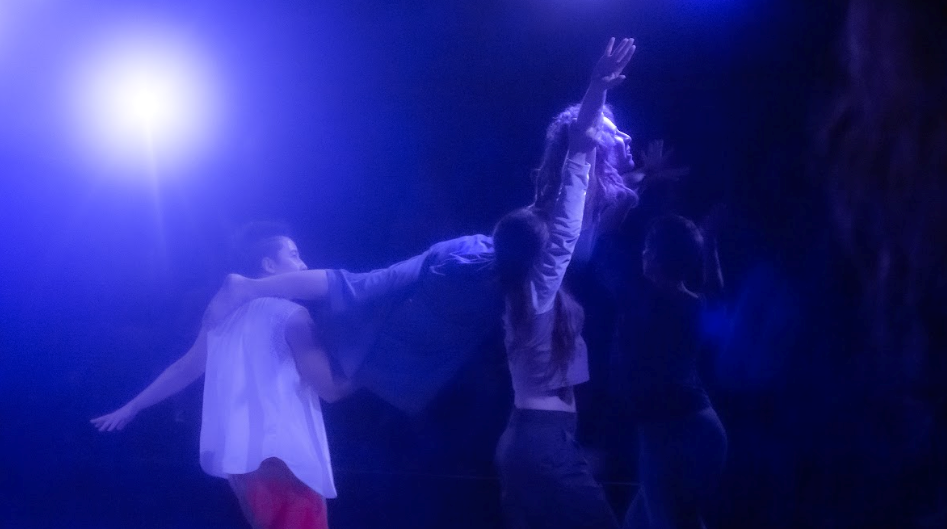
You Are in My Everywhere, ∞therside’s international collective: Agata Gregorkiewitz (Poland), Sarah Chien (USA), Susanna Grob (Switzerland), Sokratis Votskos (Greece), and guest performer, Caitlin Cawley (USA), Gibney in NYC, April 27-29, 2023.
∞therside collective:
Susanna Grob (Switzerland): Dancer
Sarah Chien (USA): Dancer, NY Producer
Agata Grekorkiewitz (Poland): Dancer
Sokrates Vostkos (Greece): Musician-Woodwinds
Alessio Bettoli (Italy): Musician-Percussion
Mirko Lancerotto (Italy): Visual Artist/Photographer
Francesca Caselli (Italy): Dancer
Vicky Angelidou (Greece): Dancer