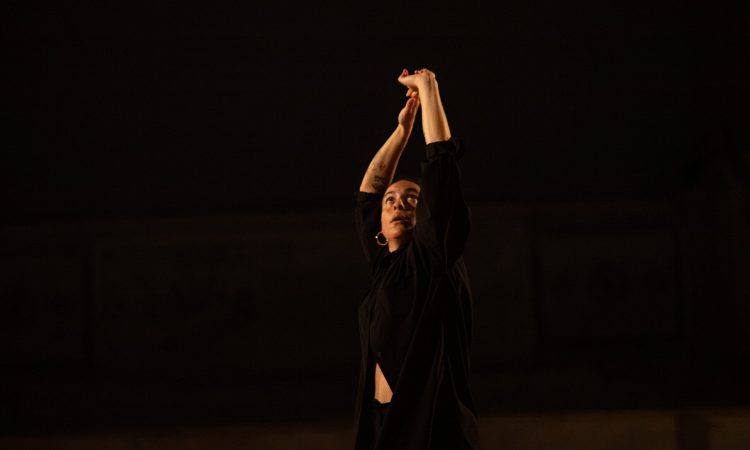
Zaquia Salinas is a down-to-earth choreographer, teacher, curator, and dancer with an artistic practice rooted in community organizing and yogic principles. We met after I reviewed her choreographic work, the meditative and powerful A Call to Prayer, and have since kept the conversation going–discussing art projects, life happenings, and the state of the world–building a thoughtful relationship between artists over time. On a fall evening in New York, I caught up with her to talk about her career as a lifelong educator, zeroing in on her course “Embodying Activism,” which she has taught at Bates College and UC Santa Barbara to dancers and non-dancers alike. This is an excerpt from our full conversation.
ankita sharma: What drives your journey in arts education?
Zaquia Salinas: Both of my parents are community college professors, and I grew up around deep respect for the role of education in social justice, community, and liberation work. I also danced in community studios and spaces growing up. I didn’t really have this sense of what counted as “real dance” until I was one of the only people of color at UC Santa Barbara. There, I realized that other people have dance backgrounds that are built around competitive, rigid, hyperstructured ideas about success that I hadn’t really experienced. In response, I was always asking why? Why do we do things this way and for what purpose?
I think it’s a real problem that dancers aren’t taught this right away when they are young–like why are we doing this exercise? What is this for? In my own teaching practice, I encourage students to reflect on what they are learning, what’s working, and how they might want to approach it differently for themselves, because at the end of the day, if they want to pursue a creative endeavor, they have to be asking themselves those questions. In this process, whether students have a dance background or not, everyone can have a rigorous dance experience, even if it looks super different than what someone expects “rigor” to look like.
By thinking more critically, students can also consider the greater context of the world that we are dancing in and understand the body as a site where community activism happens. Dance provides a very radical perspective about being human that a lot of other people don’t experience, and there’s an opportunity to see that perspective as an asset.
as: What tools do you use in classes to help students understand the body as a site for community activism?
ZS: A lot of somatic capacity-building and embodied-listening practices. These practices build tools that allow someone to show up in rigorous ways when things are intense or challenging. That could be spending long stretches of time doing solidarity work, making the kind of art that puts our nervous systems in challenging states, having hard conversations, or making change in unethical environments. What scares me most with young people is their inability to differentiate between discomfort and real harm. For me, capacity-building practices provide tools to be more responsive and available to other people when circumstances are challenging.
as: How vocal do you choose to be about your own sociopolitical perspectives as a teacher?
ZS: I think a lot about what onramps I’m creating for my students to join social movements that make the world a better place. I like making those onramps as wide as possible. So, I wear my ‘Palestinians for Black Lives’ shirt to class, and I play Arabic music, and if there is a protest on campus, I tell them to go, and I encourage them to move with others and make art because that’s also radical.
I try to provide gentle encouragement for them to bring what they care about to the space and to not have the whole “check your shit at the door” mentality about things. When there’s stuff going on, call it out. We have an opening circle at the beginning of every class to just be like, “this is what is happening right now.” We don’t have to pretend it doesn’t exist–we can dance with it. I want to have the door to activism feel wide open for them to walk through, in a way that it isn’t always in some of the more “radical” spaces that I’ve been in. I want to get them through the door, so we can eventually get them to those more radical spaces. If we can’t get them through the door, it’s not going to happen. I think about dance class as a door where this work can happen.
as: In your classes, if you have students who need more guidance to “get through the door,” how do you introduce them to these ideas?
ZS: I try to get a sense of how ready they are. I don’t think anybody is going to hear anything they’re not ready to hear. But sometimes, maybe this little nugget is going to rub them the wrong way for as long as it does…until maybe…one day it doesn’t. And it may not be anytime soon. And there are other times when I can see a student pushing back on something because they are trying to grapple with a problem and understand it. In those moments, it feels important to let them process that as collectively as possible. Even if it doesn’t get resolved immediately, oftentimes, they just need someone to make space for the question, rather than shut it down. When you’re young, a lot of your opinions have been inherited or are just being formulated. Sometimes being invited to unpack that is enough.
as: How do you handle teaching young people through this particular political moment where there is so much lack of certainty about the future?
ZS: I feel some empathy for young people–things are bleak in many ways. But also, what are we going to do? Throw our hands up, roll over, and do nothing? That sounds way more miserable than getting together with people and making art that reminds people of their humanity when there are so many things happening that strip us of our humanity.
A huge part of being an artist and community-oriented person is to keep showing up with other people relentlessly, regardless of how much money there is. There is something new to learn every time we show up, so we have to just keep saying yes to each other and saying yes to the things that feel like they’re a good source of life force. Showing up for ourselves and for each other when it’s hard, and we’re exhausted, and we don’t necessarily like everyone in the room–that is building community. I’m not willing to give up on that. I can’t. All of this makes life, not just worth living, but life in and of itself. It’s a practice, which means it is ongoing everyday for the rest of forever.
as: From your classes, do you feel like today’s youth have hope for the rest of forever?
ZS: Any young person who is like “Oh, in this reality that we’re living in, I’m gonna pursue dance,” regardless of whether they identify as a dancer, has a level of optimism. Students aren’t turning away from embodiment or self-expression, even when, from many people’s perspectives, it is absurd and frivolous. I know they have hope for the future, whether or not they think they do, because they are dancing.
ankita sharma in conversation with Zaquia Salinas, in person, September 17.