Fairytales aren’t exactly cute. There’s dark history there and graphic violence, too. Cinderella’s stepsisters cut off their toes to fit in her shoe, the Evil Queen asks for Snow White’s liver, and in Hansel and Gretel, children abandoned by their parents in the woods are almost a witch’s tasty treats. It’s on this premise that Rosanna Gamson’s Sugar Houses begins.
Sugar Houses is a dance theater piece that highlights the violent themes of Hansel and Gretel with a historical World War II slant. The monologue is the scaffolding of the piece, interrupting the fairytale to tell the audience cold, hard facts; notably, two books were required in each German home during that time: the bible and a copy of the Brothers Grimm. The singing is masterful. They clasp onto each other in small, intimate circles. Their Soulful voices build a connection between themselves that lasts far past the end of each traditional Jewish song. It fills the room with a sense of bearing witness.
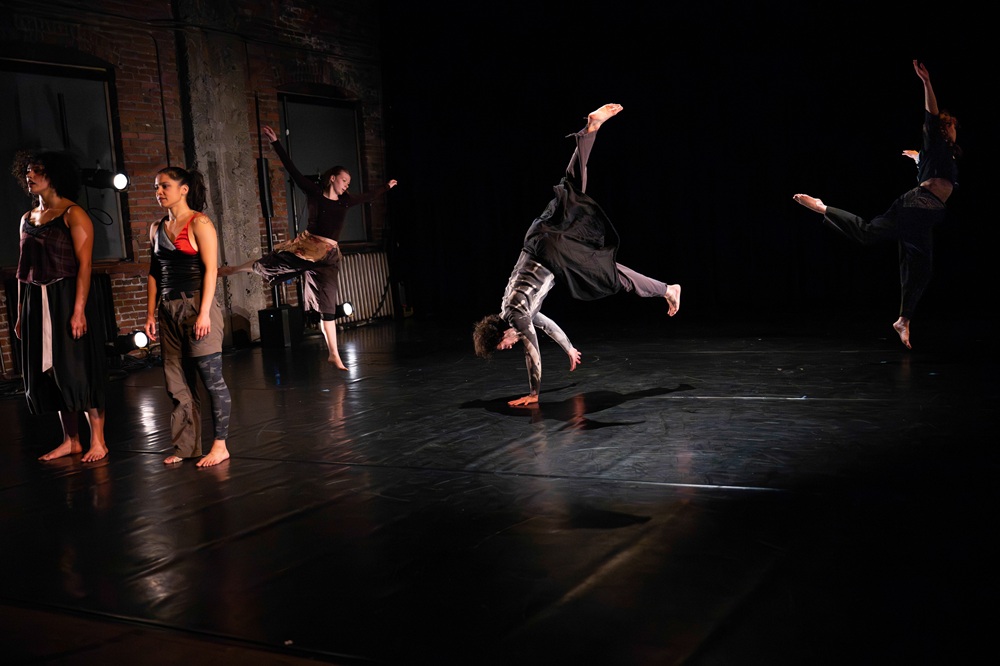
The dancing tells of the bond between two siblings. Seeming to defy gravity, Hansel and Gretel launch into the stratosphere with every leap and jump, extending their limbs to the limit. They slice the air as they fall, brutal as a knife wound. In happier moments, they skip and play. You root for them, that they’ll make it out alive. You know they trick the witch, and you wait to be satisfied.
But there’s a turn somewhere, a twist served on ice. First, gradually, then sharply, you realize things are not as they seem. Movement turns violent as Gretel tries to lure the evil witch into the oven, but she escapes only to find herself amidst a crowd. They push and pull her across the floor as she frantically attempts to get away. She is carried and forcibly held while a song is sung of her wicked ways. Without warning, the word “witch” is replaced. You remember the monologue, think of the violence, and realize you’ve been rooting for nationalists all along, that the witch, the exotic other, is the Jewish Community. Gutted, you sit for some time after the show ends, attempting to reconcile what you thought you knew.
Sugar Houses, Rosanna Gamson, Icebox Project Space, Cannonball Festival, Philly Fringe Festival, Sept 21-25.