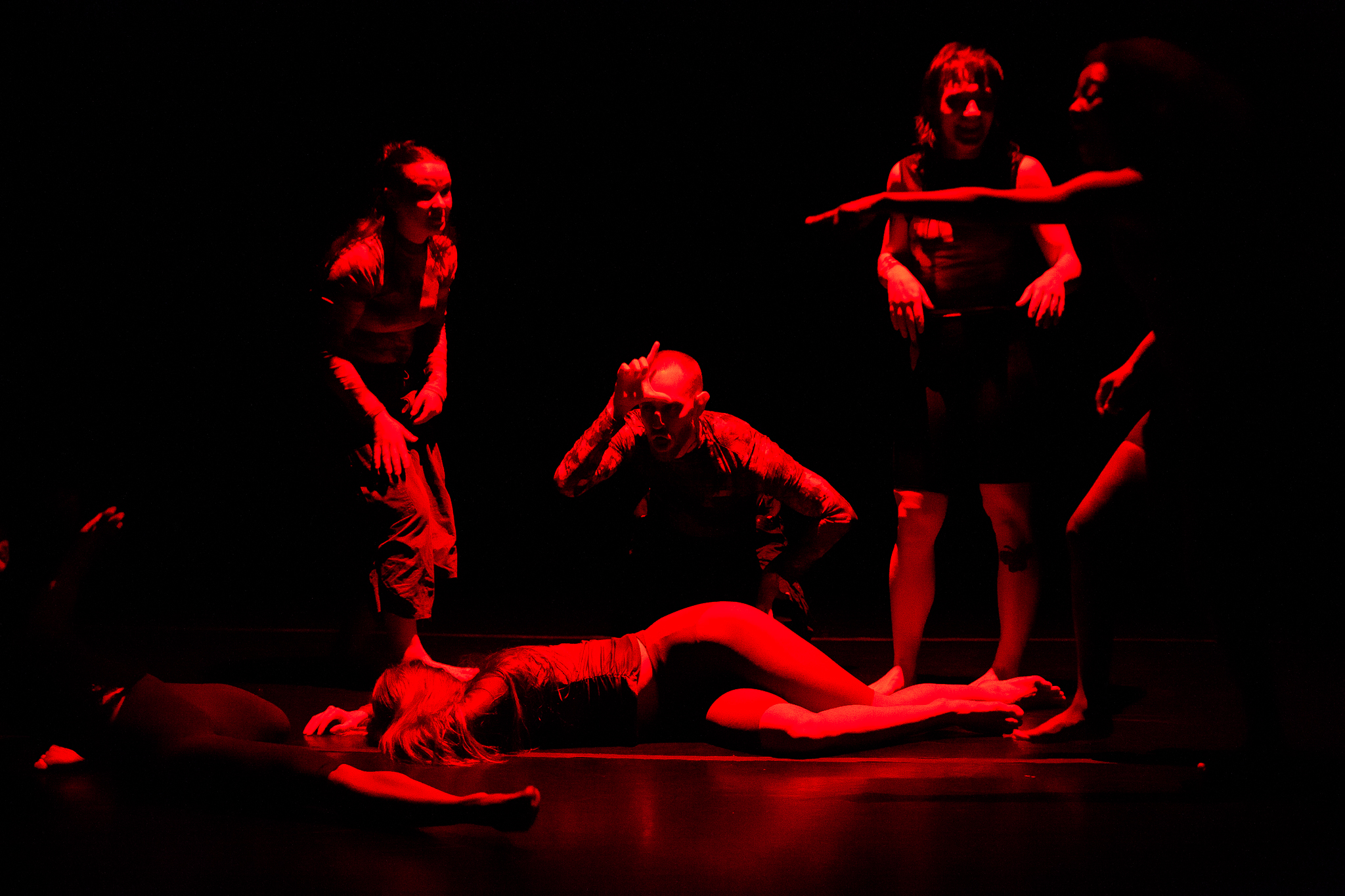
Upon enteringA Stank Upon A Time: A Story About Funk, I hesitate, careful not to step on the man who is hunched over on his knees extending prayer hands to guests. It’s Vince Johnson, founder of Urban Movement Arts and Philly Kerplop. A roaring bass thunders through the synthesizer and distorted vocals drone through the space. Guests settle, and Johnson silently and insistently passes out pizza and wine. Videographers Adriana Imhof and Aidan Un are paparazzi – hovering behind Vince and scanning the room to capture audience reactions. The music intensifies. A sonic blend of deep rhythms and swirling noises vibrate the floor and my eardrums. If soundwaves were visible, it would have looked like a tornado in there. Already so bizarre, it’s laughably uncomfortable knowing that this is just the beginning.
To the sound of church organs, Johnson takes the podium as “Bobo Bloody-Knuckles”. He begins an absurd testimony consisting of opinion-dumping, shit-talking, sounds of physical exertion, sarcastically apologizing to white women, and eventually a lecture on Blues and Funk. Known for choosing to publicize a sense of reckless abandon in his performance style, Johnson’s work is prone to increase your blood pressure, piss you off and/or gross you out – concurrently keeping you entertained.
In one of Bloody-Knuckles’ tangents, he yells into the microphone wondering why Black lives only seem to matter when one of us is murdered by police. I look around the predominantly white space. Comparing violence within Black neighborhoods to police-imposed violence, he encourages us to start marching against Black kids when they commit similar crimes.
While the messiness of this sentiment fits the show’s unruly disposition, I question the impulse of the advocation. Whenever cops–trained, paid, professionals benefitting from institutional and socioeconomic power–commit murder against a citizen whose conditions require the routine strain for resources and survival, it’s a different caliber of violence than what ensues between civilians. Understanding inequity, it would be remiss to organize against those facing the brunt of systemic hostility. The state, a historically anti-Black institution, has already taken that initiative. Accountability on all fronts is essential.
“Some might say America has done us wrong, but without America we wouldn’t have the Blues”. The band composes a Blues score on the spot as Josh and Emily Culbreath of Snackbreaks Movement Arts dance. They freestyle in playful exploration of their movement vocabularies to the 12-bar cycle and triplets ingrained in the song – which Bobo explains is an essential component of the Blues. Subtle grooves carry the dancers through rhythms that demonstrate well-versed foundations in house, breaking, and popping. This moment locates the soul-inspired nature of Jazz, Funk, and Blues in the context of this work. They put the stank in The Stank Upon A Time.
Johnson closes the show with a lecture honoring Blues and Funk as soundtracks of historically revolutionary political movements that fostered social change, civil rights, and soul connection. His own creative approach is one that shares the same unapologetic outpour of passion and expression. It’s radically honest – channeling taboo thoughts and ideas to be synthesized through obscure art-making.
The Stank Upon A Time: A Story About Funk, Philly Kerplop, Urban Movement Arts, Philly Fringe Festival, Sept. 16, 23.