Five innovative choreographies alighted the stage at Temple University’s recent Dance Faculty Concert. Created by faculty members and performed by MFA and BFA students, the two-hour long concert rendered spectacle and dynamic that engaged with interdisciplinary inquiry and artistic creation.
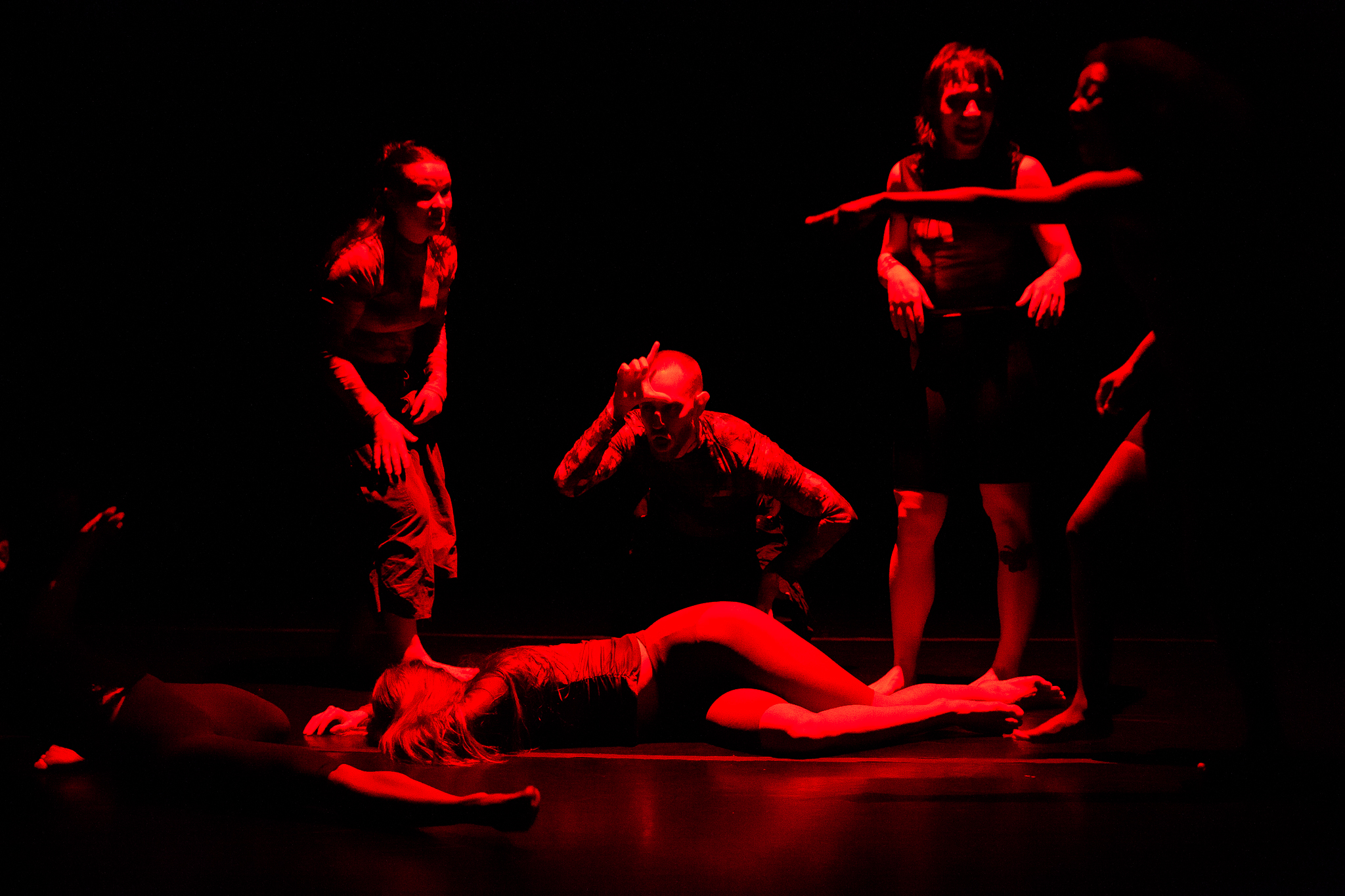
The concert opened with Xiang Xu’s group dance Nocturne. A grotesque prelude commences the dance, where one dancer lies prone on the floor, leg lifted, while another dancer casually sits on their back. The second dancer vocalizes her experience of moving across the country, seemingly unaware of the living body below her. Behind them, other dancers, covered by a huge transparent plastic sheet, resemble sculptures in museum storage. As Chopin’s Nocturne
No. 5 plays, the plastic sheet lifts to float low overhead, unveiling the dancers below. Wearing black suits, pants, and white tops, the dancers run and spin like white and black piano keyboards playing the music’s melody through their bodies. Towards the end of the dance, numerous paper planes fly from the audience, disrupting dancers’ hysterical and improvised kicks, shakes, and hops. The paper planes’ interruption of the boundary between audience and performers reminds me of words in the program note: we are interwoven “in the same cosmic fabric.”
In Decolagem, Merián Soto collaborates with seven dancers and a violist, displaying the power of merging live music, recorded music, and movement improvisation in choreography. Clad in light-colored shirts and stretchy pants, dancers’ angular postures at the beginning echo the monophonic notes of the viola. When a recording of Tunico’s light jazz plays, dancers accelerate their turns and rotations, mirroring the fluidity of the music. The violist continues bowing her instrument, adding to the sonic landscape, while also spinning her body, traveling around the stage to immerse herself as one of the dancers. By stating that the “movement is generated by the performers” and listing herself in the role of “bringing about concept and direction,” Soto gives the performers full credit for the piece’s creation.
Prim and Proper, choreographed and danced by Jillian Harris and Marie Brown, inquires into the shape of female stereotypes in a patriarchal culture. In the first section, the two dancers interweave and compete with each other, using aggressive eye contact and hitting and kicking to transform each other’s motion. The second section of the piece displays a surreal scene where the dancers stand behind two televisions, which play close-up recordings of their heads. Echoing the metaphor of the chimera, “a mythical creature composed of incongruous parts,” mentioned in the program notes, the uncanny facial expressions and wacky voices of the dancers in the media and on the stage challenge the notion of an ideal woman.
Laura Katz Rizzo’s short duet, Interference is Coherence, experiments with the fundamental elements of choreography: space, time, and energy. By intersecting recurrent ballet vocabulary with pedestrian walking and percussive music, the duet tests variations of rond de jambe, développé, and pirouette patterns through choreographic techniques such as synchronization, mirroring, canon, and doubling the time. The gradual appearance of sharp sliced lighting on the
floor and the backdrop also adds a minimalist dynamic to the dance.
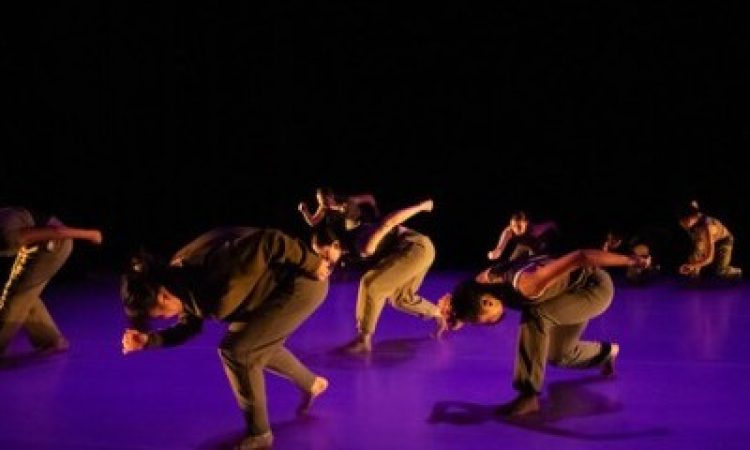
Anthropoidal, a group dance choreographed by Fairul Zahid, a guest artist from Singapore, examines the confluence of human and inhuman behavior. Reflecting the electric percussive music, the choreographer develops low-gravity and rapid movements for the dancing bodies. Dancers bend their knees and lower their bodies to march across the stage. Arms slash the air and feet swiftly shift; when the whirling bodies fall to the floor, they immediately spring back up in a seemingly effortless way. The dazzling sequences and wide range of motions resemble a fast-forwarding film, showcasing the virtuosity of the dancers. Along with the dancers’ military green outfits, the dim stage light and jungly music throughout the dance accentuate a primitive aesthetic.
While I applaud the advanced artistry and diversity showcased by the Temple Dance Department, some pieces were too long to maintain my engagement with the content. However, this performance highlighted the talented and hard-working BFA and MFA students who contributed their virtuosity and creativity in realizing these works. Audiences who missed the performance or want to retaste can access the concert video through the Boyer College
Channel on YouTube.
Dance Faculty Concert 2024, Temple University, Conwell Theatre, Feb. 9-10.