I’m in a room I’ve danced in before.
It starts with him.
I’ve seen Steve Paxton here in an evening with Yvonne Rainer and Simone Forti. It’s a familiar place, and here I am with hundreds of others, watching a collection of videos, rehearsal documentation, interviews, experiments, and performance documentation. I meander through 40 minutes of non-linear archival material on the practice and the life of Paxton. Lisa Nelson and Cathy Weiss sorted through their archive, gathering rarely seen footage, and gave us glimpses of his humor, his life, his work, his movement, and his farm.
He does plain things.
Building a studio, feeding a pig and a horse, dumping a wheelbarrow, walking, leaning, Kayaking. So many quiet moments overlapping. In my notebook, I write trip, ripple, sustain, gather, push, follow, watch, and play. Also, crisp, linear, and obeying impulses.
I note his voice, his hands, his spine.
I watched Goldberg Variations rehearsal footage from 1987 at the Painted Bride, and learned he wanted to do it in different places worldwide. I saw him improvise with nature, flick and start, a spiral across fields, pressing against a tree, the earth. I saw excerpts from PA RT and Some English Suites, apparently his favorite performance.
He says plain things.
“I simplified things enormously,” “I’m going at the speed of action,” and “I doubt it’s possible for someone to teach you to improvise.” Steve Paxton–a video amble did just that; a meandering soft shoe back and forth across time, showing the nature of a man and his thoughts.
I see weight, grace, and his “real medium—gravity.”
He ripples through others.
I’m in a room.
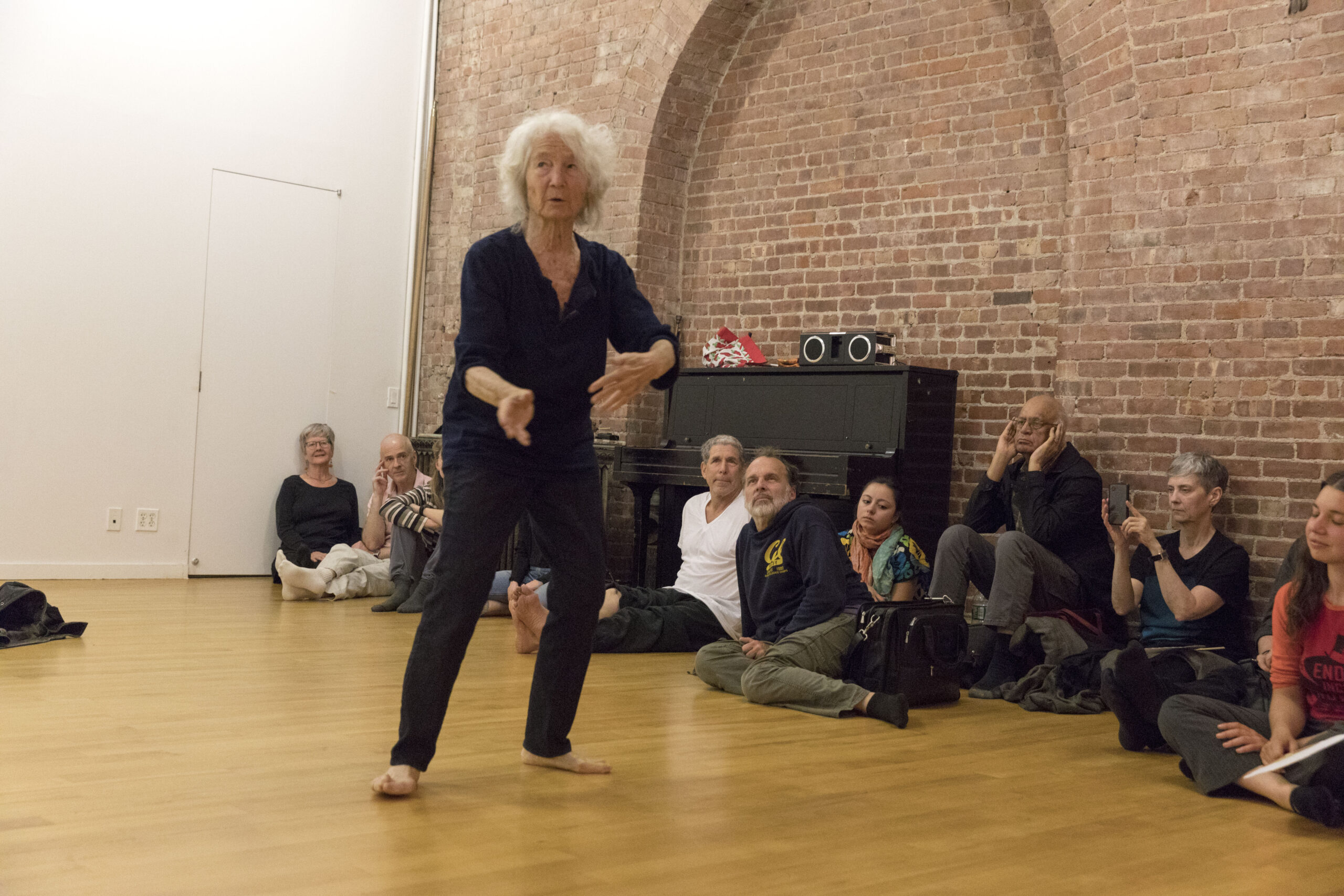
I’m surrounded by generations of dancers, documenters, archivists, historians, and students.
I’m sitting in a room with my dance lineage. I’m sitting among friends and icons. The chat back with Nelson, Weiss, and Danspace Project executive director and chief curator Judy Hussie-Taylor, starts with a few words about process. It’s lighthearted, it muses upon the nature of collaboration, it doesn’t explain anything.
There’s a lot of care and love.
When they open to the audience for questions, someone asks about the 1966 installation footage from 9 Evenings: Theater and Engineering–Steve Paxton: Physical Things. Wendy Perron stands to address the work a little further, giving historical context to the piece. This sets off a chain reaction, a ripple of voices that stays casual, revisiting moments– “Oh that was you with the baby, Barbara, wasn’t it?”
The voices of the ‘giants’ ring out.
On all sides, folks that were there from the Douglas Dunn Judson Church days, the ones that dug deep, explored all the way to the bottom of their well of questions. They all spoke up, affected by the work of this one improviser.
Yoshiko Chuma cracking jokes, Yvonne Rainer telling a story and saying “Steve was the most unusual person I’ve ever met. Not that forthcoming, but he was very alive in the moment.” Joan Jonas took the microphone and said that watching Steve Paxton walk through this very space, “That’s what got me into performance. The walking piece.”
Some of us knew the man and some of us danced with him.
Some of us studied him, the youngest of us just hearing of him. This is the archive, living in film and carried in the bodies and the histories of his peers. Generations of people whose lives were touched by his research and “his love affair of word-ing…his radiant love of dancing,” as Nelson and Weiss wrote in the program notes.
All this lands in my hands.
I’m in.
Am I fan-girling super hard right now? Absolutely.
Steve Paxton – a video amble, organized and hosted by Lisa Nelson and Cathy Weiss, Danspace Project, February 14.