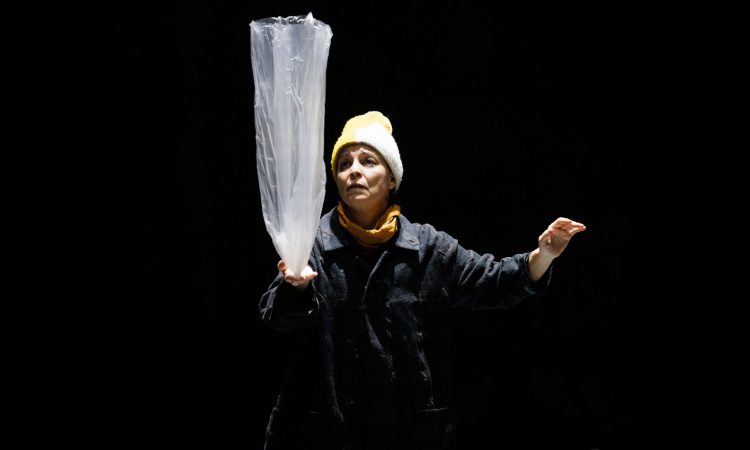
She is pompom hat, black jacket, yellow sleeves, long pants, yellow crocs, and she is wailing. She is Christina Gelsone, the remaining part of the clown duo Acrobuffos, after the loss of her husband Seth Bloom. And she is throwing tissues behind her, covering the floor. In a black out, sobbing “no!” she hauls in a large blanket made of tissues. Her seat is a wastepaper basket. She finds red crocs in the mess and listens to them like seashells. She curls up to sleep in her tissues and lightning flashes, showing us sparks of writhing, pulsing, shaking, climbing, collapsing. She is laying peacefully in the pile with red crocs on her heart.
Audience members who agreed to be part of the experience sit opposite one another on stage. The first thrown tissue lands on a woman’s head. We laugh while Gelsone sobs. Tissues waft over those seated or are handed to them, tears and snot, as she wipes her hands on someone’s knee or shoulder. We laugh while she is heaving. She starts to pile her tissues on someone’s lap, then hefts the whole blanket onto him and makes a space for him to see through her mess. Two sections happen before she takes it back. He holds it the whole time. She is grieving, after all.
Next she rolls out a big round black tub, the size of a ring leader’s stand. She plays with it–rolling it in a perfect circle around the space twice. She stamps in the center arms open, fists clenched, a face of pride and bravado and we “Bravo!” at the feats of a circus tent.
Then she startles, brought back to reality, sobs and ends up under the tub, yellow crocs sticking out.
She blows bubbles, swinging between wonder and weeping, and the wand ends up in the hands of a few audience members. They fail to blow bubbles the first few times. Gelsone’s clown comes through the crying and gives a “seriously?!” nod to the rest of us.
The bubbles left in the air rise in slow motion towards the lights, attaching to someone’s hair, or leg, popping mid-flight, or disappearing out of view. Gelsone’s precise, deliberate and carefully funny clowning sets up the premise right away that those on stage may need to help her. They hold her things, take her snot rags, nod encouragingly, blow her bubbles.
She has her things, she has some of his things, and she paints her face. Painted and in a spotlight, she stands on the tub and performs a series of clown acts. First an interpretation of a song about crying, with her big frowns, miming space, fear, and emotional switches from happy to sad. Then a swinging set of pompoms made of tissues like that of a fire dancer. Then a silly whistle. It dawns on me that she is trying to keep the comedy alive without him, clinging to the form they worked in for years.
And she is funny. Her physical timing is impeccable. She ends up curled in a fetal position on the tub, rocking herself. We watch while she shivers. Her riotous silliness, moments before, lingers in resonant chuckles, even why my heart hurts to see someone so small and shaking.
This is a true story. Gelsone is reckoning with the loss of a love and a duet. We hear a snippet of the two of them talking, otherwise wordless in their clowning. Maybe her grief was helped by clowning. Maybe she has been held up by strangers. Maybe the weight of daily tasks turned comical for her at some point. The restaging of this, asking the audience to help her, is tear-jerking and human and wise. The master craftswoman and the shy clown, both taking the goofiness seriously.
After her routines, she sits next to a woman and hands her a makeup wipe. Gelsone puts the dirty wipe on the woman’s knee, like her tissues, and we giggle while crying with her, her exhausted face held by another woman, and cleaned.
A hook descends and she hangs a bag of goldfish on it. She pokes holes in it, places her tub beneath and undresses. She showers, mostly nude, in front of us, quietly crying, unable to stand. She asks an audience member to wrap her in a towel. It takes two to get it to stay, humans fumbling the needs of someone drowning. The expression on her face changes from pleading to curiously watching folks fail, glancing at the rest of us for a laugh. I am physically brought back to moments in my life when I felt how the quake of laughter and that of sobbing are so similar.
From the hook his jacket hangs, and she dances with him. And now from the hook a noose hangs and she tries to die. And now, in a hookless space, a plastic bag gets balanced into levitation and then drops. She plays with it and puts it in her pocket.
For an hour we watch the close edges of laughter and weeping, how the body responds and is exhausted, how the layers of our humanity peel away. It’s about being in relation to each other even when grieving and alone, about how we try to care for each other and maybe fail. And it’s funny, this mess of fluids and pain and empathy. It’s a laugh-out-loud, messy, nonlinear walk together. Grief is a whole cycle, and we are not alone in it. Even strangers can hold your face. Even strangers will sit with a giant pile of tissues on their lap for a while, even while you pile more on.
Throughout the piece, she sways, tired, head leaning off to the left. She takes off her jacket and puts it back on, in a repetition of weary daily life. She pulls her hands out of her pockets and undoes the top button of her jacket. She shrugs it off her shoulders, pulls her left arm out of the sleeve, rolls it over her right side, lining toward us, inserts her left arm again, flies it over her shoulders, settles it back on, does up the top button, and brushes her hands down her torso into her pockets.
She stamps, determined, pulls her spine upright, a “bootstraps” kind of gesture, and looks around.
She pulls her hands out of her pockets and undoes the top button of her jacket. She flips it off her shoulders, wrenches her left arm out of the sleeve, sends it over her right side, lining toward us, shoves her left arm in again, wings it over her shoulders, settles it back on, does up the top button, and brushes her hands down her torso into her pockets.
She sways a little, and pulls her hands out of her pockets to undo the top button of her jacket…
It would seem we need each other.
GREEF, Christina Gelsone, Baryshinikov Arts Center, October 2026