The Table is unyielding. It goes, and goes, and goes, and goes, and goes, until they cut the lights out. And even then, it continues through the darkness in its aftermath.
It grapples with the things that drive us. It holds our desires in its hand and then crushes them–squishing their guts into the crevices of its sturdy palm.
It begins with maura nguyễn donohue, who sprints from the upstage corner of The Gym at Judson Memorial Church, lunging across the brightly lit, millennial-grey, laminate flooring. The hum of the industrial inner workings of Judson Church overlaps with the effortful breaths of nguyễn donohue and the steady pounding of her sneakers on the floor.
nguyễn donohue finds her pace, running in place with a deadpan stare while a series of scenes unfold around her. Castmates Julia Gu, Rami Margron, and Shannon Yu enter and re-enter the space, bringing with them a series of items–a bowl and spoon, a laptop, an Ikea-esque fake potted monstera plant, and a make-shift finish line which nguyễn donohue promptly tears in half. As nguyễn donohue bounds her way through these fleeting moments, she oscillates between momentary control and impending surrender.
The pace quickens. Objects come more quickly at nguyễn donohue, being flung through the air, only to be dodged at the last second. The pace doesn’t let up again until the final blackout, nearly 50-minutes later.
nguyễn donohue is continually transported into new dimensions, as Gu, Margron, and Yu assemble, dismantle, and reassemble the world around her, acting as architects of the space and even of nguyễn donohue herself. The frantic run that nguyễn donohue enters with eventually dissipates into a desperate crawl. nguyễn donohue continuously slips between embodiments of quotidian anguish–crawling, frantic searching, and exhaustion–and more composed choreographies, including a brief duet with Gu, as she approaches each impending obstacle.
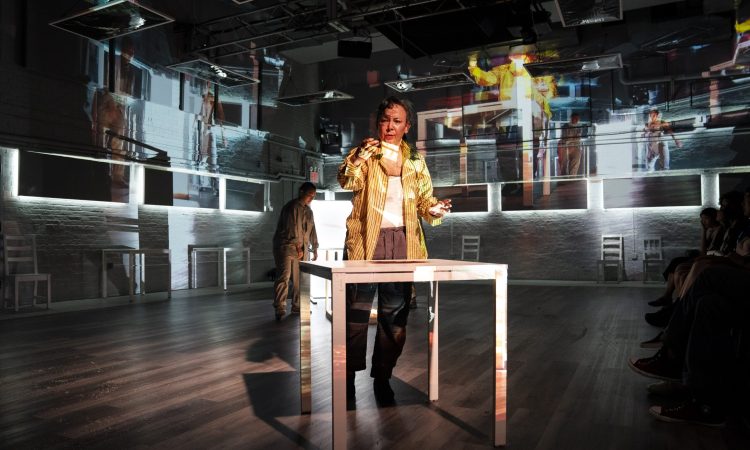
Lighting design by Tuce Yasak and projection design by Hao Bai further mutate The Gym into nightmare-ish landscapes that morph and transform with each shift of the spatial environment by the cast, presenting new challenges at a ceaseless pace. At one point, nguyễn donohue finally sits at a small white table. She is eager to indulge in a spoonful of rice from the bowl set in front of her, but the others rip it away, over and over again. The tables and chairs, which multiply and diminish throughout the performance, both imprison nguyễn donohue and serve as a brief resting place before they are mutated into a new configuration once more.
Nearing her breaking point, nguyễn donohue pulls miniature action figures from her mouth. I wonder how, and when, they got there. The arrival of the miniatures is followed by a spat of blood, which pours from her mouth onto the white table below her. She continues–pulling the miniatures from her mouth again, and again, and again. I mean, seriously, how could she endure any more? Just as I ask myself this question, she does, indeed, continue. She is relentless.
nguyễn donohue stands apart in her unwavering commitment to riding the wave of uncertainty, meeting each new absurdity, obstacle, and rupture constructed by the ensemble and design team with a tenacious conviction. Eventually, she finds an exit, an otherwise nondescript door in the back of the performance space which pours red light from its cracks. She exits, but the mess remains–dirt, (fake?) blood, grains of rice, and sweat, congealing together across the linoleum floor. There is a smell, not necessarily bad, but present. Effortful. Still, I can feel it lingering in my nostrils as I write this.
Ching Valdes-Aran enters for the first time in the final moments, overlapping with a projection of nguyễn donohue and Gu sitting in the same chair that Valdes-Aran eventually settles in. The projected nguyễn donohue and Gu lean, peaking their heads out from behind Valdes-Aran playfully. She takes a seat and, satisfyingly, eats from a bowl of rice, which for the first time is not ripped away. She begins to sing: “I’m not the one you want, babe… I’m not the one you need.”
Margron and Yu reappear, now topless, shedding their previously all-grey and somewhat sterile attire. They take turns, carefully passing an increasingly small pile of dirt to one another as it spills from their arms. The once dark and disorienting lighting warms and stabilizes. Framed by Valdes-Aran’s song, the pair appear as distinctly human for the first time.
Eventually, Yu is left alone, carefully passing the few remaining clumps of dirt from one hand to another, as Valdes-Aran continues in her song–her raspy tone echoing against the concrete walls. Then, with a swift blackout, it’s over. I sigh in relief and loosen the grip from my core. It’s over.
The Table is an experiment in testing the limits of endurance and desire. When do we persist, and when do we finally let something end? Do we ever? Ultimately, The Table refuses the comfort of resolution. Instead, it continues. And continues, and continues, and continues.
The Table, Pink Fang, The Gym at Judson Memorial Church, June 5-14.
Note: maura nguyễn donohue is a colleague with whom I work at Hunter College and have worked with in various capacities in recent years.