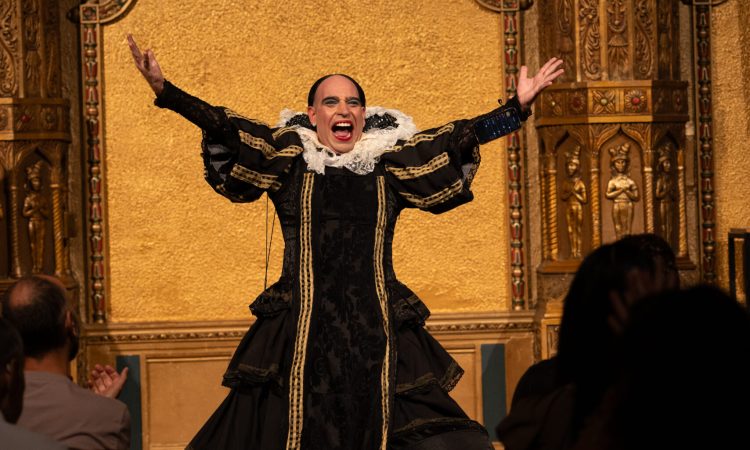
Her Majesty gallivants in on a horse to baroque music, toasting to us with hearty huzzahs. Her billowing black and gold gown has a huge lacy collar that half covers her head. On her left wrist she wears an iPhone set up to…hey wait, is that QLab? Wait, is she wearing a belt with spike tape and a speaker attached too?
Your Queen Presents: PETRUS is a one-person balancing act of theatrical spectacle with laborious reality. Theater, Edu Días shows us, is as hairy, ugly, and one-sided as it is spectacular and ornate.
After the death of her husband King Henry II, Catherine de’Medici–mother, widow, and 16th century Queen of France–is left custodian of both the kingdom, who has no faith in her, and an unruly royal menagerie of wild animals, including a very hairy man with hypertrichosis named Petrus Gonsalvus. In an act of desperation Catherine turns to the only idea that could possibly save her from losing power: exploitative theatre making. She forces Petrus, represented by both a hairy doll and by Días themselves puppeting behind a projector, into stardom. She works him every night as a horrifying yet show-stopping circus act. Petrus, who Catherine describes as ugly, is later revealed to be well-educated and artistically talented despite his appearance. Catherine, however, cares less about this and fixates instead on his monstrousness drawing a nightly crowd that keeps her both wealthy and in charge.
Towards the end of the show the astrologist Nostradamus (who is also played by Días) reveals to Catherine that he had a vision in which Petrus would soon break free. Catherine, mortified by the potential end to her gold, goes searching for him in the house of the theatre to force him back. But her rage transforms her into a hairy beast herself, leaving us to wonder who is actually the monster? What is the cost of spectacle? Whose humanity is exploited for showbiz?
…And here I am, consuming the spectacle and spitting it out into words with the power to shape the public’s view, maybe even determine an artist’s fate. I know making the work is much harder than writing about it. So what’s the reviewer’s role, my role, in perpetuating or intervening on capitols exploitation of artists?
Info Listing: Your Queen Presents: PETRUS, Edu Días, Philadelphia Fringe Asian Arts Initiative, September 9-11, 2026