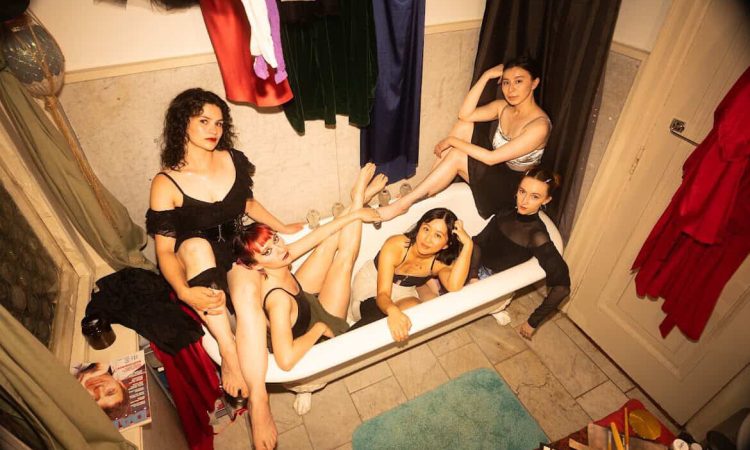
The house party begins the way any party should—with high Shakespearean collars, ballet slippers, and champagne. After trading fur coats and high heels for red solo cups, Corps de Ballet PHL scurries on to the marley, leaping and pirouetting in a welcome dance. Streamers line the upstage wall, a couch sits in the corner, and solo cups line the floor. Philly’s &space, home to this production of Dancing in Yesterday’s Stage Makeup, cannot help but look like a loft. The aesthetic works, perhaps unintentionally.
Corps de Ballet PHL skillfully references classical ballet works in a way that never feels cheesy. At the end of one solo the ensemble reenters the party, arms crossed in an explicit callback to the Willis scene from Giselle. The partying continues as the dancers circle each other, holding solo cups aloft, celebrating each other with high bravado—an ethos reminiscent of Carmen and Don Quixote. The dancers gracefully tendu and bourré; they bend their backs in arcs that seem to parallel the highs and lows of a night out. Between each dance, the performers swap out pieces of their costumes, exchanging high necklines for wrap-around sleeves and trading between skirts, dresses, and shorts.
The party ends and the morning after arrives. One dancer wakes up the rest of the sleeping ensemble and everyone realizes they must get ready to leave. A performer exits and returns with a pile of costume pieces. The partiers swarm into center stage and frantically don a mishmash of pastel skirts, frilly collars, and monotone tank tops before sautéing and pirouetting in a gracefully frenetic coda that bids farewell to the party. At the end of the show, the dancers take off their ballet slippers and jam, eventually inviting audience members to join them.
As a very loose bunhead, I feel welcomed into the sort of party where I would normally remain a wallflower. As a contemporary dancer who vicariously experiences ballet, I am curious about the choices and questions ballet dancers have about the ecosystem of their practice. Corps de Ballet PHL straddles two balletic identities: ballet’s iconic (albeit complex) history, and its relevance to a young, modern audience. Dancing in Yesterday’s Stage Makeup may reference a literal night out and subsequent day after, or it may be a vibrant rebranding of the canon of ballet stripped into a queered Mikski-esque French EDM club. Perhaps it earns the pleasure of being both.
Dancing in Yesterday’s Stage Makeup, Corps de Ballet PHL, &Space, Philadelphia Fringe Festival, September 11-13.