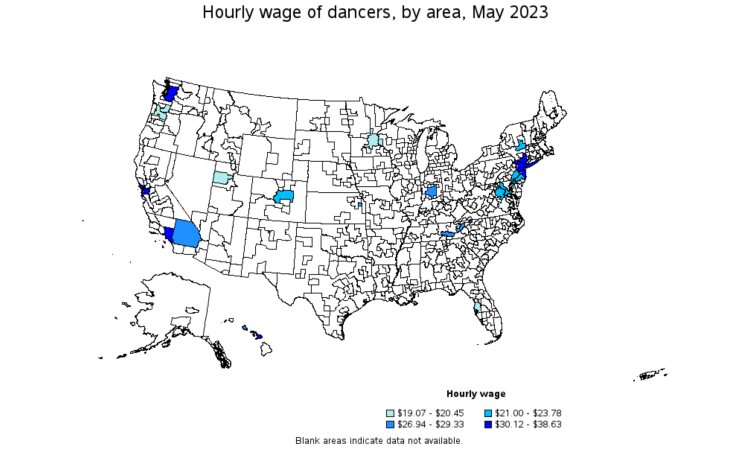
Dance is temporal and transitory, making the careers of its practitioners intrinsically precarious. Profitable employment opportunities for dancers are scarce. Landing a Broadway musical gig might be lucrative–about $2500/week, according to Playbill–but such employment comprises a small percentage of dance business structures across the country.
American choreographers, particularly those creating in the modern and contemporary genres, rely heavily on competitive grant awards to fund the creation of their work. (No matter how spare the design or how small the cast, ticket sales alone are never sufficient enough to offset the total expenditure of a dance production.) This dependence places dance artists at the mercy of performing arts granting bodies whose own financial resources are affected by fluctuations within the larger economy and changing political priorities. As an art form, dance is at a disadvantage within the American capitalist system, and so relies on the wealth and generosity of others to stay afloat.
Distressingly, key resources for individual performing artists have been eliminated with greater frequency lately, making a dancer’s life more unstable than ever. This summer, I got an email announcing that the Dance/USA Fellowship to Artists (DFA) program would be discontinued at the end of October 2026. Begun in 2018, this program provided financial support to individual dance- and movement-artists whose work focused on art for social change.
*
The loss of the DFA program is a huge hit to individual artists. While funding bodies often stipulate how award money can be used—frequently, it must be allocated to expenses pertaining to the production of an upcoming live performance—the DFA was an unrestricted grant, giving artists complete discretion over how they spent the money. The American not-for-profit arts funding model tends to support only one proposed project at a time, thus creating an inherently disempowering system for individual dance-makers and choreographers. How can dance artists ever build the necessary infrastructures to sustain their work in between each of those public performances if they are never provided with adequate resources?
Like other unrestricted grants, DFA recipients had considerable agency in how they spent their awards, a rarity amongst possible avenues of support for dance artists. When asked by Dance Magazine in 2018 how he spent the money when winning an unrestricted grant, choreographer Kyle Abraham (recipient of a MacArthur Fellowship) said that he used the money to pay off the student loans he borrowed to go to grad school and to support his mother after his father died. Faye Driscoll, winner of a Foundation for the Arts grant, said she used her money to put a down payment on an apartment, as well as to support herself when she had to drop everything and take care of a sick parent. In other words, unrestricted grants invest in lives and livelihoods, not just a single performance. In a career path, which is so often marked by multiple gigs, freelance work which lacks employee protections, low pay, and no pathways to invest in retirement or other holdings, such financial support is life-changing.
During the nine years of the DFA’s existence, 86 fellows whose work focused on community-based practice were awarded about $31,000 each. Dance/USA Director of Regranting, Haowen Wang, in an interview with Stance On Dance last month, noted that among the awardees, “there were 16 disabled artists, 19 Indigenous artists, 5 trans artists, and 21 Southern artists. Nearly 95 percent of the Artist Fellows identify as BIPOC.”
He went on: “The DFA didn’t want to fund studio-to-stage practices; it wanted to fund artists who examine how dance operates in the world and beyond the stage.” Instead, the program “wanted to recognize the diversity of lived experiences, bodies, cultures, practices, and dance forms in the dance ecosystem – beyond ballet and modern dance and other culturally dominant modalities. It wanted to be a hub for artists who address social change through dance and movement-based art forms.”
The DFA program proved more progressive than most, recognizing that only so much social impact can occur within the limited duration of a dance performance. To meaningfully engage with topics of social change and community-building, individual artists need to be treated as active purveyors of the arts economy, not mere receivers of funds as a transaction in exchange for a performance.
So what does Dance/USA want now?
*
During an interview with Dance Magazine in August, Dance/USA’s Executive Director Michele Kumi Baer explained that the DFA was ending due to vague “changing priorities” on the part of the Doris Duke Foundation, the sole financial backer of the program. This condition, she went on, necessitated a need for Dance/USA to overhaul its entire business model.
In preparing this article, I did reach out to the Doris Duke Foundation, hoping to learn more about why their “priorities changed” in relation to Dance/USA. What was their reasoning for ceasing all support for the program? At a moment when dancers are already being clobbered by a high cost of living, an elimination of arts funding, and an assault on free speech and democracy, wouldn’t the Foundation agree that America needs artists and/or art for social change now more than ever?
I never got a response. In an already impoverished artistic field, this is a shocking level of precarity.
It also begs the question: how many other resources for dance artists can vanish if the priorities of a single benefactor shift?
Dancers have seen this same story play out before. Cedar Lake Contemporary Ballet company was founded in 2003 by Nancy Laurie, the rich Walmart heiress who was estimated to be responsible for 75% of the company’s total operating costs. The company rose to quick acclaim, securing not only engagements at the Joyce and the Brooklyn Academy of Music, but also appearing on screen in the 2011 sci-fi film, The Adjustment Bureau. Despite its notoriety, Cedar Lake abruptly closed its doors when Laurie pulled all of her money in 2015.
Joffrey Ballet was also funded primarily through the financial generosity of one person. Rebekah Harkness’s wealth stemmed from her husband’s investments with the Standard Oil Company. When co-founder Robert Joffrey refused to rename the company in her honor in 1964, the heiress pulled all of her money. It isn’t a far stretch to draw parallels to the current naming war taking place at the Kennedy Center; once again, the fate of an entire arts institution rests on the whims of a single wealthy person who wants their name plastered on something.
In his Stance On Dance interview, Wang was explicit: “We are in a new culture war where the arts, the nonprofits, and many of our most vulnerable communities are attacked or dismantled as part of an oppressive political strategy,” he said. “The existing support infrastructure for the arts through the nonprofit system is severely contracting – and the reasons are layered.”
*
For many, COVID was a wake-up call to just how broken the financial side of dance already was. According to a 2020 CBS news report, 68% of low-wage earners (which includes many dance artists) earned more on unemployment during the lockdowns than they ever did while working full-time.
In the years post-COVID, things have, unfortunately, “gotten back to normal.” Arts business structures are still broken. Dancers are still fighting for “jobs” that promise little more than exposure. According to the State of NYC Dance Report released in December 2023, 41% of dance workers reported working without pay.
Meanwhile, philanthropy deficits and changing priorities have continued to force organizational and programmatic closures. The New England Foundation for the Arts (NEFA) announced earlier this year that its 30-year National Dance Project would conclude after its current cycle. The University of Arts in Philadelphia–founded in 1870 and which employed a number of contemporary dance artists part-time, and nurtured the education of future generations of dance artists–permanently closed in 2024. Stephen Petronio closed his residency center in the Catskills in 2023, citing financial difficulties related to the pandemic and a “wobbly stock market.” Two years later, the dance company he founded in 1984 gave their final performance at Jacob’s Pillow.
While short-lived, the DFA program did a lot with not that much. Fellowships totaled about $2.7 million—approximately the same as the cost to build a single Tomahawk missile, or buy two houses in San Francisco, or the revenue brought in by OpenAI every 30 minutes.
Dance artists will continue to dance and create despite this elimination of yet another valuable funding resource. Most artists get paid very little for their labor, and most creators invest their own resources into making their original projects happen.
But why should they? Why does our capitalist system invest so much into certain areas of our society, and so little in others? Why is it so difficult for a dance company to secure financing for a single production, while companies whose technology was taught on the illegal appropriation of other people’s intellectual property are considered a worthy investment? Is it even possible for our culture to change?
The end of funding for the DFA is not an isolated event; more like the latest injury to the already worn-out body of American dance.