Listen to the full article here.
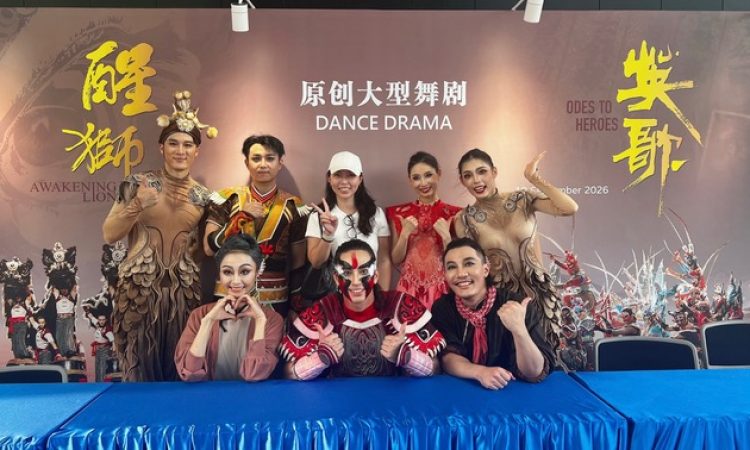
A month before I saw Guangzhou Song and Dance Theatre’s (GSDT) Awakening Lion and Odes to Heroes in Singapore, I hurried through Westgate Mall and passed a lion dance celebrating an ice-cream shop’s opening. It reminded me of restaurant openings in Philadelphia’s Chinatown. As I often had in the U.S., I glanced at the performance in Jurong East and went about my business. A month later, I sat in the Theatre at Mediacorp, devoting two hours to a dance drama featuring the same tradition.
Awakening Lion (xingshi 醒狮) is a Southern lion dance form developed in Guangdong Province. It usually pairs two performers beneath a colorful lion costume: one controls the head, the other the body. Beyond its acrobatics, the form is famous for the auspicious ritual of “plucking the green” (caiqing 采青), in which the lion “eats” and scatters a green vegetable like cabbage or lettuce to confer blessings.
Odes to Heroes, performed a week after the drama Awakening Lion, draws on yingge (英歌), a folk dance associated with Chaoshan culture in eastern Guangdong. Dancers embody heroes from the classical novel Water Margin, wielding wooden sticks and wearing dramatic, opera-inspired face makeup. They move in energetic columns to pounding drums and gongs. Both folk forms combine southern-style martial arts and percussion, and appear at festivals and celebrations. Recognized as national intangible cultural heritage, GSDT reconstructed them into theatrical narratives.
Staging Traditions
Awakening Lion unfolds against a backdrop of the First Opium War and villagers’ resistance to British forces in Guangzhou in the 1840s. The plot follows two rivals as they compete for a lion-dance championship. Combining martial arts and dance, the choreography offers breathtaking combat alongside dazzling lion dances. In a tea shop scene, the rivals fight on stacked tables suspended nearly five feet above the ground. Their virtuosic tumbling, sharp attacks, and agile evasions intensify the confrontation. Set to rapid drumbeats, the event unfolds with the excitement and skill of a 1990s Hong Kong action film. The young, playful heroine, who is the sister of one hero and the lover of another, plays as a reconciler between the two rivals. She wears a Big-head Buddha and holds a paper fan to lead the lion dance.
While competing for the title of “the lion king” throughout the drama, the heroes’ rivalry eventually transforms into solidarity in the wake of foreign invasion. Together, beneath a white lion costume, they join other lion dancers in defending their homeland. Although the sound of cannon fire and a devastated set does little to make the abrupt war scene convincing, the combination of women drummers, choral voices over orchestral music, and lion dances beneath blood-red lighting in the finale stirs me. With the enemy absent from view, the heroine’s death becomes a hurried catalyst for the rivals’ unity. The lions’ vigorous postures and dynamic head lifts consequently feel self-congratulatory, therefore making the spectacle’s connection to a war victory unconvincing. I’m also left wondering why female suffering must so often provide the grounds for male solidarity.
Odes to Heroes weaves vernacular yingge dance with Chaoshan people’s migration history to Southeast Asia in the early twentieth century. Amid mighty, lyrical rapping in the Chaoshan language, yingge figures in colorful helmets and armor strike their sticks and process across the stage. Their dancing guides a young protagonist through a fantastical journey transcending time and space to trace his father’s migration. Along the way, he encounters cultural practices and objects including qiaopi (letters and remittances sent home by overseas Chinese), puppetry, Chaoshan cuisine (beef ball), woodcarving, and porcelain inlays. Although puppet battles symbolize patriotic conflict, the production centers the protagonist’s inner exploration and growth without weighing nationalism heavily on yingge tradition.
Rethinking the Stage
Just before seeing these performances, I had taught a dance ethnography class focused on tourism. In class, I led my students through discussions about how, and by whom, cultures are commercialized, preserved, and represented. With those critical inquiries fresh in mind, I was curious and skeptical about GSDT’s theatrical adaptations of folk forms.
I anticipated balletic vocabulary and romanticized storytelling, features I have encountered in many Chinese dance dramas. Instead, I was struck by how authentically both productions reconstructed folk costumes, drum music, and movement techniques, particularly lion-dance partnering and yingge stick work. Choreographer Qian Xin explained to me that GSDT invited national martial arts champions to train its dancers in Southern Fist boxing and lion dance, strengthening their horse stances and control of the lion’s head. When producing Odes to Heroes, GSDT also invited three local yingge teams to teach stick techniques associated with various tempos. According to Qian, each village of Chaoshan has its own yingge team with a distinctive style. Rather than presenting every variation, the production selects partial yingge styles to serve its narrative and choreography.
Beyond recognizable costumes and percussion, repetitive stick striking and spinning borrowed directly from the folk dances helped these practices retain their presence onstage. While the authenticity of a tradition is always debatable when performance context shifts from the indigenous to the theater, recurring sequences created a ritual quality capable of challenging the ephemerality of theatrical performance; a month later, I could still visualize the striding steps and hear the stick beats of Odes to Heroes, their resonance carrying a force that I experienced as something almost sacred.
Throughout Awakening Lion, characters repeated precise crossed-hand positions and agile leaps in “bare-hand lion dance” demonstrating their training in manipulating the lion’s head. In the finale, the two heroes shared a lion costume alongside other pairs, transforming familiar gestures into a full ensemble of lions. Such repetition made the tradition more memorable to me than constantly changing choreography might have done.
Although my skepticism about nationalism remains, this performance made me consider theatrical adaptation as both institutionalization and a form of ritualization. Repeated movements can acquire renewed force in a theater, even as their ceremonial contexts change.
GSDT’s theatrical transformation also raised broader questions about authority and recognition: Who decides which movements represent a tradition? Who benefits from their adaptation, and who receives credit? Admittedly, in the context of institutionalization and commercialization, choreographers and star performers have a greater chance of earning public recognition through theatrical productions. I still wonder how visible the local practitioners who taught these techniques remained to audiences. Knowing that GSDT consulted them left me wanting to know more about how their contributions were acknowledged.
The National is Regional
Watching these Chinese dance dramas also unsettled my position as a Chinese-born, US-trained dance scholar living in Singapore. As a Chinese national, I had assumed that traditional dances from anywhere in China belonged to “my culture,” especially when I encountered them overseas. However, that assumption may have diminished my curiosity: claiming familiarity allowed me to take them for granted.
Having grown up in northern China, I knew little about traditions in the far south in Guangdong. The so-called traditional “Chinese” culture in the dance dramas was, and is, very regional, which further complicated the easy sense of national belonging I had expected. Calling traditional dances and cultures in Guangdong “Chinese” did not automatically make them familiar.
My strongest connection to my homeland came through conversations with the choreographer and dancers, many of whom had attended the same college as me. Our shared training and experiences brought warmth to my life away from home. That familiarity emerged through particular relationships, rather than through an imagined collective identity.
Perhaps this helps explain why I would pass by a street lion dance but purchase a ticket to watch Awakening Lion in theatre. My academic dance training offered me a curated community, but also biased me toward sustained attention to theatrical performance as opposed to dances in the public. The theater setting seems to grant automatic importance to the same type of dancing and choreography I had scarcely noticed elsewhere.
I left with questions about what the stage transforms, whom it makes visible, and why I had needed its invitation to pay attention. The next time I encounter a lion dance on the street, I intend to stop and watch.
Awakening Lions and Odes to Heroes, Guangdong Song and Dance Theatre, The Theatre at Mediacorp, Singapore.