In a quest to reach new audiences for performing arts in Philadelphia, Theatre Philadelphia and thINKingDANCE are joining forces and exploring how dance writing and discourse can provide new perspectives on theater. Since May 2018, tD writers have been lending their varied backgrounds, interests, and approaches to criticism to professional works of theater in Philadelphia. Let us know what you think in the comments!
Bare feet on blankets with picnic baskets, couples on dates, friends hanging out after work, families with kids of all ages, ice cream, more ice cream, dogs. It’s a summer evening and it feels great to be outside: Clark Park is buzzing with life. Hundreds of people are about to experience, for free, King Lear, the deeply contemplative, notoriously difficult play (both for those who stage it and for the audience) that tackles grand issues of power, human nature, and our inability to “see” things for what they are.
Shakespeare in Clark Park (SCP), the producing entity behind this commendable enterprise, celebrates its fifteenth season this summer, offering the Bard’s genius to Philadelphia audiences in the informal setting of this West Philly recreation area. And luckily for Philadelphians, SCP has ambitious plans to expand, based on its mission of “radical community engagement … by, for, and with the people of Philadelphia.” This year’s performance, hailed as the “best outdoor activity” by Philadelphia Magazine, is directed by Kittson O’Neill (also artistic director of SCP). This Lear features a live orchestra of young musicians from Play On, Philly!, several community performers, and military veterans cast as Lear’s knights—all these, along with professional, award-winning theater-makers.
The communal aspect and the invigorating green setting is what gives this two-and-a half hour production its unique charm, casting one of Shakespeare’s late masterpieces as a treat that anyone can enjoy and, importantly, enjoy with loved ones and as part of the community. Whether intentional or not, this set-up also brings the audience closer to Shakespeare’s times, when theater was a popular, low-cost form of entertainment that took place on bare stages in full daylight, with spectators moving around freely.
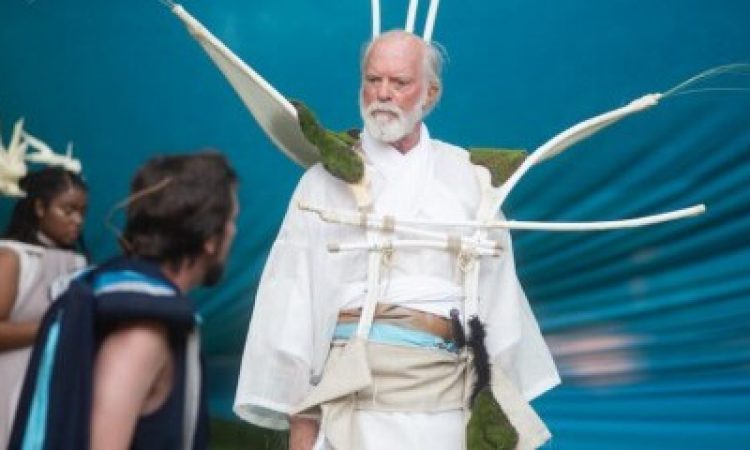
When King Lear (Dan Kern) and his three daughters (Charlotte Northeast as Goneril, Kimie Muroya as Regan, and Jessica Money as Cordelia) make their way onto the stage area, framed on the ground by red fabric with a large blue backcloth, the audience gasps. The costumes (Sebastienne Mundheim), color-coded to help viewers navigate relationships between the numerous characters, are visually stunning, opulent variations on Japanese kimonos, topped with skeletal overcoats that combine armorlike overhead structures with soft, organic shapes. This royal family is mighty, and definitely not from this reality. While the motivations behind the designer’s choice of Japanese elements were not clear to me, the costumes did draw one’s attention to the actors in the enormous space overflowing with audiovisual stimuli.
It is Dan Kern’s Lear that draws us into the fast-paced drama (the inevitable cuts made the play more action-driven, and omitted some of the more inward, reflective passages). Kern dominates the stage and, in spite of the cuts, convincingly conveys the transformation from an egomaniacal patriarch to a broken but sensitive human being who deeply laments his mistakes. He meets with some strong co-players throughout: Charlotte Northeast carves Goneril as a well-rounded character—a resolute, passionate woman whose ambition knows no mercy. Her sexually charged exchanges with Edmund (Ezra Ali-Dow), the ultimate villain in the play, stimulate some loud audience reactions. Similarly, the Fool, portrayed by the versatile Jenna Kuerzi, energizes the stage action, emerging from the audience space, moving quickly up and down the few set pieces in mocking impersonation of the aging ruler, and singing. The Fool’s humor reaches the audience (granted, some of the original riddles are replaced by modern songs, such as “The House of the Rising Sun ”).
The young musicians play with joy, and, in a storm scene, create sound effects by snapping their fingers and tapping their mouths. In fact, the joy is omnipresent, and no imperfections (the mics were problematic on opening night) diminish that sense. King Lear is no easy entertainment, the outdoor setting gives no possibility for dumbfounding special effects, and two and a half hours could feel long in our fast-paced lives. Despite those factors, or perhaps precisely because of them, the audience I saw in Clark Park went all the way with the old King, to the tragic end.
King Lear, Shakespeare in Clark Park, July 24-28.