I don’t want to review BalletX’s recent Fall Series 2012 performance critically. In fact, after taking a healthy, two-month break from watching and talking about dance (all you fellow workaholics out there should try it), I’m now confused about what, when, and how dance criticism matters in this “cult of the amateur” age. But I do want to report on my date with the company because, thanks to their new strategy, I felt welcomed back to the local scene with ease, which left me feeling generous and openhearted.
I went to see the show because I liked it that BalletX, known for their contribution to the world of contemporary ballet, commissioned a choreographer like Kate Watson-Wallace, who’s built a name for herself first with a series of site-specific dance projects, and then more recently for returning to the stage with some pretty big questions about bodies and culturally referential images in performance. I was intrigued by Watson-Wallace choosing to choreograph on balletically-trained dancers to the sounds of King Britt, a local electronic DJ, who’s been making work for much longer than I’ve known anything about it, admittedly.
I liked that when I walked into the Wilma Theater lobby, my heart was pried open by the sound of a little girl fiercely covering a Maroon 5 song (one which I otherwise don’t care for), and accompanied by an entire rock band of students from South Philly’s Andrew Jackson School. I liked that, between the formal dance performances onstage, front-of-curtain acts serenaded me, and I was glad to hear for the first time a few numbers by musician David Cohen, as well as the Philadelphia Gay Men’s Chorus, in the place of house music, silence, or worse–neighboring audience members’ overtly unfiltered insta-critiques. The entire evening flowed together as one big Philly cultural outing, without disruption.
In addition to what I came curious to see, I witnessed “Instant God,” by Italian choreographer Mauro Astolfi. His complex vocabulary evoked something among the 10 stunning “Xers” that looked like abstract organic chemistry: fluid partnering among many different combinations of dancers, formation changes by way of invisible magnets, dynamic shifts in tone without signaling narrative, emotion, or sexual relationships.
Also on the bill was Co-Artistic Director Matthew Neenan’s “Switch Phase”, driven by its folk-y and romantic score of recordings by string quartet Brooklyn Rider. The ballet showcased four male-female couples, interchanging with the shifts in music like smooth caramel.
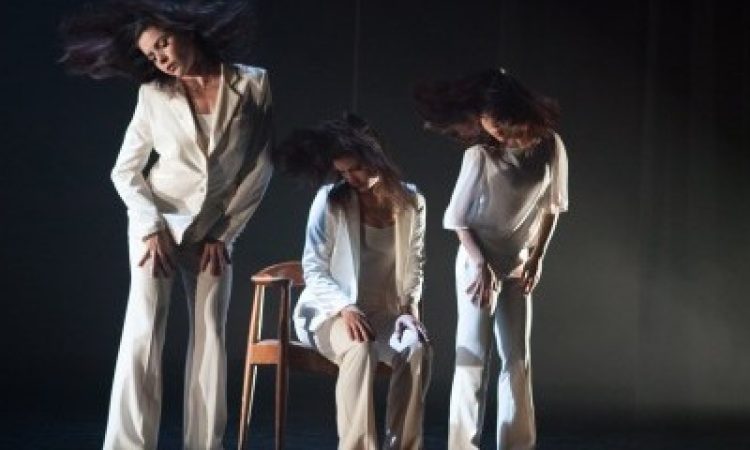
And then there was the anticipated “I Was at a Party & My Mind Wandered Off…”, a post-modern piece, colliding with the more traditional ones. Dancers sang. Men wore ladies’ tops. Faces were covered in backwards-combed hair and piles of clothes. This was a dance of the popped ribcage and hands flopping like nervous ticks. Classical technique, as the dancers knew it, was now extinct, so……was this then the after-party?
I attended a recent workshop about the power of serendipity in communities, led by gay community organizer and Executive Director for the William Way Center Chris Bartlett. He said that intentionally creating opportunities to bump against difference allows for serendipitous events, or happy accidents, to occur. And he talked about the role of artists, describing their “negative capacity”, or ability to transcend predetermined facts, as central to this idea. Artists are often the first group to embrace the unimaginable, leaving great space for newness, possibility, and reinvention.
In a way I think this was what BalletX was attempting to do. In one night I witnessed the work of six aesthetically different artists and groups, some of whom had almost nothing to do with the others. We shared the same space, and will continue to share the city. I was reminded that, in a way, we’re all in this together, when it comes to finding audiences for our work.
I left cheering for them all.
Fall Series 2012, BalletX, The Wilma Theater, November 7-11. balletx.org