I arrived at the Wilma Theater for BalletX’s spring series eager to hear from the choreographers at a pre-show talkback. Although they seem new at this–Christine Cox and the three choreographers struggled passing the microphone around without getting tangled in the wires (Cox joked that this little dance they did was the fourth piece of the evening)—they offered a lot of insight into the pieces to be performed that evening.
Three different choreographers zoomed in on the evening’s three premieres in their answers to the pre-show talkback questions. Olivier Wever described Instantly Bound as an abstract and deconstructed view of recent horrific events like the Sandy Hook School shooting—as well as how the community bonds after a tragedy. Tobin Del Cuore explained that No Sleep represented feelings of solitude and loneliness people felt while surrounded by others in the city. Gabrielle Lamb didn’t delve into the meaning of her work; instead she told us that she titled it Stations of Mercury, because she was alarmed to learn that Mercury would be in retrograde during the time she choreographed for BalletX. I found their descriptions riveting and was ready to dive in.
As Instantly Bound begins, a single spotlight flickers on. We see a man. The spotlight turns off. Flickers on. Another man appears. Off and on again. The first man is alone, collapsed on the floor. When the other dancers appear, their heads are hung low, slouching. Sliding legs forward. Left. Right. Are they zombies? I think back to Wever’s description of the piece and can’t quite figure out what he was trying to represent through this movement. Are they the dead? Or, are they the community? I’m not sure, but the zombie-esque movements seemed like an inappropriate choice to me given the subject matter. Looking back, I wonder if I felt this way because my emotions were running high because of the Boston Marathon bombings which happened two days before the show’s premiere.
Allison Walsh prepares for sleep as her solo in No Sleep begins. She strips down to a skimpy pair of underwear and a lacy bra as she lies down beneath a fiberglass sculpture hanging from the ceiling. It looks like the underside of an iceberg. The sculpture lowers down, hanging dangerously close to her. She jerks awake, with a tremor. Then she does straight-arm plank, suspending herself above the ground for several seconds. She stretches her leg out to the side and rolls over onto her back and then lifts her leg up to practically touch her nose. She does it effortlessly, as if these are the simple stretches she does when she can’t sleep.
I’m not sure about the role of the sculpture. Its top is flat and it rotates so the flat surface faces the audience during part of the piece. A video, created by Del Cuore, is projected onto it —but I can’t make out the images. Was the video unreadable on purpose? I’m not sure. Although I’m confused by this, the dancers in No Sleep wow me with their impressive physical abilities.
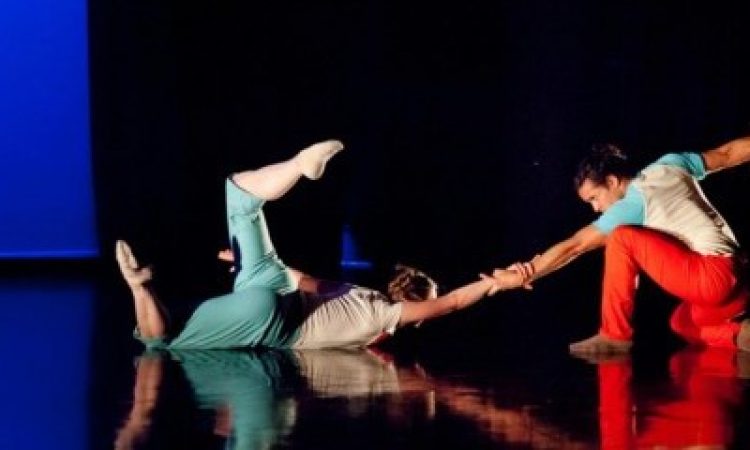
The dancers form an assembly line as if they’re working in a food factory. Some add parts to the conveyer belt from their stations, another appears to be taste-testing the product. The dancers in Stations of Mercury are dressed in retro costumes–think poodle skirts and bobby socks. After a final pas de deux, a chain of interlinked dancers appears downstage to pull a couple who are on the ground offstage, dragging them along as the audience laughs. Despite the grim foreboding of Lamb’s piece, hers is the most playful of the three. I found myself laughing throughout the entire piece–it is silly in a good way.
Throughout the entire evening, I wonder if the pre-show talk colored my opinion of these pieces too much. It was as if I were examining each piece under a microscope—and I got upset when something didn’t seem to make perfect sense to me, even though the general feeling of each piece aligned with how the choreographer explained it. I feel as if I would have enjoyed a post-show talk from BalletX more; it would have been great to probe the minds of the choreographers afterwards.
Spring Series, BalletX, April 15-21, www.balletx.org