We live in a world that is both our living room and our soapbox. We can comfortably tweet in pajama pants on a cushioned chair in the airport or perform a song that will be watched by a million people for a computer camera in our bedroom. The pair of dances presented this cold Wednesday night at Christ Church Neighborhood House, introduced by thirdbird’s Anna Drozdowski as “one from South of Philadelphia and one from the South of France,” engaged in a constant conversation between public and private.
Singer/Songwriter, created and performed by Magda San Millan and Chelsea Murphy is a subtle self-referential spectacle. In the format of a small-scale concert or open mike event, each highly performative “song” is followed by an explanation during which the “singers” publicly reveal what they were feeling during their performance.
“I try to empty myself,” Murphy cheekily reveals after her first number, a dance borrowed from pop culture’s sexy vernacular of step-touches, wearing hose over a leopard print dress while her red-lipsticked mouth croons or screams with no sound, “so that I can be slowly filled up by sorrow.” She follows another of her songs with the statement, “I can’t move my vagina without moving my mouth, but I can, obviously, move my mouth without moving my vagina … I think.” These are jokes, and they are not jokes. These two brave performers, both recent graduates of the Headlong Performance Institute, fully invest in everything they explore, as tongue-in-cheek (or in this case as mouth and vagina) as they may be. The result is daring physical comedy. San Millan especially has the ability to draw the viewer into her physical state, and ends the piece with a riff on the hypothetical intro “If I were a song.” She says to the gathered public that if she were a song, she would be “a silent movie of our own private images.”
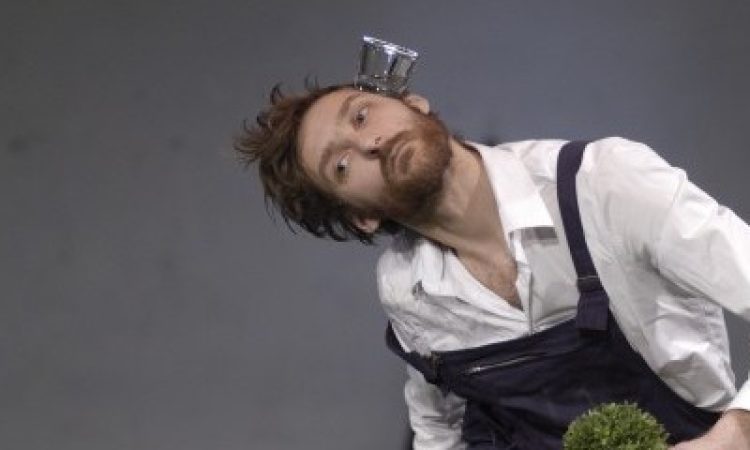
Allege, choreographed by Clément Layes and performed by Vincent Weber, is a complete individual world of simple objects, the color green, seemingly futile tasks and contagious postures. Weber enters in overalls with a small glass balanced on the back of his head and proceeds to systematically take more glasses and water bottles out of a bucket. He uses a chalkboard to messily plan out his attempts to water a small tree, the act punctuated by the music of David Byrne, which begins every time he snaps (we hear the beginning lyrics “I work, I sleep, I dance, I’m dead” over and over again). He also controls a spotlight, which appears on the tree each time he flashes the palm of his hand, making it appear larger than life.
Weber makes many attempts, often comical, and ends up soaking wet, a state that allows him to move the glass first onto the side and then the crown of his head through simple bouncing. Audience members, rapt in their attention, crane their necks sympathetically into his postures. Though the public appeared totally invested in what he is doing, the logic of his world remained totally private.
Weber approaches the audience in a robe he has groped for with a bucket on his head, adjusts his glass and begins to speak, revealing the very public nature of the personal tasks he has been undertaking. Every object is named (is given meaning): the cup is the mechanism, the water the energy, the bucket the limitation, and on and on. Layes creates allegories through different pairings of objects (Weber speaks faster and faster as the combinations become further reaching and more elaborate) and manages to use these objects to metaphorically explain everything from the theater and the cinema, to a political meeting, to our dreams.
Putting oneself on stage is a public act, but both of these works seemed utterly comfortable and at home with what they put forward. The choreographers kept their structures simple, and the tension between public and private was lessened, was made as cozy as a soapbox lounging in a living room.
Allege, Clément Layes/Public in Private and Singer/Songwriter, Magda San Millian and Chelsea Murphy, January 29, Christ Church Neighborhood House