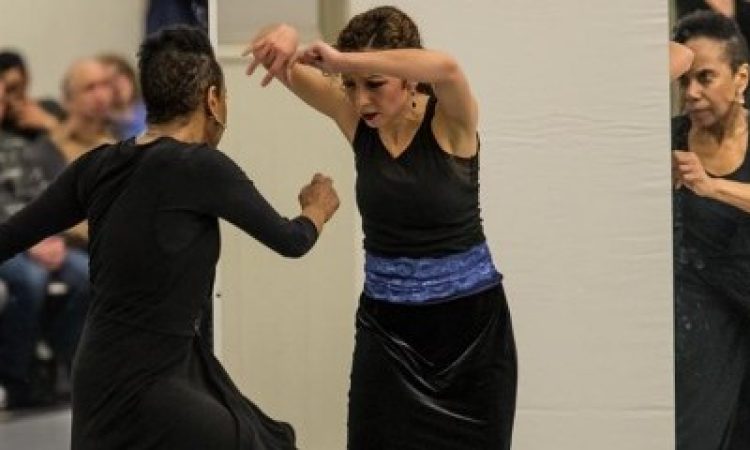
Highlighted against a sliver of white wall, exposed by the parting of two large mirrored panels, tap dancer and jazz vocalist Germaine Ingram appears caught in the act of emergence—or of merging—as her art joins another percussive, popularly-sourced form on the same stage. Ingram dances toward the audience, her stature and versatility revealed as she leaves behind the angular imprint her pose made on that white space. A parallel moment occurs shortly thereafter when the bare arms of flamenco dancer Rosario Toledo reach from behind one of the mirror-walls into the sliver of white space to clap driving rhythms against Ingram’s subtle solo. Tonight’s performance is subtitled, “In my solitude.”
* * *
At a “Hi Tea,” which Dance USA-Philadelphia hosted for Toledo earlier in the week, she discussed her collaborative experience in the Philadelphia Flamenco Festival’s Tapas series. This opportunity to collaborate with artists from outside the flamenco world—a first for Toledo—has inspired the Cádiz-born dancer to perceive the different ways each dance artist (Eun Jung Choi, Meg Foley, and Ingram) hears and responds to rhythms. These four artists employ different languages of movement. Can they converse?
Moving downstage, Ingram seems engaged in an inner dialogue revealed in hand gestures reaching around her torso, touching her chest and hips, in head-turns from side to side, listening. As this inner dialogue becomes more energetic, an off-stage cajón drum picks up an insistent rhythm that quiets as Ingram approaches a standing mike. Guitarist Dani de Moron begins to strum chords from his stage-left seat while Ingram’s rich contralto intones, “Let them dance in the dark” and Toledo enters upstage with attention-demanding footwork.
Exploring one another’s languages allows these artists, Toledo comments at the Hi Tea, to think and create not only from within their own forms, but from creative contact with others. This generous sharing of each artist’s world inspired her to take new journeys, perceive new vistas—some complex, some enlightening, others funny. Toledo’s month-long workshops with each artist resulted in the Tapas series at the Flamenco Festival: three studio performances, each about 45 minutes long, featuring Toledo and a different collaborator each night, supported by Moron’s sensitive musicality. Taken together, the shows serve as prisms revealing flamenco as part of a larger dance picture.
These two powerful, petite women dance face to face, side by side, back to back, and, at times, as one another’s shadows. Toledo projects electricity barely contained; Ingram collected centeredness. Circling one another and criss-crossing the floor, they pull and press the space, always sensing one another, eyeing the other dancer, attending to and shaping Moron’s rhythmic commentary. Like a vamping jazz diva, Toledo drags the mic toward Ingram who begins a soulful, wordless cry into it, then leaves the song behind as she stands quietly in the center of Toledo’s driving, stamping circle.
Toledo remarks that these collaborations have reinforced her awareness of where she comes from—both her city, Cádiz, and her conservatory training, which began with ballet and then focused on traditional Spanish dance. Already speaking two movement languages, then, she has now extended her range to explore postmodernism and tap. This research, remarked festival master-mind and director, Elba Hevia y Vaca, is of as important to her as is the opportunity to present cutting-edge flamenco artists, Toledo among them, featured in this year’s festival.
As Moron begins a mournful soleá, Toledo and Ingram listen attentively, clapping and then dancing, scatting, strutting. In a quiet moment, Toledo begins an anguished solo as Ingram sings strong, low notes. Moron begins to beat his guitar, then strum it, as the dancers seem to merge into one body, then dance themselves through the mirrors’ passage to the white wall and into the blackout.
Philadelphia Flamenco Festival 2014: Dance USA-Philadelphia Hi Tea, March 4, 2014, at 142 Spruce St.; Tapas, March 8, 2014, at Drexel University Dance Studio, 3141 Chestnut St.