Three disheveled men slump, slack-jawed, leering. One wears a baseball cap with a fake ponytail attached to the back. They applaud inappropriately and frequently. They are at Annie Wilson’s burlesque show called Lovertits. I am at an experimental dance-theater performance that critiques the male gaze called Lovertits. We meet at a wormhole where our parallel universes converge.
The performance begins with Christina Gesualdi as a smiling, stumbling, lobotomized seeming Yoga teacher in a sparkly top hat and heels who asks us to take our time, soften up our ambition, let the sounds wash over us.
Jenna Horton gives us a guided tour of Old City as a Franklin with no underwear and an open coat. I cannot pay attention to her speech because I am distracted by her crotch rubbing against the floor.
The three men snort.
Gesualdi and Horton perform a strip tease duet as if they are two girls in a mother’s closet elated with wonderment at their gangly limbs and taut, bouncing flesh. I am reminded of a girl I knew at age six who ran around her yard with no underwear and flipped her skirt up at any adult she saw.
The three men hoot.
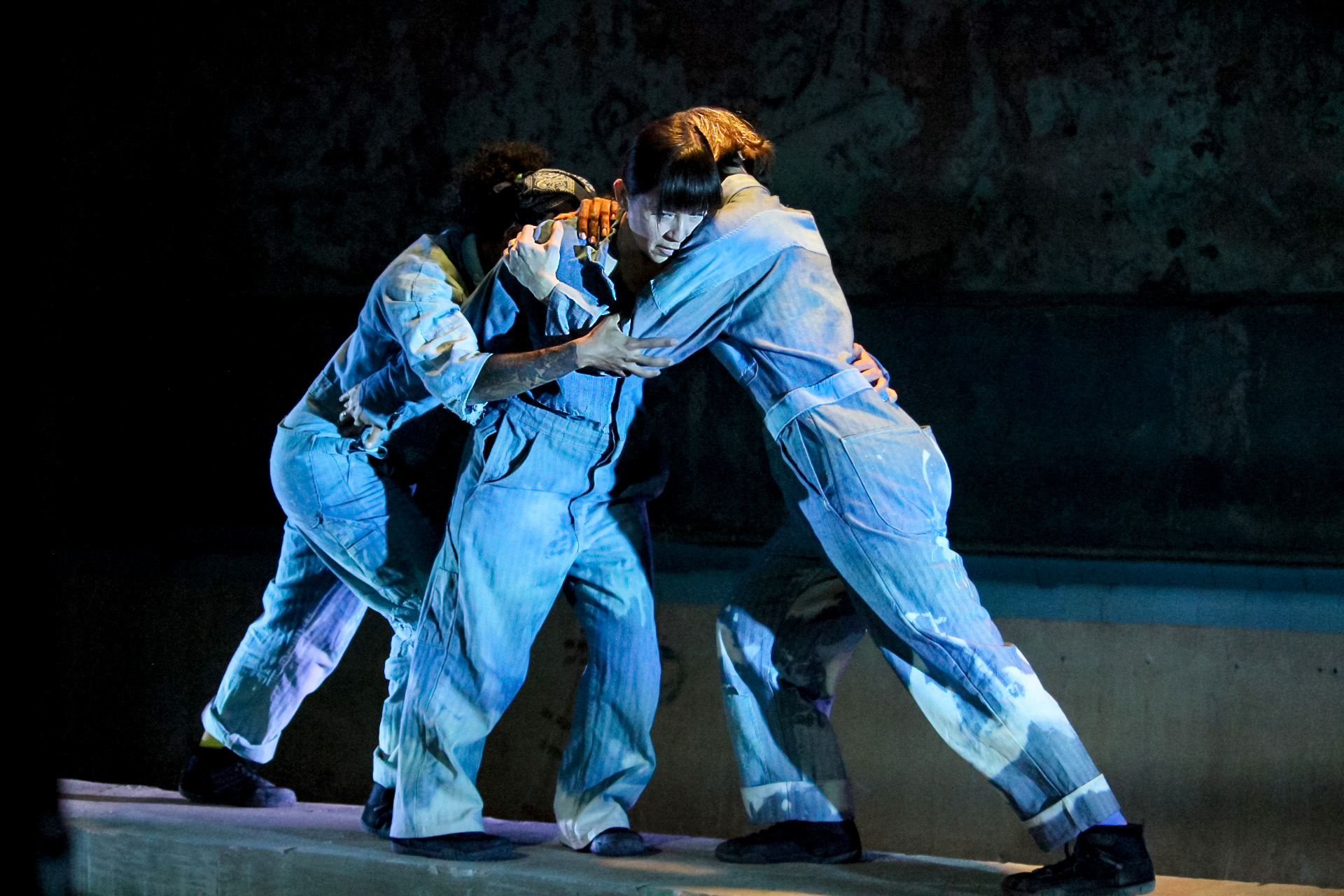
The three performers grunt through the space. They climb tables. They drink the audience’s beer. Ilse Zoerb takes the ponytail baseball cap and screams “What the fuck is this hat on my head?” The hat owner give her a dollar. She brings it to the waist of her skirt then changes her mind. She tears the dollar up and yells “Suck it!” The audience hollars with support.
In the beginning of the piece, the choreography is static, bound by unison and a flattened, frontal orientation. Later the work becomes fleshed out by Wilson’s deft use of repetition and juxtaposition. Sound designer, Adriano Shaplin fills the space with thunder, ambient music, birds and cicadas. The piece slows from a manic comedy to a steady, devastating slaughter.
Gesualdi says “feel the clothes on your body,” as she spirals and tumbles, relishing in her nimble body, “sense the constellation you’re forming with your neighbors.”
Horton and Zoerb perform and repeat a scene from the 1994 film of Little Women, each time with a different tone, delivery and context. Gesualdi returns to punctuate the scene with a humorously impotent sounding trumpet.
In the last rendering of the scene Gesualdi shuffles, gallops and bleats through the space like cloven animal having a petit-mal seizure. Horton pulls a scroll from her vagina and reads the page: a tutorial on how to butcher a goat.
The performers become hypnotized goats. They are flesh. They are mortal. Jenna acknowledges that someday someone will hold her organs in their hand. The three men are alert and wide eyed, bewildered yet sober.
Lovertits, devised and directed by Annie Wilson, Ruba Club, September 19-22.