Though not a new concept, dance fusion has lent itself to new aesthetics in the field. With the blending of classical ballet and modern to create what is currently known as contemporary dance, merging styles can open the door to new movement potential and heighten the visual experience of the viewer.
Montreal based RUBBERBANDance Group demonstrated their contribution to dance fusion at the Annenberg Center with a movement vocabulary honed over ten years. Their merging of classical ballet, hip-hop, and contemporary to produce the Rubberband method evolved from Artistic Director Victor Quijada’s experiences in hip-hop clubs of his native Los Angeles to his tenure with companies like THARP!, Ballet Tech and Les Grands Ballets Canadiens.
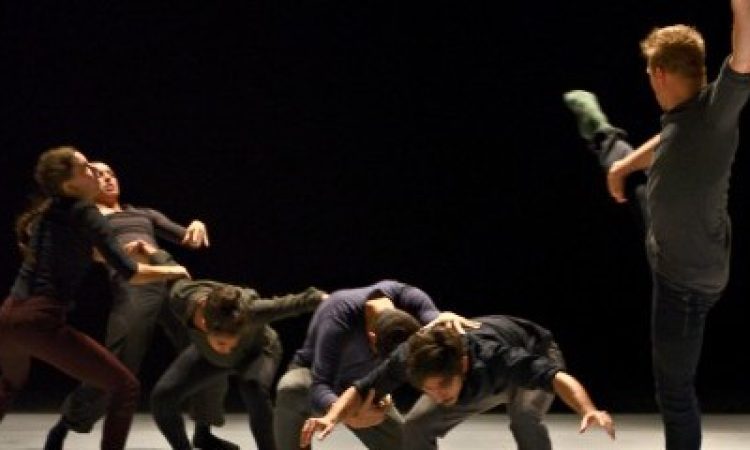
The local premiere of Quijada’s Empirical Quotient, an evening length work of his six-member company, effectively showcased his technique through extreme physicality, agility, theatricality, and partnering.
The audience was allowed a glimpse into Quijada’s creative world as the dancers used the stage to warm up before the show. From handstands and cartwheels, to back flips and breakdancing, they prepared the stage as if testing the ground for battle.
“Standby, lights, music!” a voice over the loud speaker announced.
The dancers huddled together and then slowly, like a rubber band, the group expanded, pulling away from one another.
Empirical Quotient abstractly dealt with human emotions and the effects of time on self-perception and identity through vignettes of groups, duets, and trios. The sextet created and explored relationships by investigating the tensions that exist within structures and the need to claim your individuality within those structures. Noticeable to me was a recurring choreographic design as Quijada used the music to instruct his dancers when to start and stop; a break in the music would cause the dancers to pause, only to resume as it continued.
Waving, a hip-hop dance move of the 70s, was seen in many iterations throughout the piece. It is accomplished by the controlled flow of energy when alternating between tensing and relaxing certain isolated body parts. This wave-like visual could also be seen in the partnering sections where one dancer would react to the touch of another. Upon impact, the dancer being touched would initiate a movement that rippled to other parts.
Versions of other hip-hop dance steps like the electric boogie, up-rocking, b-boying, and popping overlapped with a la seconde turns, glissades and rond de jambes, creating an aesthetic that required and delivered stability in moments of off-centeredness.
The fusion was visually interesting when the company seamlessly moved from one genre to the next, and exciting when they lived in the off-centeredness of Quijada’s choreography, but I found myself, at various points during the performance, losing interest. These moments reminded me of the limitations I have seen in companies where the artistic directors serve as sole choreographers. The homogeneity of style was one problem I had with Empirical Quotient.
Another problem I had was when the dancers onstage would interact with an invisible member of the tech crew who would announce light and sound cues throughout the piece. These moments may have been more successful if they were more frequent or were more strategically placed but they appeared to be an afterthought, as they were not effectively integrated to establish a connection between the choreography or the narrative.
Although those moments didn’t work for me, I was elated at the fact that Quijada’s choreography eradicated gender specific formulations by exhibiting the physicality of both the male and female dancers. By equalizing the requirements and expectations from all six dancers, Quijada added to the dialogue on dance and gender. From back handsprings to floor spins, his de–gendered vocabulary, was worn with ease by the entire cast who stretched themselves past the expectations of any one form.
Empirical Quotient, RUBBERBANDance Group, Annenberg Center for the Performing Arts, April 16th -18th, www.annenbergcenter.org, www.rubberbandance.com