Flamenco is crescendo and decrescendo, ebb and flow. A lone singer’s croon invites a firestorm of hips, arms, and feet on the floor. A whirl of guitar, drums, and dancers gives way to the slow, deliberate tapping of a single pair of shoes. Tablao Philly, a 150-minute program including three separate acts by three different performance groups, was an experience of unbridled crescendo, a night that accelerated in vigor, skill, and intensity until the end.
The audience gathered in the Asian Arts Initiative’s black box theater, with café tables positioned on either side of the stage and rows of chairs behind them. Tapas and wine accompanied the entrance of De Luna a Lunares: guitarist and cantor Cristian Puig and percussionist Guillermo Barron, followed by dancers Monica Herrera, Marilla Quevedo, and Griselda Marin. The performance was fierce, confident, and at times breathtakingly beautiful; occasional guitar solos seemed to awe both dancers and audience into rapt silence. For the most part, though, the first act’s atmosphere mimicked that of an open mic rather than a concert performance. One dancer giggled and made side comments to her fellow dancers while the musicians played. Another maintained a more rigid composure. Some portions of the dance were choreographed, but many seemed spontaneous, driven by the mood of the moment, leaving the audience to view each woman more as an individual personality than a member of a dance trio.
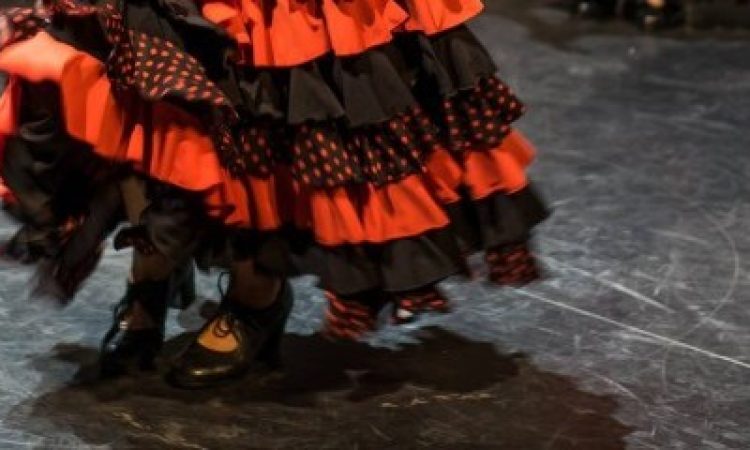
Pasión y Arte doubled the intensity with a presentation of fiery, emotive, technically adroit movement and sound. Cantor Barbara Martinez and guitarist Andreas Arnold provided subtle accompaniment, while cantor Hector José Marquez delivered impassioned melodies in a full body performance that could have been a show of its own. Pain, love, longing, and delight played like light and shadow over his face while four dancers—Kumiko Koide, Amelia Hernandez, Alexa Miton and Elba Hevia y Vaca—took the floor. The interplay between male and female, instrument and dance, became quickly complex. Each dancer entered the stage at will, seemingly called by the music to do so. She announced her hips, cast broad shapes with her arms, and tapped her feet, each motion increasing in speed and fervor until the music joined her in ecstasy. Only then did she calm the room, regarding her spectators in silence before beginning a rhythm of her own, which was then complemented by the musicians. In this way, the audience understood flamenco as a practice in respect and reciprocity, a duo between movement and sound, a united search for meaning.
And then there was the third act: La Meira, world-renowned flamenco dancer and teacher. She took the stage with the joy of a woman who has lived beautifully, who uses her mastery of this art form to share bold slices of that beauty with the world. Moving from playful tapping to exuberant leaps, La Meira drew the crowd into the breathless orbit of her flowing white dress, her wise countenance, and the delighted vocals with which Marquez accompanied her performance. Thus ended a night of dizzying talent and energy, the audience left to savor the sweetness of voices, hands, instruments, and bodies, lent to one another in the lusty, spirited creation of something greater.
Tablao Philly, Pasión y Arte, Asian Arts Initiative, October 29-31. http://www.pasionyarteflamenco.org/