Life can be painful. How do humans deal with extreme difficulty or failure, and how do we recover from trauma? In Joe Goode’s newest work, The Resilience Project, he begins by asking these questions, and asking how resilience might be a universal trait that all humans need to survive. I spoke with Goode about his work before seeing the performance on its opening night.
Seeking stories of military service and subsequent re-entry into society, Goode asked DC-area Iraq and Afghanistan war veterans, “How have you been able to be resilient? Who’s helped you?” Goode’s interest in how humans deal with hardship is not new for him. In his research for The Resilience Project, he neither looked for nor received wartime tales of one-dimensional bravery and heroics. The interviews with veterans lend themselves to stories of deep trauma and catastrophic life-ruptures. They are the shadowy, underexposed leftovers of war that none of the combatants interviewed allowed themselves to plan for at the time of deployment.
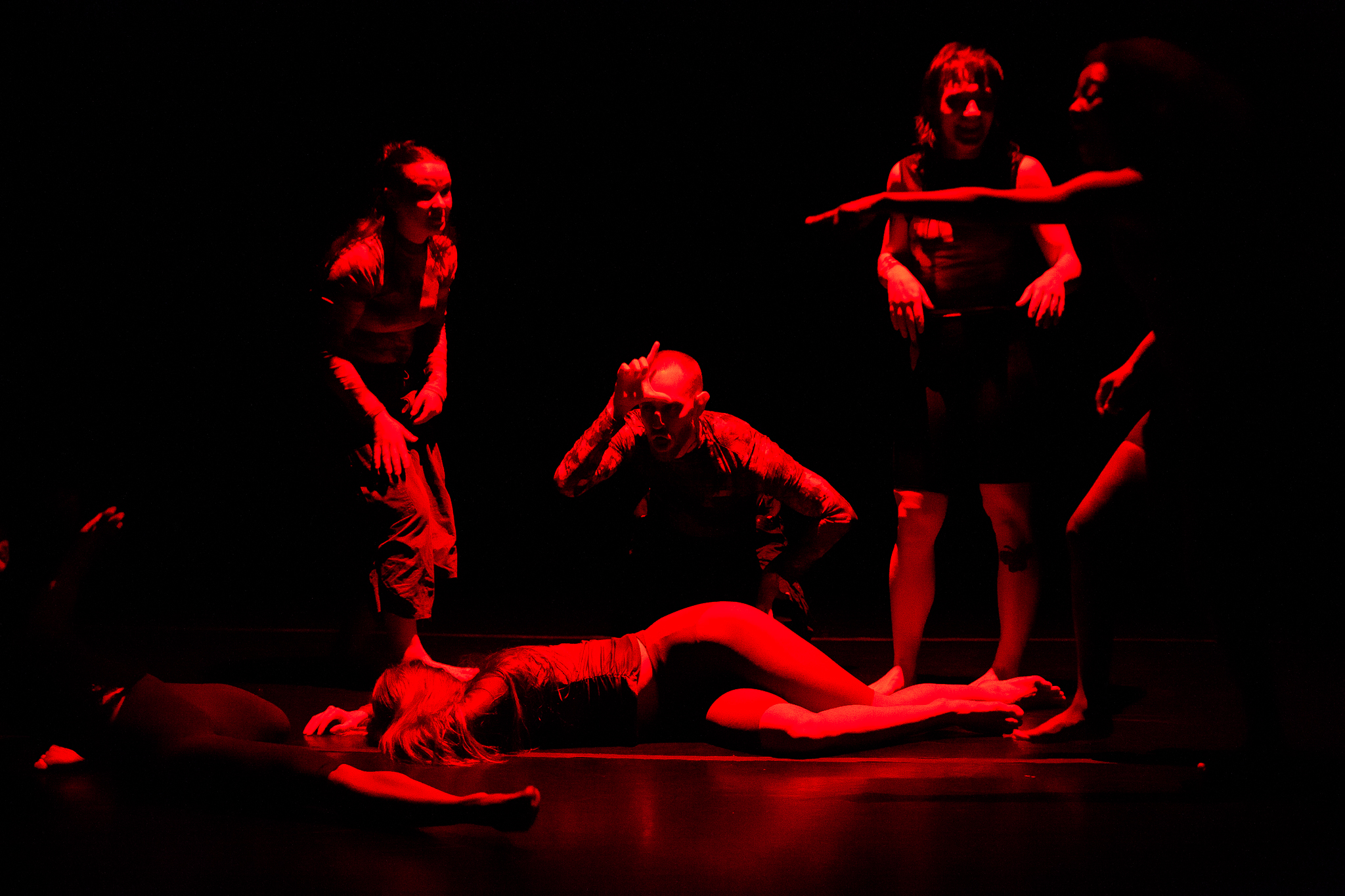
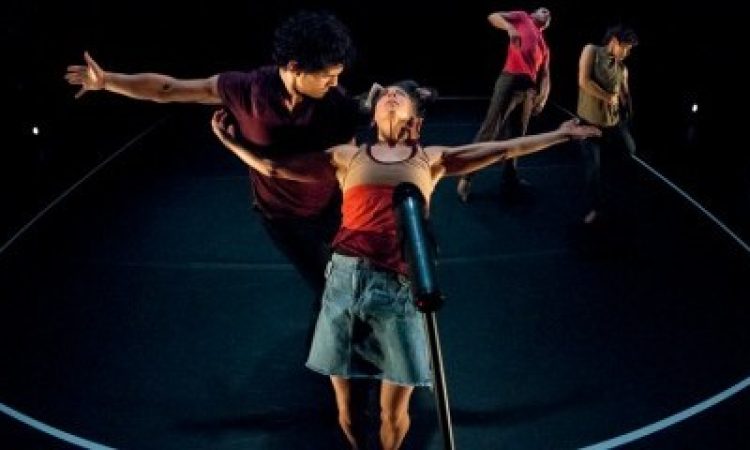
The veterans’ words appear in The Resilience Project as verbatim text, spoken by performers Felipe Barrueto-Cabello, Marit Brook-Kothlow, Melecio Estrella, Molly Katzman, Andrew Ward and Alexander Zendzian, as well as Goode. Utilizing the performers’ broad skill-sets, Goode crafts distinct, short vignettes, layering and colliding text with movement and song. Nearly all action unfolds inside a square boundary, affixed to the floor with white tape. The otherwise sparse stage is mutable, transporting me to internal and foreign environments. I am inside the veterans thoughts, and then I am with them as they find themselves waking up in a hospital, permanently injured.
These stories are spoken by the performers throughout the roughly hour-long work through microphones standing in each of the four corners of the white square. At times these narrations are effected with moody echoes and reverberations, redolent of pathos and anguish. The vignettes are mostly relational—duets and trios and groups tumble together. Dancers carry one another, offer support, or serve as launching pads for dazzling handstands and other feats of strength and virtuosity. It would seem, in the face of trauma, that no body is an island. The dancers are heroic and lovely with their stretched limbs, precisely honed technical abilities, and steady, clear voices as they recount the veterans’ stories. I think back to my conversation with Goode:
We’re always about winning, and smiling and … having a positive attitude, which is great and a very useful thing. But what happens when life gives you something you hadn’t planned for, and doesn’t fit into your little positive profile of how your life is supposed to go? We’re wildly unprepared for that.
The dancers’ bodies—while at times appearing permeable and vulnerable, with softening torsos and yielding limbs—are mostly pictures of Apollonian symmetry and ability. Perhaps these heroic bodies are appropriate, in a work that’s not only about military service, but also about the painfully difficult recoveries these veterans experienced. Finding resilience in the face of overwhelming hardship is a heroic act. These stories, whether about struggling with PTSD and being afraid to go outside, or being female in the military and having to confront crude generalizations upon re-assimilation, are unimaginably brave. Goode believes this resilience is crucial to survival:
We all need to learn resilience, it’s a skill that we need to live in this world. And we’re all going to lose our parents, we’re going to have relationships that fail, we’re going to lose jobs. It’s just a question of when.
I wanted more space in the work for considering that ultimate failure of the body, the one we’re all desperate to outrun, the one these veterans had to confront one way or another, whether during their service, or in the aftermath of being irrevocably injured or afflicted with PTSD. Nobody wants to die, and no matter how heroic and brave and resilient we are, this one will get us in the end. Perhaps death is really the only true universally human trait. Dance has the capacity to force us to confront our own mortality, our volatile bodies. Goode’s trust in dancing is evident.
The Resilience Project, Joe Goode Performance Group, American Dance Institute, February 5-6.