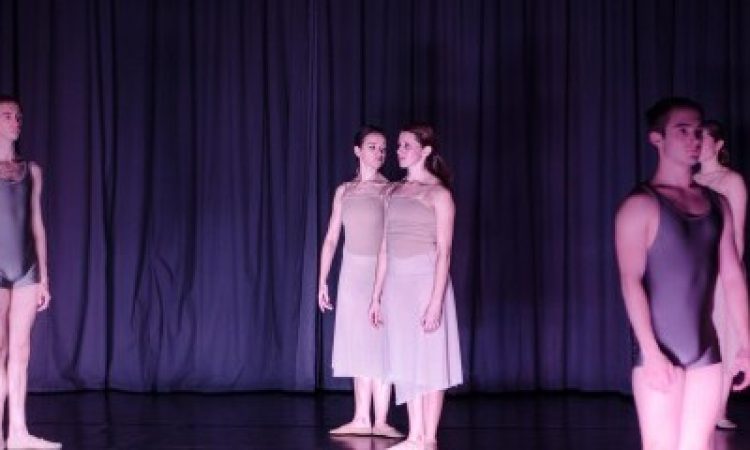
I am one of the first people to enter the theater. The stage is brightly lit and the black floor is covered with foot imprints of powdered chalk. Drone-like sound engulfs me. It is Saturday night and I am at Christ Church Neighborhood House to see Nora Gibson’s Contemporary Ballet, Ephemeral. Four women in nude dresses and two men in unitard shorts are already on stage. They occasionally walk in a casual manner, circling the stage and distributing the white powder, before stopping again in first position. Their pace is even to mine. As I go towards my seat, our trajectories converge momentarily. The light downcast on their bodies highlights every little imperfection. I can already tell—this is not your average ballet. The mixture of humanity with the perfection of the ballet posture takes me by surprise. I am in reverence.
When the audience quiets, the ensemble gathers into two crossing diagonals. Their arms move in unison, teasing time with precision. Like a school of fish suddenly shifting direction, they turn and repeat, developing and reiterating the phrasing. The sound landscape composed by Michael McDermott is perfect. Departing from what is considered ballet music, he creates “sonic photography” from found sounds and overlapping rhythms. It develops parallel to the movement, supporting and drawing me further into the experience.
I don’t dare blink. Bodies dance out of their formation with grace, building on the complexity of the classical movement, appearing in a new formation as if by magic. Strobe lights flash in slow tempo, like a visual metronome or a reference to a storm. The polyrhythmic visuals and music mix in synchronicity, unraveling though time and space like glaciers gliding toward each other over millennia. On stage, each grouping is an entity in perfect unison with itself. As the dancers alternate between standing and moving, the ballet vocabulary contrasts with the sometimes casual standing. It becomes more significant over time, bringing me further into the dance—the two men drawing more attention only because of their different costumes.
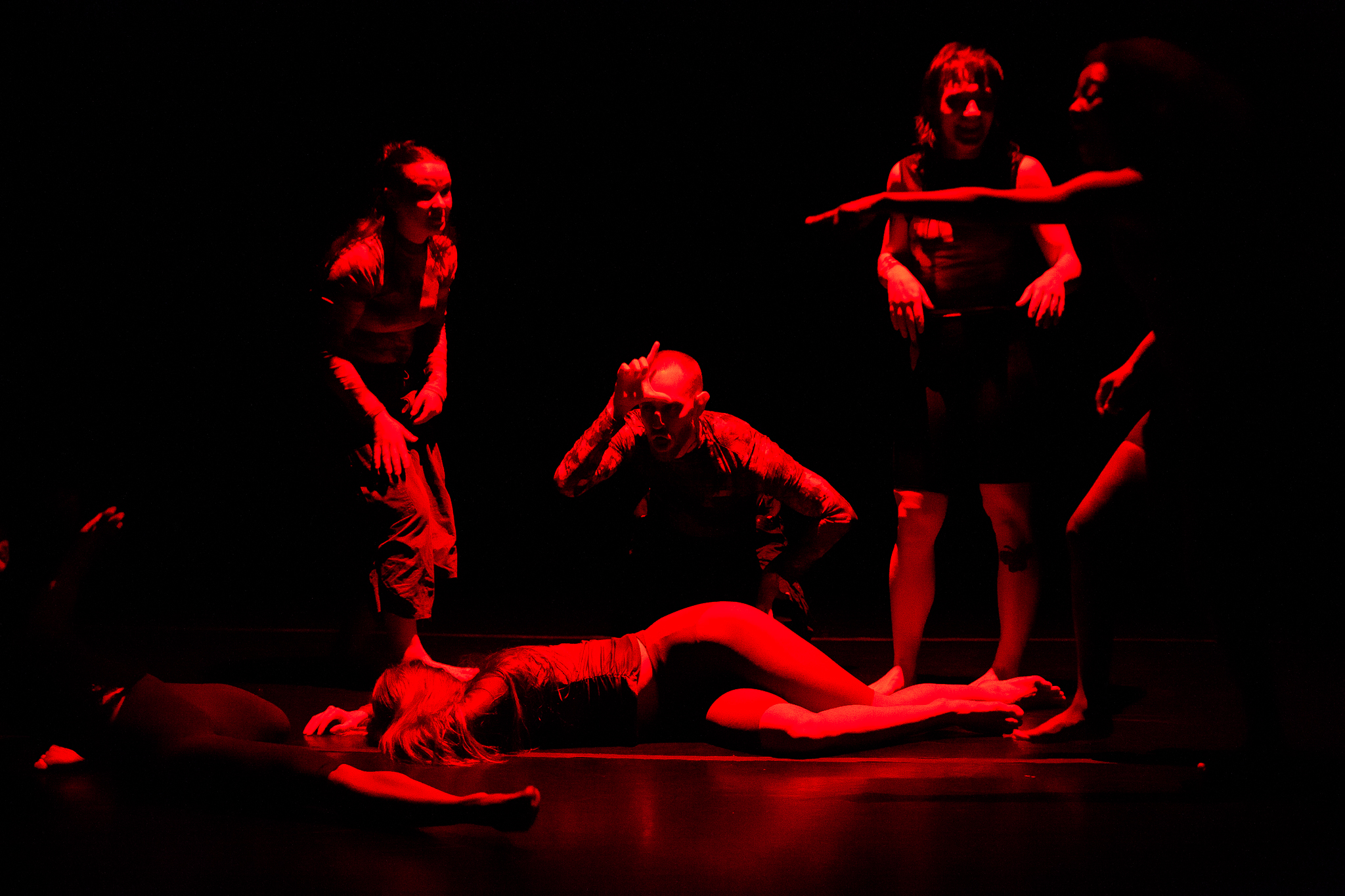
Every new section is marked by a shift of hue in the lights designed by Katinka Marac. Orange, red, green, and blue shine with extreme intensity, flattening the bodies into a two-dimensional painting. The strobe flash disappears and re-appears, disrupting my focus. It reminds me of the here and now, social media and flash photography. I notice these highly trained bodies and their differences. I see the strain and effort it takes to perform this. Empathically, I feel their clenched muscles and soft arms. I am dancing with them, until the choreography takes me again and the dancers become paintbrushes on canvas.
As new diagonals emerge, Amy Novinski is last to move toward her allocated space. I am so taken by her precision, presence and timing I don’t realize the reference to the beginning until her very last gesture. Time has cycled and morphed. Ephemeral could have been 70 minutes or millennia long.
Ephemeral, Nora Gibson Contemporary Ballet, Christ Church Neighborhood House, February 19-21. http://www.noragibsoncontemporaryballet.com