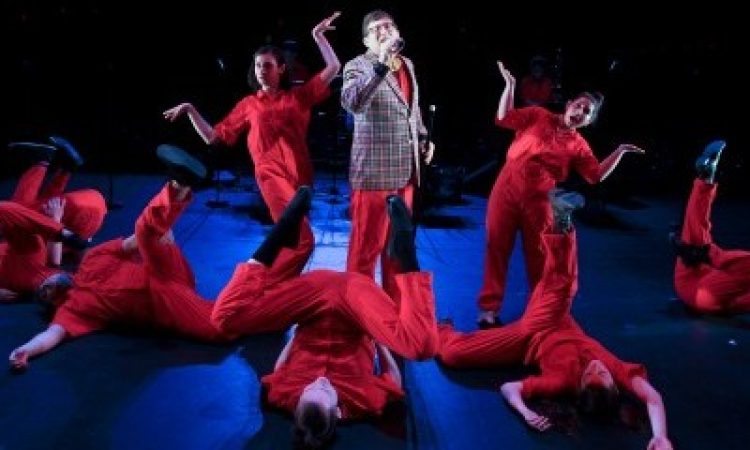
“Why do you wanna die, kid?” the MC of a gameshow asks Alameda, a teen who opened The Elementary Spacetime Show by attempting suicide. In an eerily bizarre place described as neither present nor absent, a contest—where winning allows the contestant to choose between life and death—is equal parts Rocky Horror, Game Show Network, and a bad acid trip. Three strikes from “give-y up-y comments,” and the player is forced to return to the land of the living.
The show featured choreography by Sonia Tayeh and Ben Hobbs, and the production was performed primarily by University of the Arts students, whose professionalism in crafting the song and dance that filled the entire theatre space blew me away.
Alameda ultimately had to choose between enduring life’s dolor or stepping into an unknown void. She met Precious the drag queen, who offered her own equation to life’s happiness. After thinking aloud, Alameda reworked the theorem to her own benefit, concluding that “suffering minus meaning minus hopelessness equals zero, absolute nothingness.” The ensemble’s exaggerated whirling overpowered Alameda’s fixedness, enacting the overwhelming feeling many face in the fight against depression.
Alameda’s affinity for the rationality of suicide led her to debating the value of life’s absurdity as she faced a series of challenges that probed her to consider existence from all perspectives, from physical to spiritual, emotional to social, satirical to medicinal. Being forced to understand opposing sides in order to better defend her own argument reconnected Alameda to a sense of purpose.
Later, Alameda met Alameda 2, suggesting that identical combinations of atoms exist in the universe, resulting in another person who thinks and moves analogously to one’s self. In essentially talking to a living reflection, Alameda moved from self-loathing to self-acceptance.
Being a part of the liminal freak show provided a place for Alameda to feel understood, tolerated, and respected, and provided her with the strength to endure suffering. Feeling normalized supported her ability to move forward in spite of inevitable exacerbating emotions.
Her journey reminded me that we live in a physical world where our capacity to be flexible in body and mind is reflected in our ability to lead what feels like a personally satisfactory life. The light-heartedness of the vaudevillian game show facilitated accessibility to sensitive, heavy content. The Elementary Spacetime Show alludes that we can never know actual reality, and extended an invitation to explore life’s significance through existential questioning. The audience is reminded, after all, that meaning is not found, but created.
The Elementary Spacetime Show, César Alvarez, Co-presented with University of the Arts, Arts Bank, September 10, 11, 14-18, 20-24, http://fringearts.com/event/elementary-spacetime-show-10/