“Why are we here?” asks Annie Wilson, covered in glitter and lying half-in-half-out of a basin of water—a landlocked merperson. Why do we do what we do? “I realized,” she admits sardonically, “that I make work to literally save the lives of the people I love most.”
After a muffled laugh from the crowd, she acknowledges: “I know,” she says, “that’s ridiculous.” We’re sitting about 20 feet from the La Peg bar at FringeArts. If we need a break, she tells us, we should go to the bar and bring her back a drink. “We’ll just have to slog through it now.”
This self-flagellating, cynical misery monster is the “bastard” in Wilson’s At Home With the Humorless Bastard. The piece is, among other things, a series of irreverent rituals about grief and getting through the day, told in part through a sarcastic lens. Rituals range from watching TV naked in bed to walking around the house singing and grumbling, from Grecian wailing to the building of shrines.
Wilson’s sister died this past summer. “So this whole exercise,” she tells us, “is a failure.”
The bastard: an urge to fall down, a depressive thought that won’t flush away, the bobbing reminder of personal failure. Grief personified in reluctance to persevere. Maybe, too, the humorless bastard is the big plastic sheet, sagging with blood, hanging over Wilson’s head.
It’s not a lot of blood, just a few gallons cradled in the center of the clear sheet. That leaves a lot of red-streaked tarp sagging from the ceiling, a sanguine celestial lid, drooping downwards to a point in the middle: an upside-down volcano, a breast, or, in what’s probably the best comparison, a huge homemade Diva Cup.
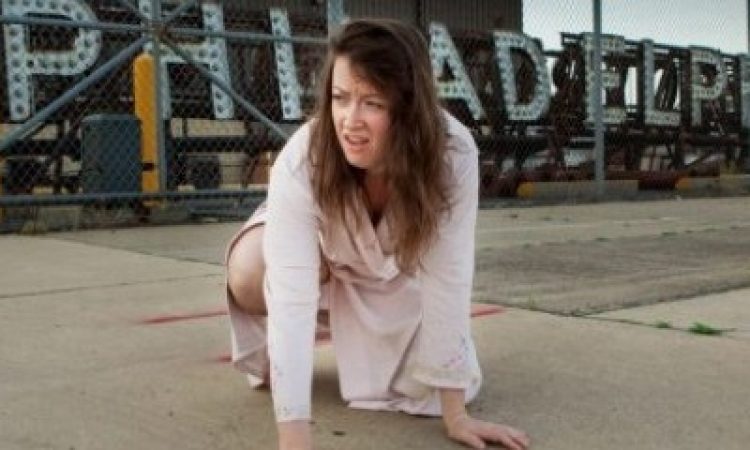
The first ritual: Wilson, after setting up a messy, abstracted apartment complete with massive 4-foot toilet-paper rolls and dead leaves strewn everywhere, wanders around it singing to herself. The song turns to mumbles; then, she strides around the cluttered “apartment,” her song descending into exasperated moans and groans. The stride turns to a repeated struggle against falling on her face, each footfall accompanied by a lashing sway of her body, her arm swinging down left, down right, down left.
This intensifies into a savage stomping dance. She hops, slashes her arms, and falls to her hands and knees, her robe hiked up around her waist, moaning, as if vomiting. Yet even when her movement becomes frantic, it remains a rhythmic andante, whether she stays in one spot or travels. Finally, she is on her back, rolling left to right. When she wants to stand, she must roll to build momentum and then throw herself up to her feet.
Wilson squeezes all the juice out of the moment. She works up every bit of reluctance and anger to the point of losing focus, control, direction.
Back to the tub, which is filled to the top with water, glitter, and Annie. She’s holding a microphone topped with a flashlight, so that if she wants to talk it shines directly in her eyes. The bastard. Wilson groans, smiles sardonically, and assures us that we’ll all get through this together.
“It’s hardest for the ones left behind,” sings the bastard, and we echo it back to her, who echoes it back to us, and we echo, and re-echo.
“If you don’t want to sing, I just ask that it’s an active rejection,” Wilson says. “So cross your arms over your face, like this, and say ‘No. No. No. No. No. No. No.’”
At Home with the Humorless Bastard, Annie Wilson, FringeArts, December 1-3, 2016, fringearts.com/event/home-humorless-bastard/.