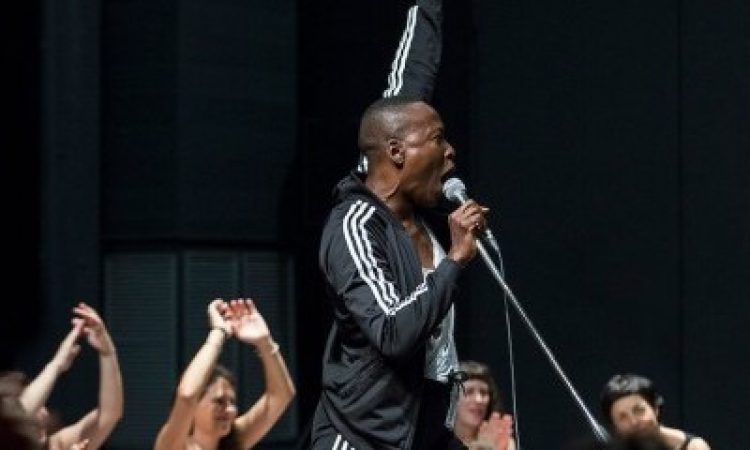
New York, NY—#PUNK, the first part of nora chipaumire’s* forthcoming triptych #PUNK 100% POP *NIGGA, takes as its point of departure Patti Smith’s song I Am a Rock and Roll Nigger. On stage at FIAF’s Crossing the Line Festival before a packed, purple-lit mosh pit, nora chipaumire stands in triple-striped sportswear in a powerful stance. She holds a microphone and recites Smith’s titular lyric. On repeat.
By opening with the n-word, chipaumire hits a nerve. She puts into play the most highly charged word in the American grammar book. (This is a phrase I borrow from Hortense Spillers’ essay “Mama’s Baby, Papa’s Maybe: An American Grammar Book.”) Integral to American vernacular, the n-word crops up time and again. It is without analogue. As cultural theorist Greg Tate says, “No other word has proven itself so emblematic of the host culture’s worst and best features, meaning white supremacy and Black resiliency.” The n-word tends to surface when white America, emboldened by a sense of safety, lets its mask slip off, as in Smith’s song which indiscriminately calls all people she deems “outside of society” by the n-word. I won’t argue that chipaumire’s dance somehow reclaims the word, nor heals the theft of black aesthetics and bodies. It’s not so simple—the n-word still stings and there’s something horribly chilling about watching chipaumire sweat before Alliance Francais’ visibly white audience. But there is a power in her punk, radiating from her stance and her scream. (For more on black power in abjection and the n-word, as I’m thinking about it here, see the work of Dareick Scott.)
chipaumire, a native of Zimbabwe, is both an American and African artist, an inheritor of colonialism’s violent legacy on two counts. In #PUNK, chipaumire plays a Black African punk musician, a continuation and variation of her characters in Afro Promo #1 Kinglady and portrait of myself as my father. Similarly to how in portrait of myself chipaumire stages the boxing ring as a performative space for dance, in #PUNK she uses the punk rock club as inspiration. chipaumire and her partner Shamar Watt scream lyrics, dance on and off stage, and command the audience to dance and sing along. #PUNK’s soundtrack remixes punk and African music; the choreography cuts together moshing and Zimbabwean dance. Punk is not only a white boys’ club. From reggae-influenced 70s British ska-punk to contemporary American artists Mykki Blanco and M Lamar, there have been and will be black punks.
A history lesson: the word “punk” originates from 17th-century English, meaning a prostitute, or a worthless person. It was later appropriated by the punk rock movement, whose musicians reveled in their outsider status. “Punk” can refer to the music movement, but it also retains an earlier connotation as a diss meaning “faggot,” particularly in the context of prison bottoms. As chipaumire screams the words “go back to Africa, faggot,” so much racialized and gendered matter seems to be negotiated on her body. chipaumire strips off her white shirt to show off sculpted pecs laced in pink; the audience erupts. Her thumb pulls down her waistband, revealing three layered pairs of Calvin Klein boxers, as she thrusts, declaring “I fuck with the past” and “I fuck even more with the present.”
As in portrait of myself as my father, chipaumire plays with stereotypes of the Black African male through masculine posturing. She swaggers and gyrates. Performing as a hypersexualized rock star, chipaumire reminds us of the ways the black body has long served as a repository for white America’s sexual anxieties. (See Frantz Fanon and Scott for more on this.) Her tensed muscles are pulled in opposing directions by discursive stereotyping of the black body—on the one hand the n-word as a supermasculine signifier and on the other hand, “punk,” as a signifier of queer perversion.
Watt lays down a four-beat count-off. Energized with riotous possibility, chipaumire rocks and bangs and screams—as if moved by a kind of freedom drive, “the freedom to act out,” as Ralph Lemon suggests in the post-show discussion. Rage comes through, as in the freedom to act out against, but also joy, as in the freedom to act out for. For chipaumire, punk is joy as rage, rage as joy. Another paradox: this freedom is also a kind of constraint. As Lemon notes, black bodies have been scripted since slavery as acting bodies, bearing the burden of activism. Watching the show, I sense the four-beat count forms the corners of a spatial-sonic box, in which embodied citations vibrate: Nazi high kicks, Elvis’ gyrating hips, ape-walks on all fours. The two bodies snap into place, as if possessed by a compulsory force. Their vibrations, however, exceed the box and exercise a command on the audience—totally spellbound, the audience claps, cheers, and shouts when told.
She falls flat on her back, exhausted, as a final act. She’s drenched in sweat. I think of how celebrities, especially racialized celebrities, are built up to be torn down. I think of the mining of black bodies and aesthetics. I also think of the many pleasures of exhaustion, the catharsis that comes from artistic and physical activity. I am exhausted as well, though I feel my exhaustion to be at a different scale than chipaumire’s, with different stakes. What kind of thriving is possible in exhaustion? What kind of power? Questions, not answers, that I linger with now.
#PUNK, nora chipaumire, Tinker Auditorium, FIAF Crossing the Line Festival, Sept. 14-15, https://crossingthelinefestival.org/2017/events/punk/
*chipaumire’s name is usually written in all lowercase.