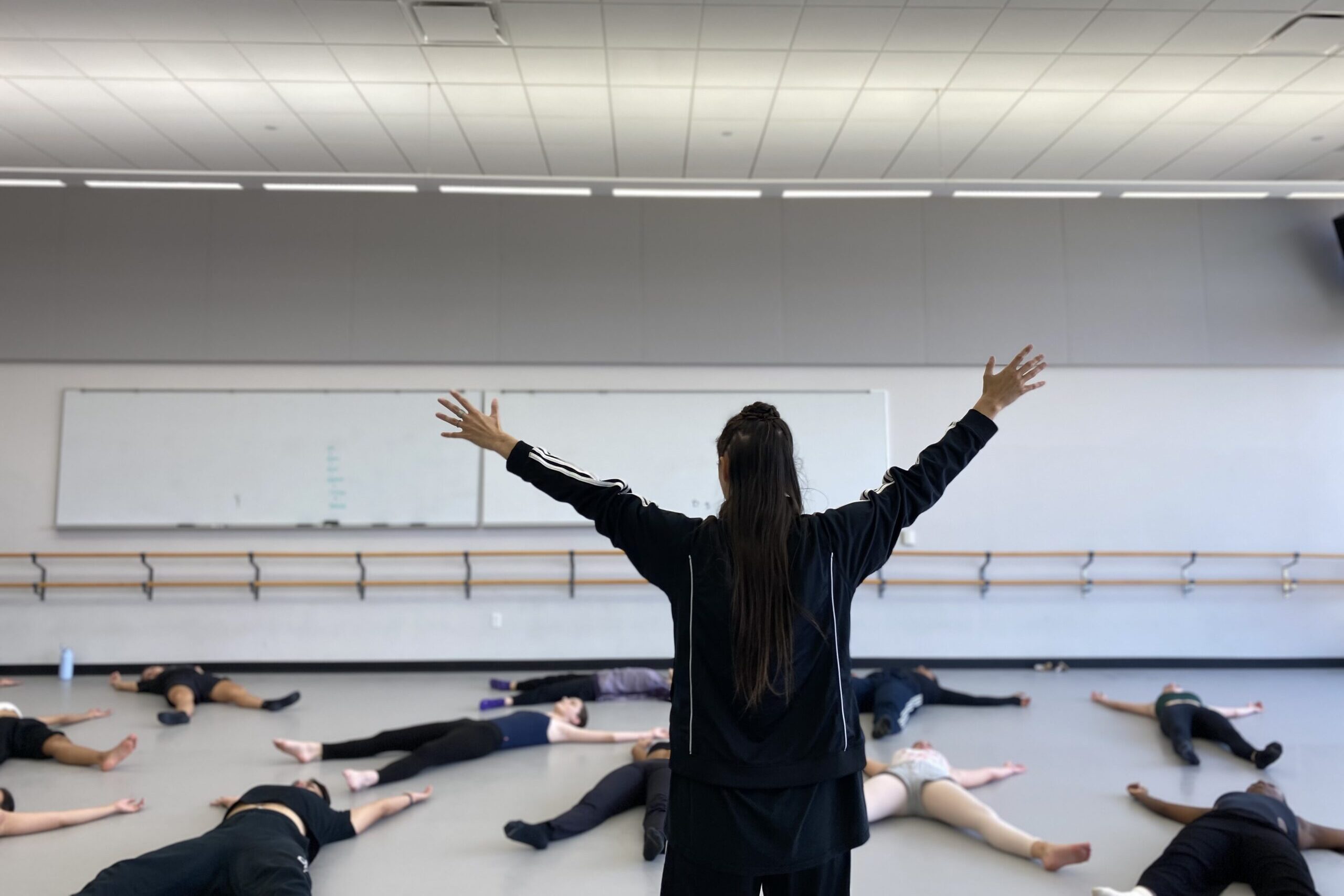
On Saturday I attended Bebe Miller and Susan Rethorst’s “Shared Practice” workshop in the theater at New York Live Arts before attending their shared performance, The Making Room, in the same space that evening. Rethorst and Miller took turns facilitating the workshop, and the two hours went by in a flash. We dancer-makers worked in duets, putting one movement in front of another without stopping to edit what was being made. We watched and assessed the simplicity of movements in time and moved right on to the next exercise, revealing methods of making from both artists’ process. Starting my experience of The Making Room with this workshop felt apt. There is an ongoing-ness and a cohesiveness to the entire project and processes (described in another TD article previewing the work by Meredith Bove.)
Rethorst’s Stealing From Myself, a duet for Philadelphia dancers Greg Holt and Gabrielle Revlock, functioned as a sort of prelude, a short story before a longer prose work. They moved books and chairs (the only objects in the space), traced each other’s outlines, drawing their bodies into the space, and made intricate hand gestures and quick, full-bodied shifts one after another. Their partnership was ambiguous yet synchronous. In Stealing, Rethorst quoted movement from her earlier works. Most notable for me was Holt dragging Revlock by her feet across the floor, then jumping and hopping over her relaxed legs and torso, a direct quote from THEN, Rethorst’s first Philadelphia work, made for Group Motion in 2013. Rethorst also reused upbeat music from the movie Beetlejuice, that came in at random, and appeared in the 2013 piece, and in a 2015 work she created with students at Ohio State University (where Miller was the chair at the time). Holt and Revlock posed and preened through phrases, moving chairs towards and away from each other, putting on jackets and taking them off, until Revlock declared “The End” after flipping fully through the pages of a book. The piece was witty, colorful, ironic, and totally enjoyable.
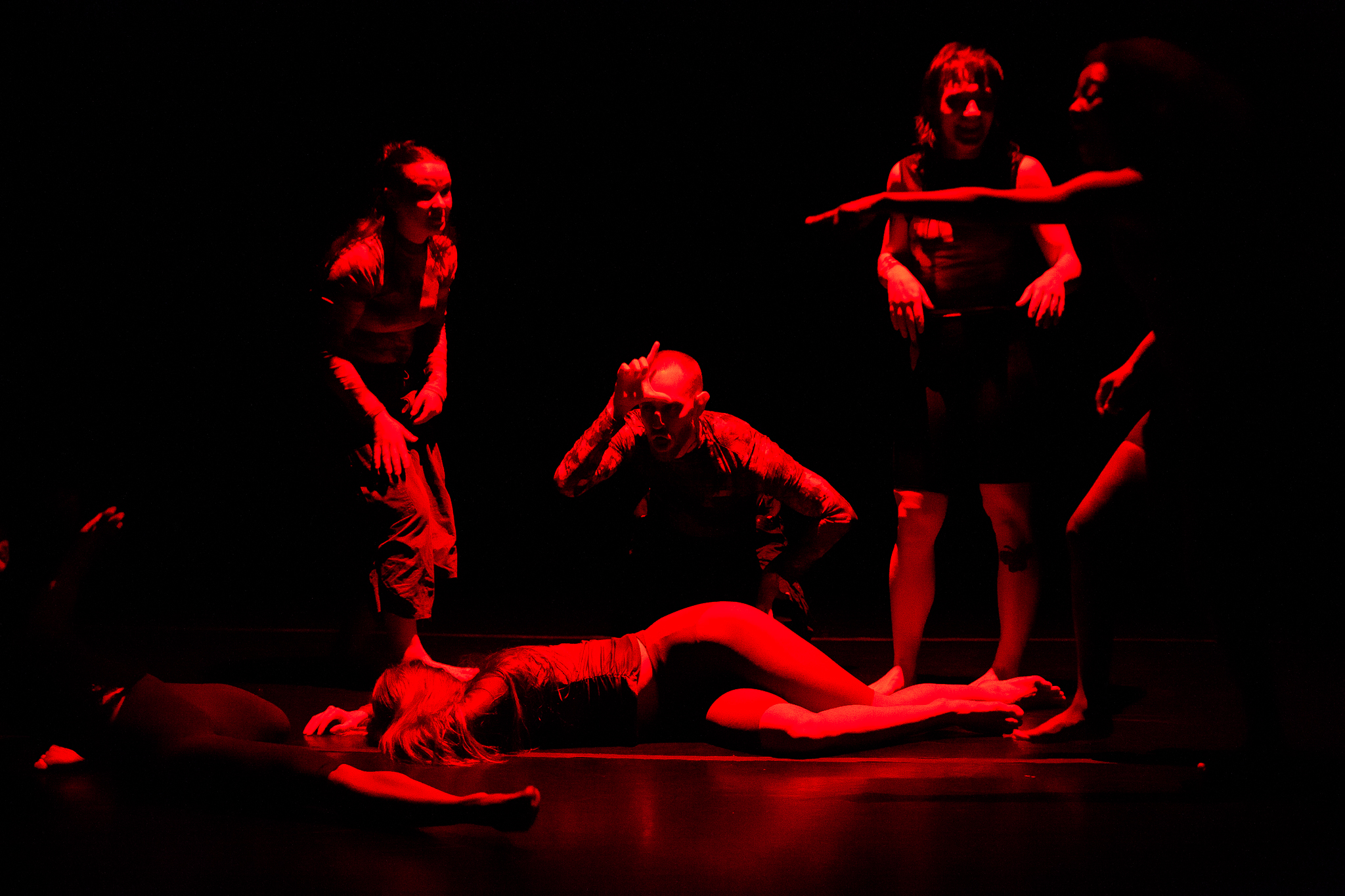
Miller’s In a Rhythm followed, and she began with a casual introduction of her literary inspirations and the dancers, as they began warming into movement around her. Discussing her musical choices, she called attention to the one repeated note, high and quick, which provided a kind of stilted metronome throughout the piece. Miller spoke about a David Foster Wallace short story (she told the audience to “Read it.”). However, she didn’t explain the plot, rather, she focused on his writing, his structuring of words. She brought up an interview in which Zadie Smith speaks about Wallace’s writing. And she discussed an interview in which Toni Morrison was asked when she would “stop writing about black people,” a question that Miller rightly said is “ridiculous.” Miller and dancer/ rehearsal director Angie Hauser entered with one earbud in each ear, speaking in interview style about how to make words “march forward.” The dance similarly marched forward. Trebien Pollard suddenly lifted Bronwen MacArthur above his head, Hauser and Michele Boulé locked into a close duet, and Christal Brown watched from the side holding the space. They all lined up to look at the audience, melting into one another before a gestural phrase broke the group into exiting and returning. The performers held their own, not with their personalities, but with the purity of their movement and the clarity of their choices, which seemed to be a combination of improvisational scores and set material. Miller used sculptural felt as both set and costume. The costume elements were adorned and discarded: Boulé unrolled a piece of felt into a perfect diagonal only to have someone run through, rumpling its geometry. MacArthur lengthened herself into a perfect arabesque, then sat on the felt and wrapped her legs in it, getting cozy for a moment before she rolled out and onto the next thing.
The piece is 70 minutes (which also flew by), and it contains two moments of full out dancing that were the most satisfying I have seen in a while, quenching my thirst for beautiful dance without pretense. A moment of pure rhythmic unison for the female dancers showed wit in its syntax, and in another moment, a line of dancers moved downstage to upstage, never stopping as they watched each other take a vertical pass up and back. This led into Boulé’s freewheeling solo, ending in a running circle, her clear face radiating as the other dancers entered once again to support her.
Like Rethorst, Miller places one event after another without being precious about it. Both artists allow the movement to be the centerpiece, clear dancing against the white marley and black box of the NYLA stage. The Making Room reminded me that it is enough to read meaning within movements, placed one right after another.
The Making Room, Bebe Miller Company & Susan Rethorst, February 21-24, New York Live Arts, https://newyorklivearts.org/event/the-making-room/