I feel about Malson the way I feel in a bath gone tepid—I sit in it wishing it were warmer. Not cold enough to get out, nor hot enough to sink in.
I stay for the dancers—Maylin Castillo, Lisst Galego, Diana Columbie, Gabriel Mendez, Marcel Mendez—whose names the program doesn’t mention but should. Their tenacious fluidity carries a choreographic arc that ultimately doesn’t do their skill justice. Choreographer Susana Pous makes proposals but struggles to develop or complete them.
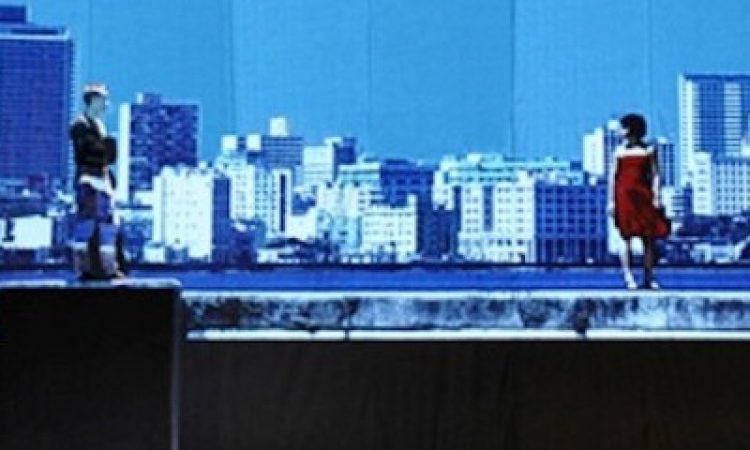
To begin, Malson thrusts us into its metallic and cold playspace—made sterile by the fluorescent lighting, muted by the grey-to-black monochrome of the costumes, and made cavernous by X Alfonso’s recorded echoey claves. The dancers’ movement vocabulary radiates a crisp, square efficiency; their bodies oscillate somewhere between athletic acrobat, robot, and moving mannequin. This palette exists in contrast to the color-saturated projections—a crowded street in Havana, the dancers in vivacious greens and reds, a sky, and a very fancy old car—which appear throughout the piece.
With his back towards us, a male dancer sits atop Malson’s only set piece, a large grey cube which doubles as the seawall of the Malecón. He looks out over a blue ocean projected on the back wall. The image of a woman, dressed in red, with a distinct black bob, approaches him. He reaches for her, yet cannot grasp her. The flirtation reeks of cliché until her electronic image starts appearing and disappearing—at one point, in a surprising Dali-esque move, floating in the sky. My curiosity piques, but the exploration turns out to be a blip. Despite the strong visuals, the screen-stage relationship doesn’t develop beyond “this grey world over here and this colorful one over there.”
Piqued interest followed by diffusion continues. Other whiffs of potentially substantive material arrive and pass by—a gesture towards suicide, a reoccurring theme of claustrophobia (everyone on the staircase, everyone stuck in an elevator, everyone clambering to get in the car), and loops, both musical and choreographic. I’m briefly able to drop into a section in which Pous leaves narrative and leans into the abstract, letting the movement speak for itself. The projection hurtles us down an Escher-like stairwell as the dancers, their strides military and businesslike, begin to create a weave of square walking patterns.
The last image: the five dancers sit together on the cube-turned-Malecón on the Annenberg’s stage in Philadelphia, PA. They glance up at a flying gull in the projected sky. They sweat. The energy to cultivate agility, flexibility, perception, strength; the energy to craft an evening-length work; the energy to be an artist; the energy to even get into the States as a Cuban (in September 2017 the Trump administration decided to withdraw staff from the US Embassy in Havana in response to alleged sonic attacks, essentially suspending all local visa processing), the energy to escape a nightmare—Malson—it short circuits. The image falls flat.
Malson, DanzAbierta, Cuba Festival @ The Annenberg Center for the Performing Arts, Mar 22 & 23.