“Early music” (typically pre-1800) has caught on in the United States, especially in hot spots like Boston and New York. Philadelphia has joined the trend, with Leon Schelhase’s Ravensong series, among others, hosted at St. Clement’s Church in the Art Museum area. While the music such performances present was often inspired by, or written for, dancing, it is rare for dance itself to be included in modern baroque-music performances. Dancing requires space, costumes, lighting, sight-lines—much more demanding than a small ensemble of musicians on a platform, with listeners in unraked seats, the typical set-up for many early-music performances I’ve attended. The dancing in the baroque period requires a kind of attention that we can’t be sure today’s audiences—attuned to acrobatic partnering and legs kicked to shoulder-height—will sustain. But, in the hands (body!) of a fine performer, baroque dancing can thrill.
Ravensong’s presentation of Le Roi Danse (“the king dances”) featured French dancer Hubert Hazebroucq with Schelhase and musicians from the Polish-Austrian group, Il Giardino d’Amore, led by violin virtuoso Stefan Plewniak, and Philadelphia’s Kleine Kammermusik, a jewel among U.S. early music riches. The rectangular hall at St. Clement’s, with its slick wooden floor, brings to mind a baroque ballroom; although the seating had no rake, Schelhase invited viewers seated toward the back to stand, if they chose, to see the dancing better. The program alternated music-only with danced works, giving Hazebroucq an opportunity for costume changes and the occasional breather. Not surprisingly, among the ten composers presented, the exceptional opera-ballet creators Jean-Baptiste Lully and Jean-Philippe Rameau dominated.
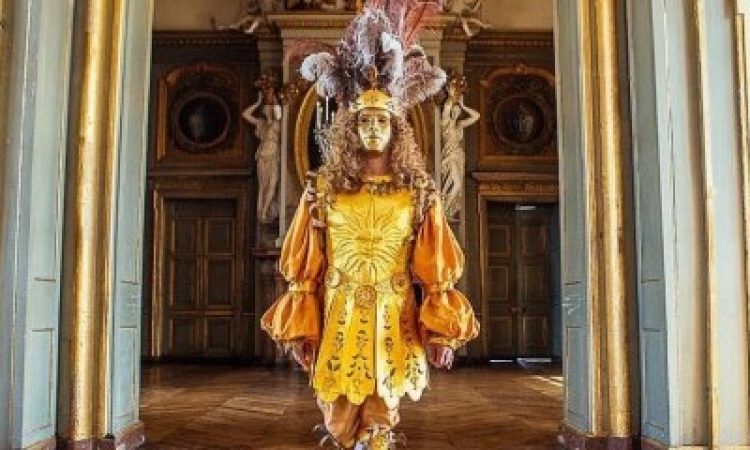
The “Menuet” from Francois Couperin’s Concerts Royaux (1722), with choreography by the great Paris Opéra dancer Claude Ballon, opened the dancing. Elegant, sprightly, neat, and glistening, this dance in noble style beautifully introduced the posture, steps, and arm carriage of baroque dance. Skirted and masked for the dances in the program section “La Belle Danse,” Hazebroucq performed two entrées for women, choreographed by the prolific Guillaume-Louis Pécour. Since only male dancers were permitted at the Paris Opéra until the late 18th century, such travesty performances well reflect this practice. Here, Hazebroucq was flirtatious, fluid, and utterly convincing in female character.
Hazebroucq showed off entirely different characterizations in three subsequent dances—for a sailor, a harlequin, and a peasant—where the steps’ bounce and verve, off-center torso, bent legs, and stamped landings accented the rhythmic drive of the music, played with unbounded energy by the ensemble. Returning to majestic mode, Hazebroucq treated us to a royal “Chaconne” (chor. Raoul Anger Feuillet, for whom a form of baroque dance notation is named), and an “Entrée d’Apollon,” by Pécour. The beats of the speedy step vocabulary, interspersed with held balances and open limbs, expressed the elegance and virtuosity of this style. To close, the group played the exquisite variations on the “Folies d’Espagne” (chor. Feuillet and Pécour, music Antonio Vivaldi), to which Hazebroucq presented a full range of interpretation: approaching-to-retreat, tempting the audience with direct address only to back off suddenly, and at times bold and demanding.
What makes this dance so enticing? The performer must master not only myriad small steps and beats, startling balances, numerous jumps, and complex arm coordinations, but also the musicality, spatial play, and—most important—the character of each dance. The steps must reveal the figure’s inner life and social position, and this Hazebroucq played with masterfully. Close up to his audience, rather than on the vast stage of an opera house, he danced almost into our laps, revealed his torso from all angles, paused breathtakingly right before us, skittered away and re-engaged with us, almost inviting us to join him. He used entrances and exits dramatically, peering through the glass panes of one wall before appearing in full, slinking or marching in or out, promenading himself before us to command center stage. A virtuoso dancer, fine actor, and deeply versed historian, Hazebroucq brought alive the riches of eighteenth-century theater dance for our twenty-first century sensibilities.
Le Roi Danse, Ravensong, St. Clement’s Church, Oct. 22.