Whistling wind sounds welcome us into the theater as several cowboys stand in the foreground. A vast mountain range projected, cacti, and the beaming sun behind them. The minimal set etches the essence of the country Western trope that so often questions who or what is civilized, one that is so often exclusively represented as White. High Noon is less concerned with the White, cis-het, male-centered narrative typical of cowboy stories. Instead, the work breathes life into the movement narratives, internal monologues, and soulful jazz influence of a Black queer mythology.
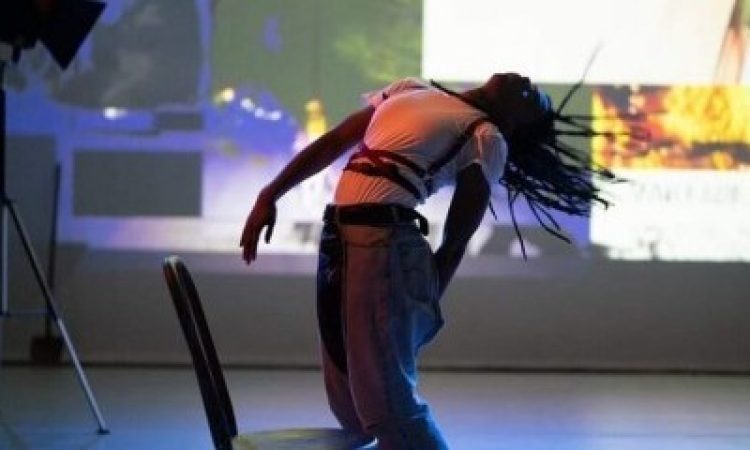
Ninth Planet’s High Noon upholds a ranch aesthetic with characters sporting chaps, tassel-sleeved jackets, and cowboy hats but reinvigorates the familiar Western motif by prioritizing queer artists of color. Kris Lee, Vitche-Boul Ra, Samantha Rise, and Oliver Spencer star; Ra in a brown long-sleeved vest, cropped to expose a mid-drift featuring defined abdominals, accessorized with an unmistakably bold and daring stage presence. Kris Lee sports blue jean chaps and a plain white tee under a strappy leather body harness with the sex appeal turned all the way up! There was even a glowing lasso. Rise and Spencer serve roaring, solacing soundscapes, and several introspective monologues to ponder as we wander through the psyche of a cowboy. Their percussion mimics rattlesnakes and they send whispers through the microphone as Lee stands alone centerstage, writhing in a restless contraction and folding into themself. Springing forward into a lunge, they send stark looks in every direction; hypervigilant. After recovering to a stabilized, upright stance, their hands revolve around the brim of their hat with quickness. Spencer narrates thoughts of misperception, dissociation, self-recognition, and lack thereof.
While Lee confesses to discontentment, Ra sunbathes, squirting bursts of cool mist upon their face with a portable fan, unbothered. As we learn the difference in temperament between these two, it’s gratifying to see how their dances reflect a growing shared comfort. What started as distant, watchful movement responses to one another, develops into fluency of communication and exploration. Archival images of Black folks from the 60’s playing jazz music, singing, dancing, kissing, send their bodies into dips, kicks, and turns. The movement is expansive and free.
In the final duet, Ra and Lee press their bodies together, bearing each other’s weight. Sharing rhythm, they pace forward in synchronous steps, gradually peeling apart. The movement evolves into hip thrusts and body rolls that wave through their dance. Moving with some distance between them now, intimacy sustains. It remains sensual and playful with plenty of eye contact and organic laughter. It was pleasurable to witness this joining after a desolate beginning; though we were quickly reminded that the moment is temporal and yonder awaits.
High Noon, Ninth Planet, Icebox Project Space, Sept. 5-18.