by Emmett Wilson
I navigated the stairways of Our Lady of Mount Carmel School Building to find the Art Room Studio once before, when ‘Professor Gabriel’ (an alter-ego of Amalia Gabriel Colón-Nava) cultivated a dance-lecture on corn there. On this visit, I gravitated to the same spot- the north edge of the stage planted in a classroom with big west-facing windows letting the golden hour in. I found myself delighted to be in this space of somatic sharing for Spring Studio Works, hosted by Leah Stein, featuring the work of Kimya Jackson, Amalia Gabriel Colón-Nava, and AJ Wilmore.
We begin at the pump, on a ‘page’ (the stage) to witness A Love Letter to Gas Stations. An ‘aisle’ made of two ropes lines the ground at the east edge of the stage. There are snacks! Oreos, tootsie rolls, life-savers- that we later learn have been ‘saving lives’ since 1912. The speakers leak sounds of pumping gas, cars rolling in and out. We are really there because Kimya Jackson is dancing in the aisle- picking up her feet carefully, a passé here, an undercurve there. Apparently Kimya can’t help but dance in gas station stores and I learned it can be necessary, to soothe, to celebrate stopping by-going. Kimya gently acknowledged the possibility of hypervigilance one might have at a gas station by offering a meditation- take inventory, find your favorite things, remember your presence. Kimya flowed with the confidence that comes when you have no doubt about a relationship. The work didn’t impose any particular agenda, instead, Kimya created a wide container of information that allowed me to pour in the thought that gas stations- sites of fossil fuel foolishness, and a bandaid for food apartheid- are also sites of respite and play, a model for us to carry into the beyond.
Then, Professor Gabriel returned! Writing on the chalkboard like before, but the ironic professorial demeanor was shed and I recognized the sincere prof-teacher-guide side of Amalia woven into her just as Gabriel is woven into her name. When Amalia drew the outline of a human with the words ‘where does grief live in your body?’ I understood I was witnessing the growth of a piece born a week before when I suggested Amalia share stories of her time at a food justice conference in Chicago at an open mic I hosted here in Philly. Amalia smoothly-courageously- shared experiences right after having them. Smooth courage continued in this second study featuring a moment of reading her notes aloud simultaneously with an audience member. She dumped the contents of her bag at the front of the stage, and organized the contents of her mind in a body mapping exercise crafted by the Urban Bush Women (cited at the conference)- ‘I come from’ fist to the heart,‘I come from’ bow-legged lasso dance, ‘I come from’ all fours and shaking- Amalia repeated these gestures and more until the words fell away and I learned a bit about where she’s going- to a place of understanding how to share nourishment (food, dance, feelings).
Now, AJ is curled up in a rolling suitcase- we saw her get into it, but I still feel surprise; mirror neurons (and magic) have me curled up with AJ; I’m a baby without a sense of object permanence, like ‘where did AJ goooo?’ and then ‘peek-a-boo’: her voice emerges singing-
‘I’m up in the woods, I’m down on my mind
I’m building a still to slow down the time’
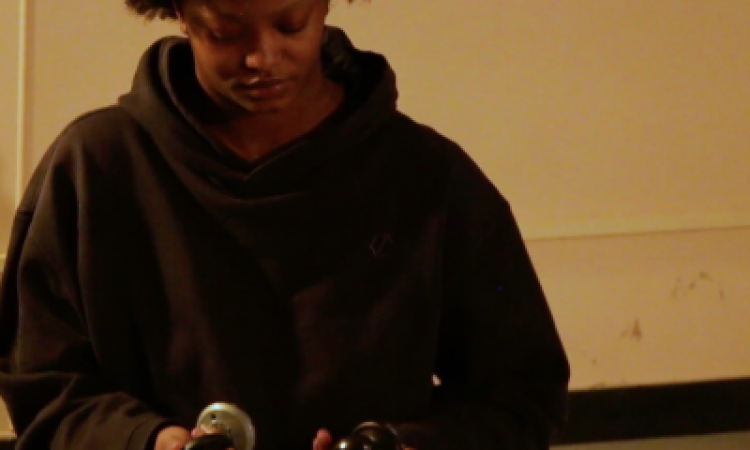
We are in the proverbial (and quite queer) WOODS- the song is by Bon Iver, given life by AJ, who is now scratching at the inside of the suitcase. AJ holds her phone out for us to see a photo of her and a loved one, scratch-scratch-scratch, and another, scratch-scratch, one more- just kidding- one more again. The ‘kidding’ sentiment grew when AJ went to the chalk board and did a plie in parallel to become kid-height and marked it with a piece of chalk. She labeled that mark ‘AJ’ followed by a frowny face. She marked her present height with a ‘?’ and then, in relevé, her taller (future?) self was followed by an ‘!’. Cut to AJ trying to put a door knob together, then pushing the parts on a diagonal towards the suitcase and the setting sun, her whole chest quivering not with effort or exaggerated emotion, but as a dance communicating the complications of piecing parts of life together. She sings ~the song~ again, her voice calling out crisply, and an airplane passes by as if on cue. AJ ended with a tour of her childhood home projected onto the ceiling and cascading down that west side of the room. It was a live view from google maps, AJ gently and deliberately scrolling to see the green house at different angles, reminding me that it’s worthwhile to investigate oneself with care.
Reverence was in the room during the post show discussion. Audience comments included feelings of gratitude for the gifts of these pieces, and someone noted the airplane going by as an act of god (in the poetic sense). I left feeling joy to remember that dance is a way of knowing and understanding the world together.
Spring Studio Works, Kimya Jackson, Amalia Gabriel Colón-Nava, AJ Wilmore, presented by Leah Stein Dance Company, Art Room Studio, February 19.