Who’d have thought that a dance-filled travelogue series would be found on a government website? But that’s exactly where you’ll find “Bare Feet with Mickela Mallozzi,” accessible through streaming on the NYC Media website.
Mallozzi, the Emmy-winning host of the series, is a professional dancer who shares her travels through a dancer’s lens. The series description drew me in, inviting me to join Mallozzi as she “experiences the world one dance at a time.” Mallozzi is filled with energy; her abundant enthusiasm spills over onto the screen, sometimes a bit over the top for me.
As someone who also enjoys both travel and dance, I not only include dance performances in my itinerary, but also participate in classes and informal dance sessions when possible.
In initial episodes of the series, Mallozzi can be found, in the words of website, “dancing her way through her own DNA map.” She travels, discovers and presents local traditional dance in Greece, Romania, Morocco, Ireland, France, Spain, Guadeloupe, Uzbekistan, the Republic of Georgia, and Italy where she has family roots. These became the locales of her award-winning PBS series, also streaming on Amazon Prime.
More recent episodes, titled “Bare Feet in NYC,” follow Mallozzi as she uncovers the dance and music traditions of locals in New York’s ethnic neighborhoods. In Season 6, episode 2 , Mallozzi explores Latinx communities and cultures with Brazilian samba, reggae, and Argentinian tango.
In this episode, Mallozzi notes that the Latinx community is New York’s fastest-growing demographic, with almost one-third of New Yorkers claiming Latin heritage.
Her first stop is Queens, for the post-COVID reopening of the Astoria Tango Club, where singer Pablo Pereyra hosts a monthly milonga, or tango party. Pereyra, a Buenos Aires native, claims it’s the most authentic milonga in the U.S. “It’s like being in Buenos Aires,” he says, “except that you don’t need your passport and you save a couple thousand dollars in a ticket.”
The milonga gets under way with a beginner tango lesson. To encourage the newbies, the dance instructor says tango is 80 percent walking, describing it as “walking in embrace.” I’d probably describe it in more sensual terms. Mallozzi offers her own finessed description of tango: “It is this conversation you are having with another person, with their body, and it just wakes up something inside of you.”
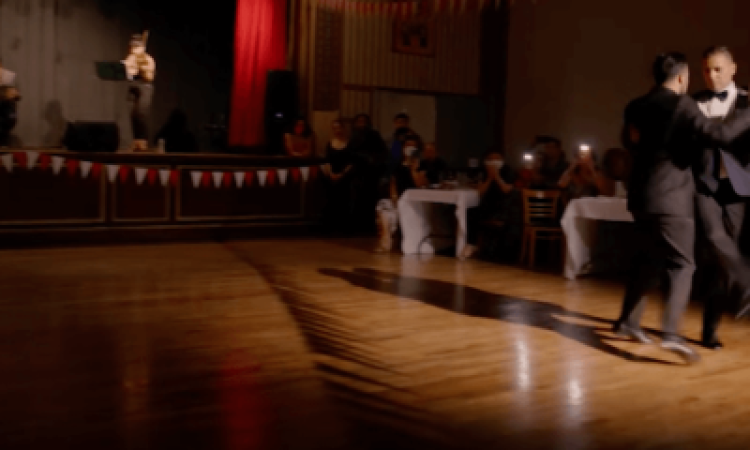
The tango videography is compelling, especially close-ups of those interviewed and of footwork in dance segments. Then the camera pulls back, and brings the viewer into the larger space of the dancers. I am captivated by two men in a passionate tango, powering their way across the dance floor. Other dancers are featured, but I prefer the moves of the less polished, more seductive non-professional dancers.
Mallozzi visits the Loisaida Center, home base for the all-women, Afro-Brazilian percussion ensemble Batalá New York. The Big Apple doesn’t have a monopoly on this; Philadelphia has its own amazing percussion ensemble, Batala Philly, where you don’t have to be a drummer or Latinx to participate. Its website welcomes all: “Whether you are a professional drummer or have no musical experience, you’re welcome to try it out. We’re an open organization for anyone, regardless of sexual preference, religion, race, and musical experience.”
Next stop, Ballet Hispánico, the international touring company and New York institution. It is the largest and oldest Latinx dance company in the nation, according to Artistic Director Eduardo Vilaro. “You have to realize that for oppressed and marginalized people, to be able to have a space to walk in and hear their language and see themselves reflected,” he says, “is so powerful. It’s that whole idea of belonging.” Mallozzi takes belonging to heart, joining a class with the company’s free Pa’lante (“moving forward”) program, which Vilaro says is for high school graduates “still struggling to find their way in this career.”
Mallozzi ends the episode in Central Park’s Bethesda Terrace, for a bachata and salsa dance party that I longed to join.
With a nod to my intersectionality as a dancer, traveler and Jew, I had to watch the “Jewish Roots” episode. Mallozzi visits the 92nd Street Y, which has held a weekly Israeli folk dance session for 40-plus years. I’ve been to these sessions that draw over 100 dancers and, in true New York fashion, I learned quickly that if you don’t know the steps you’d better get out of the way.
Watching “Bare Feet in NYC” brought back memories of my own dance-inspired travels. No matter where my travels have taken me, I found that, even if I didn’t speak the local language, I could communicate through the unspoken language of dance.
“Bare Feet in NYC,” Mickela Mallozzi, Season 6, streaming online.