In a dimly lit stage corner, a spotlight illuminates five female dancers clad only in skin-toned underwear. They delicately lean towards each other, and their bodies rise quietly in tandem with the ambient music and a woman’s tender voiceover. Rather than exuding sensuality, their bare bodies convey a sense of alienation, emphasized by the dancers’ restrained movements and blank facial expressions. The emerging Chinese choreographer, Shiyu Wang, employs these exposed, innocent bodies to construct her own Garden of Eden and uses it to reflect upon the experience of adapting to and embracing an alien culture and society in America. Throughout the 30-minute piece, I empathize with Wang, while also curious about the moment of seduction and the awakening that may follow.
The subsequent duet begins when two dancers stagger across the stage, their heads enveloped by a long piece of white veil that stretches between them. Admist intermittent melancholic piano chords, they repeatedly pull apart only to rebound towards each other, compulsively linked by the veil. When the lighting turns to an uncanny blue hue, the two estranged bodies swiftly expand their limbs, accelerating their physical connection through loving embraces, experimental presses, and supportive leans. The twisted veil and the heightened piano notes visualize the tension between them. As they gradually unveil themselves, their synchronized bodily rocking echoes the accent of a marching violin. Their increasing eye contact suggests a developing connection between body and mind.
The lights fade to black, leaving only a shimmering wisp of fabric on the dark floor. The soloist, Michaela Delaney, rolls and crawls towards the light source. Like a cautious fox, she sniffs the gleaming fabric and promptly looks around. Accompanied by syncopated electric tercets and tinkling piano notes, she raises a hand, stretches her fingers, and wiggles her feet from side to side. Within the progressive stage light, the isolated motions fuse together allowing Delaney to scan her almost naked body. With curiosity she slides her body into the clothes she found on the floor, and her “civilized body” steps into an alien society.
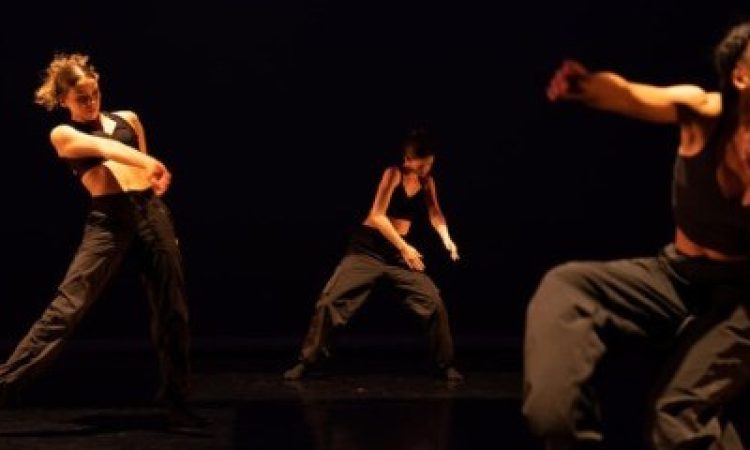
As the electric sounds crescendo, four dancers successively join the emergent “society” by bringing their daily attire onto the stage. Transitioning from a duet to a trio and then to a quintette, they seamlessly dress while extending their legs and arms, their bodies now merging into the clothing. The recurrent marching rhythm, executed by the galloping violin bow, unifies the dancers, and elevates the dance to its climax. Wearing simple pants and tops, the five dancers collectively swing their bodies, execute high leg kicks, and wave their hands to the audience, unexpectedly breaking the invisible fourth wall that separates performers and spectators. Wang’s dynamic choreography hybridizes technique-driven modern dance with postmodernist spontaneity, offering audiences a visually and kinesthetically captivating experience.
Split Bill: Into Outside, Shiyu Wang, MAAS Building Studio, Philly Fringe, Sept. 14, 17 – 18, 2023.