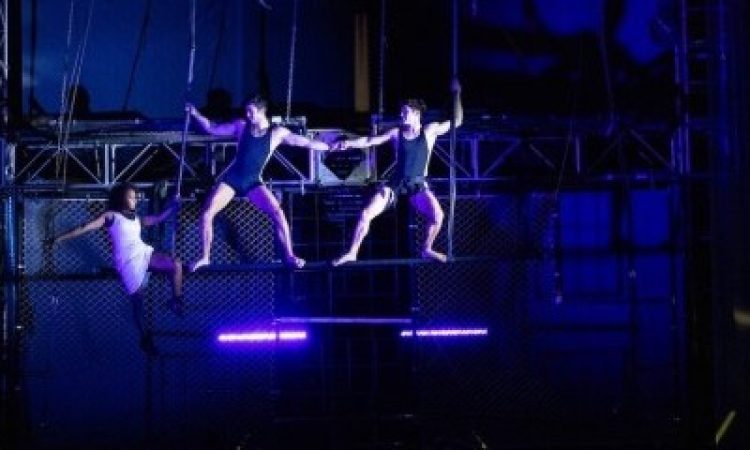
It was gray and drizzly as I approached the Ball Bearing Factory for Brian Sanders’ JUNK. As Brian himself pulled back the black trash bag curtain to open the house, he grinned and said, “Have fun storming the castle.” Rigged with pulleys and large metal hooks, the warehouse setting included chain-link fencing, metal piping, chains, and scaffolding. Delivered by a disembodied, robotic voice, the curtain speech disclaimed that what we would see had already been done; PROTOTYPE was a reimagining and expansion of various pieces “Mr. B.S.” had created over the last twenty-five years of Philly Fringe performances.
With a cast of five dancers, PROTOTYPE was classic JUNK: gravity-defying aerial work and partnering, cheeky humor, and moments of vulnerability and softness. Set in the near future, projections of fiery magma, sinkholes, and a neon cityscape complemented the work’s gritty, retrospective mood. As a drone flew erratically overhead, I found myself thinking, Who knew the apocalypse could be so beautiful, funny, and sexy?
The standout piece was the aerial solo with a square grate suspended from the ceiling. Dressed only in short black bottoms, the dancer spun and climbed over, under, and atop the apparatus, displaying control and agility. Interspersed were moments of vulnerability, where he allowed his body to surrender to gravity. A combination of amber and cool lighting cast multiple shadows of his body against the sharp corners of the grate. Having seen this piece performed by various dancers over the years, the nostalgia and enduring beauty of the smooth, cool metal juxtaposed with the dancer’s warmly lit, sculpted body brought me to tears.
PROTOTYPE ended with a splash as dancers stripped down to black underwear. Two dancers frolicked in a thin stream of water that drizzled from the ceiling, playfully kicking up the puddle that formed. What started as a trickle suddenly intensified when two dancers entered and dumped entire buckets of water over their heads. Quickly, the space transformed into an erotic slip ‘n slide filmed from above and projected onto the upstage.
Always with a sense of humor, the joyfulness of play, and splashes of the erotic, Brian Sanders’ work illuminates the beauty in everyday objects, in what others may perceive as trash, in what may easily get left behind. As our world seems to sometimes be barreling forward toward an unknown future, PROTOTYPE helps us remember the pleasure in slowness, the vulnerability in trust, and the fearlessness in experimentation.
PROTOTYPE, Brian Sanders’ JUNK, The Ball Bearing Factory, Philly Fringe Festival, Sept. 20-24.