The following is a selected writing from one of tD’s Emerging Writer Fellows, Nate Tantral-Johnson. Nate is a BFA in Dance student at Bennington College in Bennington, Vermont. Learn more about Nate here.
Author’s note:
This writing is my attempt to theorize alongside Cherish Menzo’s FRANK. The work is both porous and opaque. The work is also thoroughly Black; in the lineages it enacts, the theorists it cites, and in the performers who animated it over the course of a 90 minute evening in the Théâtre Jean-Claude Carrière. I am not Black, thus, it is not my intention to insist on a prescriptive reading of this work. Instead, I am engaging the work of scholar Tina Campt, who activates the idea of a “new Black gaze” to speak on the imperative of an “affective labor of adjacency…” In an opening monologue, dancer Omagbitse Omagbemi tells the audience: “the bodies, people, the symbols are fictional, … where together, you, I, and the other, will create an authentic account of the inner workings of something (un)homely.” I want to take this invitation, in the spirit of adjacency, by feeling — and imagining — together with Cherish Menzo’s performative propositions. The labor of FRANK is both collective and specific. It occurs on thresholds and in-between places, the closing distance before an encounter, the moments preceding collapse. The labor of FRANK is a labor of wonder. This writing is shaped of my own wonderings, the questions and research which arose from what I witnessed in the theatre. But Campt also says that this new Black gaze must be active and effortful in its thrust towards “relation to, contact, or connection with another.” How can what Menzo presents help us to reimagine the ways we relate to each other? Let’s wonder together.
And, as Omagbemi says: “oh, well, let’s enter FRANK…”
MONTPELLIER, FRANCE
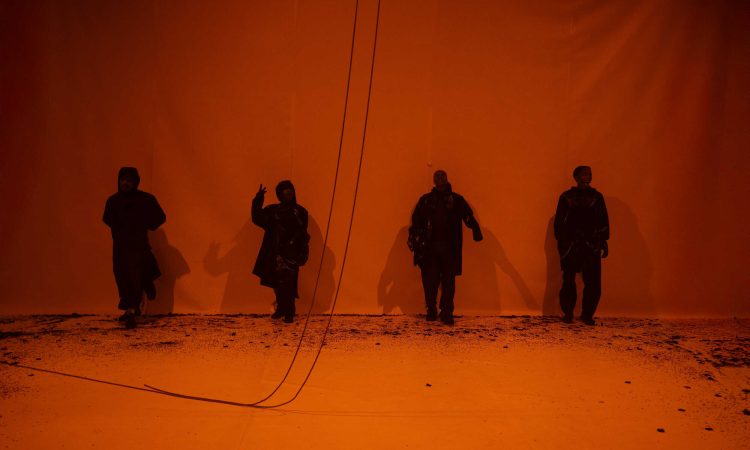
A sheer plastic sheet, thick and tantalizing, walls in a darkened performance space. Seen through the translucent barrier, a lone figure (Omagbitse Omagbemi) is made vague and distorted. Cloaked in a heavy raincoat, her body appears only as a silhouette — only the suggestion of form. The swelling silence reminds me of gasp as we watch her slowly turn her head and open her mouth, as if to speak; nothing comes. On the back wall, suddenly, a projection — a gaping jaw and the inside of a mouth, HER mouth, impossibly red — like the room itself is looking for something to swallow. Here, even the theatre is a body — like all bodies — in constant recomposition. This is Cherish Menzo’s FRANK.
As humans, we are concerned with anatomy — the formal architecture of the body, and the ways of moving that this form enables. But the study of anatomy makes precarious assumptions; namely, the assumption that a body is as it appears. And the history of anatomy is a history inextricably entangled with racism and the violence of reduction, which insists people as bodies and bodies as things. Of course we are more than our anatomy. Of course we are wider and deeper. FRANK demands that anatomy be under interrogation — how does the lens of anatomy, with its fragmentary way of imagining the body, shape our engagement with the world? And how does it distort the way relation emerges? By destabilizing the operation of viewing, Menzo resituates the experience of FRANK outside the container of anatomical thought.
Three performers (Omagbitse Omagbemi, Malick Cissé, and Mulunesh) join Menzo to form an ensemble of four. At first ordered and sharp, their circular march rapidly splinters into a tilted and stuttering rhythm. Each time I begin to recognize a pattern, it has already shifted. Cissé taunts the audience through the sheet, close enough to the plastic that his breath condenses on its surface. When all four join together and begin to crawl at odd angles across the floor, it is impossible to discern where any one body begins.
Anatomy tells us that the body is discrete, that concern for the body ends at the edges of the skin. To study anatomy is to be implicated in individuation, to come to know the body as one, singular, thing. But surely dance must remind us that our bodies are not apart from each other, or the world itself. In this way, anatomy has no imaginative recourse to de-composition. The dancers begin to leak paper scraps, like ash, from sources which elude me. Even when they seem to have spent themselves, another cloud showers to the floor, which is becoming obscured under scattered piles of debris.
One influence on FRANK is the notion of anatomy in Mary Shelley’s Frankenstein, or the Modern Prometheus (1818). The program notes that FRANK is simply an abbreviation, a gesture towards Shelley’s fictive, anatomical miracle. Likewise, in an opening piece of text, the dancers state “[FRANK] is imaginary, a stitched fabulation created expressly for a particular moment in time.” The tri-frontal organization, with spectators arranged on multiple sides, evokes the staging of an anatomical theatre, the very place where Shelley proposes that the impossible can become possible. Within these spatial and discursive frameworks, Menzo enacts a shift in the logic of corporeality. Together with Shelley, she helps us imagine that the body itself is a kind of “stitched fabulation,” composed from innumerable sources which refuse to be reduced to a single truth.
But this framing carries another weight. The history of the anatomical theatre is fraught with racial trauma. Invoking the anatomical theatre requires us to think about and against its white supremacist and colonialist origins. These sites were maintained by racialized exploitation at the hands of white physicians, who utilized crimes such as grave-robbing in order to obtain non-white bodies without consent, to be “subjected … to the disintegrative violence inherent in the process of dissection (Lawrence & Lederer, 2023).” Positioning the work as fabulation does not excuse us from the necessity of this oppositional thought — rather, Menzo invokes Saidiya Hartman’s language of critical fabulation, as “a method of writing against the archive; telling impossible stories to amplify the impossibility of their telling.” What fabulation does, here, is to amplify the impossibly tangible presence of Black humans rendered unreachable by anatomy and its carriage of assumptions.
The spiral continues to intensify, the tremors growing in scale, until it collapses within a showering of paper dust. The stage is suddenly quiet. Left alone, Menzo lies on the floor under soft, impartial light. No one moves for a long time. Even the gentle swaying of the plastic seems decelerated, like the rise and fall of a ribcage during sleep.
In her writings, Menzo discusses grounding the piece in the spirituality and ritualised movements of Winti — a religion first practiced among people who were enslaved in the country of Suriname. Made illegal by Dutch colonial rule in 1874, these rituals nevertheless continued on, as tactics for survival, in secret and out of view. FRANK references this history of illegibility as Black resistance — from beneath the rain coats and within a gathering haze, the bodies of the performers continuously slip visibility. The audience’s gaze from its place of separation becomes implicated, the plastic skin making physical the individuating operation of viewing, which asserts distance between the body of the spectator and the body being witnessed. In the colonial history of anatomy, this distance reinforced the proposition that bodies under dissection, especially non-white bodies, heed no empathy and offer up their objective and objectified “truth.” It is urgent to reject this proposal, and to tend to the work of presence that exists apart from the visible, tactile, and legible surface.
Entering from the darkness, Omagbemi peels away a corner of the sheet, looks around, and steps outside. She gestures, casually, and the house lights lift. She looks into people’s eyes. “You didn’t think I was actually going to stay in there?” In hindsight, I should have known that a logic of severance would never hold. Not here.
She takes a piece of cord and pulls it, hard. One plastic wall crashes down. Cissé, Menzo, and Mulunesh return, joining in, ripping up panels of flooring. Now without their raincoats, their movements are vigorous, exorbitant. One by one, the plastic walls land in crumpled piles to be crushed underfoot as the performers travel amongst the wreckage and then out into the audience on all sides, watching, wandering, reciting from Shelley: “I became acquainted with the science of anatomy, but this was not sufficient…” Mulunesh, suddenly standing behind me, runs her fingers through my hair. This is a place where mediation does not hold, where the notion of a body is a space of infinite width and depth. Further, this body space is both collective and specific, forming and reforming itself in entanglements and emerging relations. Dysfunctional and impossible to hold, the audience’s gaze must fracture — this decomposition of the gaze and the body of the theatre finally enacts the fabulation of an anatomy unpenned by otherness. The container is inadequate. The edges are leaking.
FRANK, Cherish Menzo / GRIP & Theater Utrecht, icw Dance On Ensemble, Théâtre Jean-Claude Carrière, Festival Montpellier Danse 2025, July 3-4, 2025.