Content warning: This essay contains references to sexual exploitation, child predators, and themes of implied sexual violence.
I think about proximity first.
Not as abstraction, but as geography. The literal bridge between the island of Palm Beach and West Palm Beach connects a gap between two different realities.
The section of Palm Beach County I knew was small enough that the same roads carried everything—dance studios, school parking lots, house parties, ocean afternoons that felt ordinary, par for the (golf) course.
Years later it became clear that, moving through that same geography, Jeffrey Epstein was targeting and trafficking local girls from my community.
Reruns of early-2000s MTV shows make it feel obvious in hindsight—Rock of Love, A Shot at Love with Tila Tequila, America’s Next Top Model, The Girls Next Door, a show that turned the lives of Playboy bunnies into a glossy and glorified competition for Hugh Hefner’s wrinkled attention. What was packaged as entertainment, fashion, and beauty brands now reads as explicit instruction targeting girls: desire as storyline, women as hierarchy, bodies as spectacle to be ranked, evaluated, and replaced.
The engine behind that media landscape didn’t exist in isolation. It mirrored what was already in the air around us—training us to see girls’ bodies as currency before any of us had the language to name it.
Some of them were children from the same world I moved through. Some were girls I might have brushed past in the same rooms–the same heat, the same quiet Florida afternoons no one thought to question.
I was a ballet dancer before I had language for what that meant—before I understood what it means to be trained into visibility, into line, into being looked at.
On one side of the bridge is West Palm Beach. There sits Alexander W. Dreyfoos Jr. School of the Arts—where I trained in ballet, jazz, and modern— it was only a few miles from Jeffrey Epstein’s house on El Brillo Way. At the time, that distance meant nothing. Just school, studio, bridge, island.
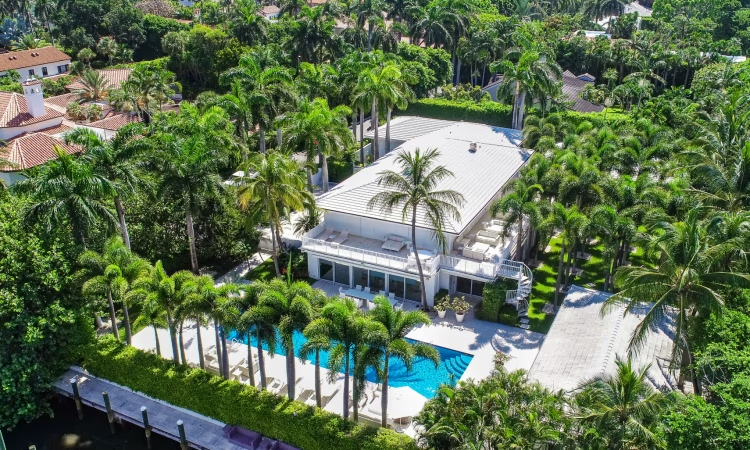
On the other side of the bridge, Palm Beach: heat, salt, air, bougainvillea spilling over fences, royal palm trees lined in slow, disciplined repetition, and the quiet glide of luxury cars that seemed more air-conditioned than driven: older Mercedes, early-2000s Range Rovers, Bentleys moving without urgency–hedges trimmed into obedience, lawns flattened into impossible green, estates set back behind gates and discretion. A landscape built to erase labor, mess, and anything that might interrupt ease.
Palm Beach society is a tight circle. People know each other. A small world with a lot of money—men moving through the same rooms, the same clubs, the same names until they no longer need introduction. Not large in presence, just in reach.
The bridge wasn’t crossing. It was sorting.
And I learned to cross it in a body already trained to be seen.
What I remember most are the royal palm trees.
Where there are royal palm trees, there is money. And where there is money, there is maintenance.
Like the girls themselves, the royal palm trees were planted with great intention–lined along roads in disciplined repetition—tall, thin, statuesque forms suggesting order more than nature. Nothing about them was accidental.
They were found. They were chosen. They were bought. Placed. Ordered. Maintained. Groomed. They were strong. They had to be if they would need to withstand the abuse from hurricanes and tropical storms. Some would eventually break in half–their palm fronds falling to the ground in one final sweep. Some would be forced to stay.
From 2004 to 2008, I moved through Dreyfoos School of the Arts —learning how to hold a body under attention, extend without breaking line, remain visible without collapsing.
At the same time, Jeffrey Epstein was already under investigation in Palm Beach County for sexually abusing local teenage girls. By 2006, people knew in fragments—never cleanly, but enough that silence itself became structured.
The real assholes, people said, came from somewhere else. But “somewhere else” did a lot of work in Palm Beach.
By 2008, the same year I graduated in an auditorium full of parents at the Kravis Center for the Performing Arts, Epstein’s case was resolved through a non-prosecution agreement in federal court. Life continued.
Two sides of the bridge. Same years. Different protections.
I crossed into Palm Beach for performances.
The arts lived between these worlds—fundraisers, galas, hotel ballrooms, private clubs. Not separate from wealth, but carried by it. Funded by it. Framed by it.
These performances were framed as opportunity—access to patrons, philanthropy, proximity to those who could decide whether the arts survived. Without them, there was no funding. Without funding, there was no us.
That was understood without needing to be said.
I do not know if he was in that room.
He did not have to be.
What mattered was the room already knew how to exist without explanation.
We changed backstage in tight clusters—pink costumes, pinned hair, heavy makeup under fluorescent lights that made everyone look slightly older. Music leaked through the walls. The choreography lived in repetition, extension, control.
Then the stage.
Chandeliers above us. Glass catching light. Heads turning in sequence—not all at once, but as the room adjusted itself.
And something shifted: the audience became one body, and we became another.
Not yet women. Not yet guests. Not yet participants.
Dancers.
What I remember is not spectacle, but normality.
That is what unsettles me.
Nothing announced itself as exceptional. Nothing had to.
It was simply arrangement.
And arrangement is its own kind of power.
The same house parties. The same rooms. The same rotations of people moving through a small world where proximity meant access to everything.
Being a pretty South Florida teenage girl was sometimes spoken about as if it carried certain advantages—attention, entry, ease, doors that opened without explanation.
Some pretty dancer girls I knew–they had sugar daddies. It was the language of the time. Or so I was told. There was a reason some girls I knew drove nice cars. A hummer for a Hummer, I guess.
And later, when Epstein’s crimes entered public language, I did not think first of scandal.
I thought of geography.
The bridge. The palms. The roads carried everything without naming what they carried.
Same roads. Same palms. Same rooms. Different protections.
By then, enough people had heard. Enough had seen fragments. Enough had learned to live around what they would not name.
What mattered was not what was known. It was what could be ignored.
I used to think it was hidden.
Now I understand it was distributed.
And nothing about it required secrecy.