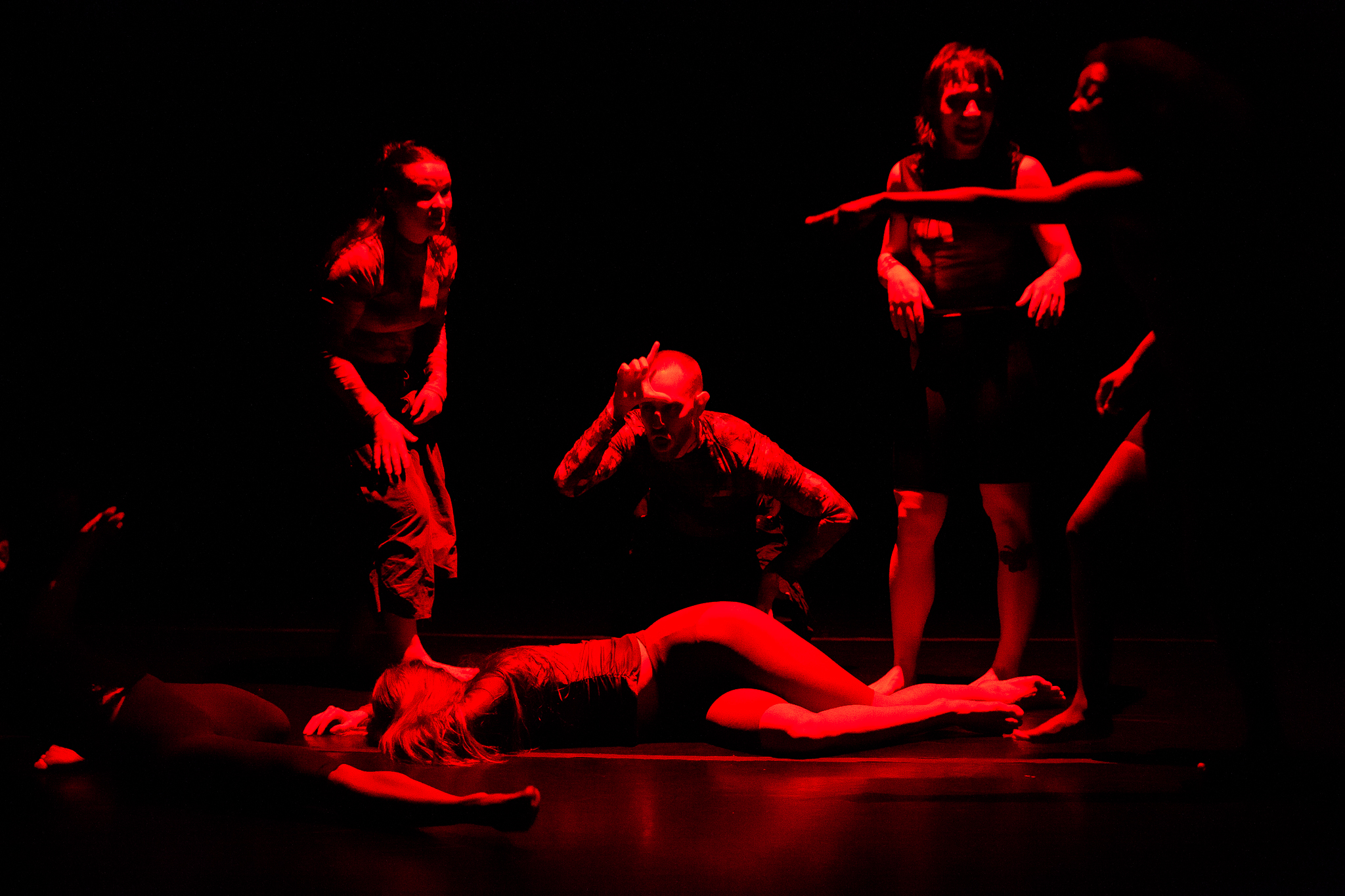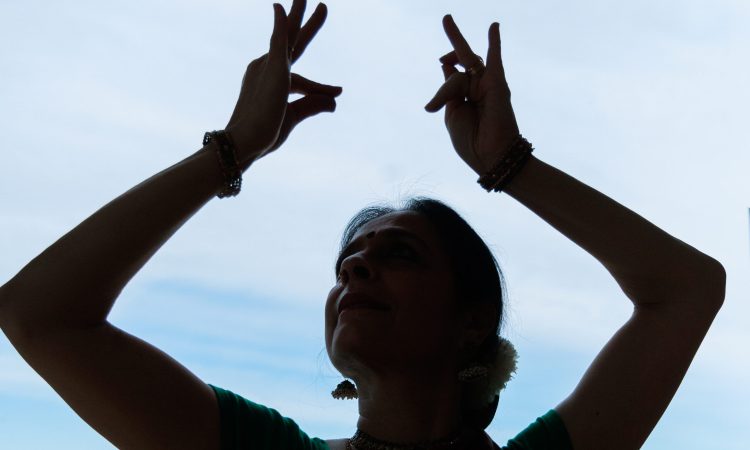
Vijay Palaparty, Founder/Co-Artistic Director and Nalini Prakash, President/Co-Artistic Director sat down with me to discuss the legacy of their dance organization Spilling Ink within the context of their newest iteration of Godavari: Who Am I?, to be presented at the Philly Fringe Festival this September. The 20-year journey of the piece started near the inception of Spilling Ink, with each iteration marking a chapter of the artists’ personal journeys. This time, as the organization enters its 20th anniversary year, Godavari continues a group conversation around where we come from and who we will become.
Below is an excerpt from our conversation, edited for brevity and clarity.*
Zoe Farnsworth: What was the genesis of Spilling Ink?
Vijay Palaparty: [Spilling Ink comes from my deep background in classical Indian Dance and my drive as a dance maker to demonstrate how the work of making happens. The work tends to be] anchored in identity politics and investigates [the question] what is the strongest sense of who you are? How does the practice form the practitioner?
ZF: Can you give us a little bit more about where you come from and how that helped to create Spilling Ink?
VP: I grew up in Cleveland, [Ohio], where there was a robust South Indian community around classical Indian art, music [and dance]. I was always accessing aspects of identity through the arts, and was very fortunate to have a window into the torchbearers’ practice and their process of introducing [these forms to] America. Figures such as Dr. K. Uma Rama Rao (Lasya Priya) in Kuchipudi dance, and Padma S. Rajagopal (Nupur Anjali) and Sudharani Raghupathy (Shree Bharatalaya) in Bharatanatyam dance are my mentors.
I was looking for grounding through [these artistic/cultural] anchors… and that was so important for me because I was living in a 97 percent White suburb of Cleveland, not wanting to be like anybody.
ZF: How did growing up in a basically all-White suburb inform your sense of identity?
VP: I basically knew that’s not who I am. I wanted to embrace differentness, which could only be grounded in where I was truly from.
ZF: Nalini, what is your relationship to traditional Indian dance, and how did you come into Spilling Ink?
Nalini Prakash: I met Vijay back home in Chennai, South India, through training under the same guru, Sudharani Raghupathy, in Bharatanatyam, which I had been practicing and performing for 35 years before. I came to the United States in 2008 to complete a masters in Dance/Movement Therapy at Drexel University, and Vijay was beginning to think about creating work together and starting this organization. I went on to my current role of Director of the Dance/Movement Therapy and Counseling program at Drexel while dancing and working with Spilling Ink.
ZF: What is the kind of work that you like to make at your company?
VP: I’m very much a generalist. I’m always situating the work amongst other vocabularies, and that’s where visual art and other forms of expression come into it.
God forbid the… form remains static, because then what’s the point? I create space for the material to give and take, and the work is always different, never the same. That’s really the crux of Spilling Ink.
NP: [I would also add the question of] how do we allow our communities to move and express their stories in the spaces that we create for them? [That is an important part of the organization and how we work.]
ZF: Could you talk a little bit more about how you make space for community and how other forms of expression come into your work?
NP: [I’ll bring up] Symphony of Temple Bells, which was inspired by Vijay’s mother, Satya Palaparty, who is a poet. Her recently produced book at the time was our inspiration. Parts of the dances were choreographed, but a majority weren’t. We had a theater artist come in and read the poetry, we had musicians [improvise in the moment, responding to the other expressive forms], and then we had a visual artist, Nimi Trehan, painting live as we were performing, so we were [all] taking inspiration from each other…We try to find different ways to bring different artistic communities together, with [the aim of creating embodied, holistic experiences for our audiences.]
ZF: Nalini, can you talk more about the genesis of the piece Godavari, Who Am I?
NP: Only a year before I came to Drexel, I went to a dance intensive… where the organizers discovered me and invited me to participate in a themed performance series on the sacred rivers of India. I was assigned the Godavari river, along with a resource person to help me learn about the river and its history.
ZF: Can you speak more to how identity factors into the work for you personally?
NP: The current version of Godavari, Who Am I? embodies the feelings and questions around each of the three performers’ identities. Godavari’s role in my own liberation and identity formation is the reason the piece is coming to be how it is today.
And as I was beginning to learn about the Godavari, I was questioning my identity and I started thinking if I hadn’t [learned this particular dance form], who would I have been?
Growing up how I did, completely immersed in the role of artist, role model, teacher all as one, these positions in society sometimes got heavy.
ZF: Why was it heavy?
NP: I was always perceived as this artist figure, so I couldn’t just just let my hair down, or really relax and let go because eyes were always on me. In India being in this idea of the guru-shisya parampara, which we call the tradition, the students really idolize you and as teachers we are modeling a way of being in life, teaching skills of empathy, compassion; it all comes into play.
ZF: How does this relate to the river specifically?
NP: In my research I came upon a pivotal story of the Godavari for the work. There is a sage whose land is impure because a cow had died on his property. He prays to Shiva and says please send Ganga down to cleanse my land and so [Shiva] lets Ganga down out of his tangled locks and she comes down as Godavari. Even Ganga has this different identity of Godavari; we are all trying to wear these different hats, and that felt important to the piece.
ZF: Who was in the piece originally?
NP: I created the piece as a very personal solo in 2008. Once I came to the United States, I showed the work to Vijay, and he asked whether we might do it as a group. This continues today, as now each one of us- Vijay, Ramya, and myself is looking at our personal journeys through the piece and [collaborating to bring these different approaches together.]
ZF: After having done this piece multiple times and investigating these questions of who you are, have you found any answers or more questions to who you would have been if you hadn’t assimilated into Brahmin or Bharatanatyam culture?
NP: I still feel very much there but I think the freedom of being away from the environment has given me a little more space to breathe. I felt as an artist I grew a lot more when I started working with Vijay. I felt I had more freedom to try out new things I couldn’t in India.
VP: I would also add that the art and the way we make it provides space for not being fixed.
ZF: Why do this piece at Philly Fringe specifically?
NP: Currently, as Spilling Ink is embarking on celebrating 20 years and we are planning the year ahead, performing the most recent iteration of Godavari: Who Am I? after my solo performance almost 20 years ago seems like a homecoming and an opportunity to share our growth with a city that has been part of our journey… Since the work isn’t static and continues to evolve, presenting this iteration of Godavari: Who Am I? for the community I garnered in Philly is important. What better platform to present Godavari: Who Am I? than at a festival that is inclusive of all arts and performances and has provided artists the opportunity to explore and create for almost 30 years?
*Zoe is neighbors with Nalini Prakash.