Stage fog and scratchy Dixieland sounds permeated the air as I entered Conwell Dance Theater, inviting the audience into a room of memories and dreams. From the start, Keila Cordova’s Volcano, My Love situated its ambitious theatrical undertaking between worlds (including artistic genres), gently slipping from one reality to the next.
The 75-minute story washed its protagonist, a seafarer who’s lost his memory, ashore a paradise island, to the world of mermaids, to a proto-Polynesian village, and all the way to a volcano that houses the god of Camden. The play opened with ten dancers in green-blue sheer tops and loose skirts portraying an aquatic atmosphere, drawing circles, ripples, and waves with their limbs in kaleidoscopic formations. At times they became sea anemones with unique human characteristics, eventually evolving into merfolk, alternately immersed, by way of changing lights, in the elements of water and land.
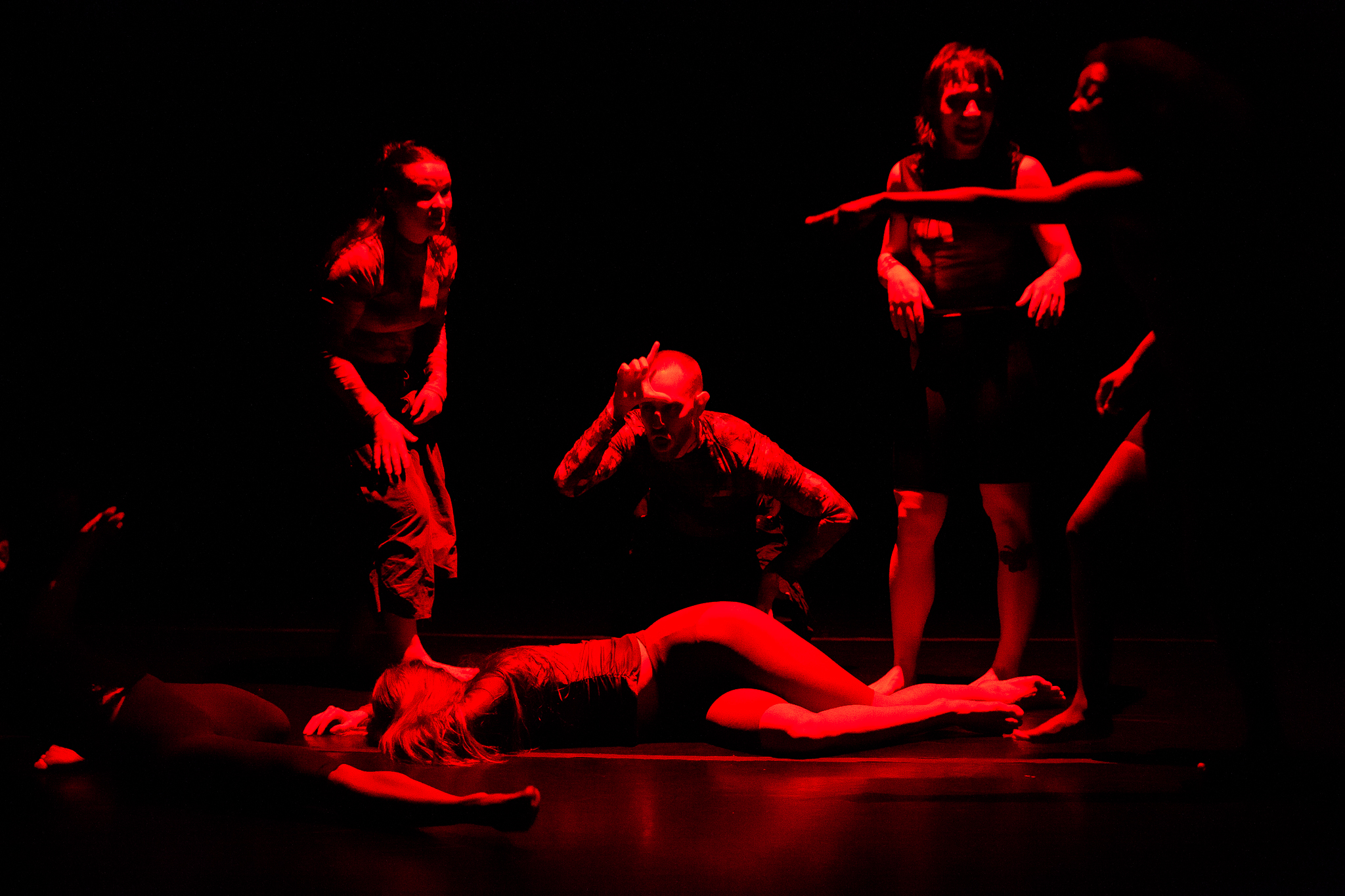
The rest of Volcano, My Love used dialogue to advance the tale of the man trying to find his way in shipwrecked exile, learning to understand both mermaids and villagers, and clamoring for any memory of his past. Meanwhile, the mermaid who rescued him longed for his human affection and plotted to transition to a land-bound life, while village elders commanded a girl to sacrifice to the god of the mountain. Interspersed throughout these scenes were monologues by various characters, including a hilarious mad-scientist explanation of mermaid anatomy and reproduction. The volcano loomed large on five beautiful panels staggered on the stage.
My attention was jolted halfway through the play, when the seafarer exclaimed: “This island is paradise.” A villager concurred: “Welcome to New Jersey!” The local inhabitant went on to refer to the exotic sites with Jersey references, including a mountain named Elizabeth, and Teaneck, a place of great mystery. Another villager accompanied a song about the island of New Jersey on his ukulele. The apparent absurdity of lauding “the armpit of America” as paradise did more than provoke mild laughter in the audience – it invited us to consider that there’s more to reality than we think we know, that nothing need be only as it seems.
This crossroads of myth, memory, exile and archetypal meaning-making is where it’s at for Cordova. Trained both as a choreographer and a storyteller, she drew on images from the Pacific cultures of Panama and California, where she was raised, to render her work. Volcano courageously married abstract and narrative techniques and mostly skirted and sometimes played on the cheesy minefield of “interpretive dance.” And it did so with a cast of eleven, three costume changes, original music and a large painted set – no small feat for a low-budget Fringe performance.
However, the audacity of this production is also its pitfall: good dancers are not automatically also confident actors, storytellers and singers, and the director asked her cast to stretch their talents in ways that require refinement. Nonetheless, both audience and artists entered a world between worlds, a suggestive re-imagining of a genre and of “home,” not just for those of us driving back across the Delaware River.
Volcano, My Love, keila cordova dances, Conwell Dance Theater. No further performances.