Framed around the theme of change, Vervet Dance’s Semi-Composed: Metamorphosis was a series of structured improvisational works exploring interactions between music and dance. Collaborators Melinda Faylor and Loren Groenendaal (with guest collaborators Curt Haworth and Charles Waters) presented a program of five pieces, four involving dancers and one John Cage-inspired musical number, “Philly Fantasia.” The semi-structured approach gave a dynamic element to the show, as dancers and musicians responded to each other’s rhythms and movement phrases.
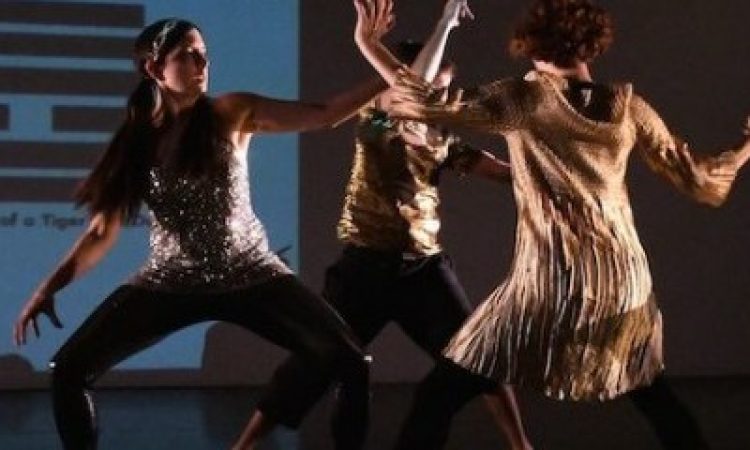
The program opened with “. . . of changes,” which relied on audience interaction by generating selected I Ching characters through coin tosses prior to the beginning of the show. The resulting hexagrams, projected on a screen, offered the performers a corresponding character representing a particular aspect of change to interpret through dance and music.
Five dancers clad in sparkling costumes clustered together in dim light in the stage right corner of the floor at the Performance Garage. The first I Ching character drawn was “1. Tai | Peace,” and the opening was calm, even slow, as the dancers began to stir and move to a sequence of isolated notes and tones played by Charlotte Munn-Wood on violin. Gradually the two men and three women began to cover more ground as the dynamic increased, going from a faint rumbling sound in the percussion to a clear, bell-like sequence on chimes played by Julius Masri. The dancers could be seen turning, falling, and rolling along the floor in an effortless manner, their movement punctuated by the minimalist accompanying tones.
The next randomly generated I Ching character, “47. Oppression | Exhaustion” was projected with the following phrase beneath it: “There is no water in the lake but there may be progress.” In response, the dancers moved more slowly, often pulling themselves heavily along the floor, as if in utter weariness. Munn-Wood’s ethereal sounding violin moved into tremolo as the figures dragged across the floor. In “10. Treading,” subtitled “Treading on the tail of a tiger that doesn’t bite,” the tempo of the percussion increased, bringing dancers back to their feet to revolve in a full spin.
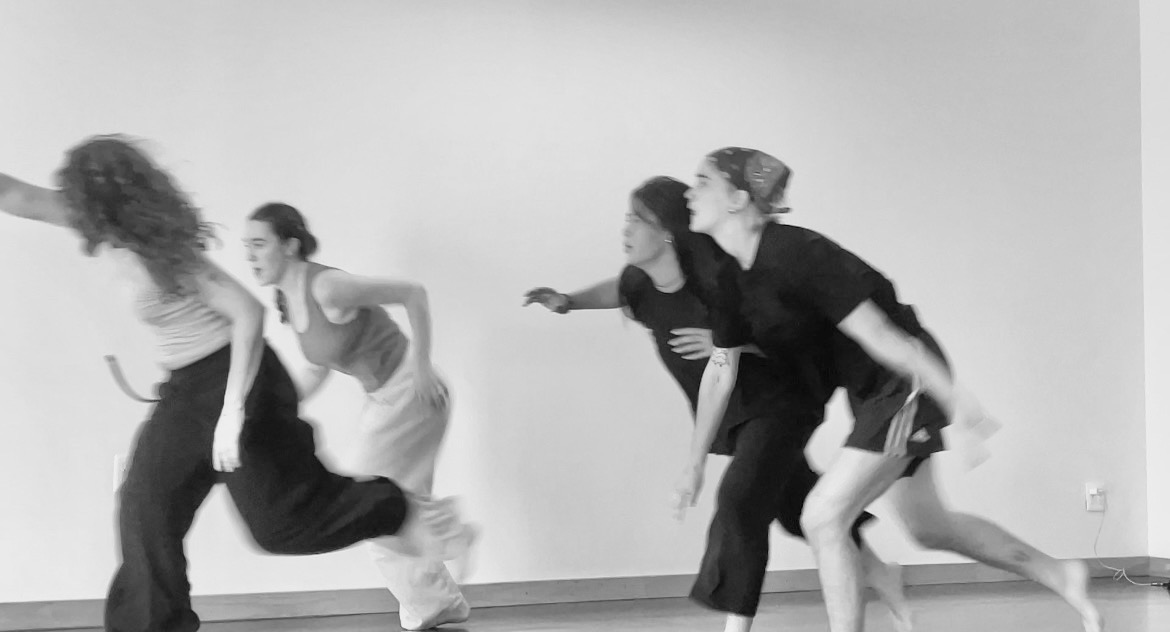
The quartet “Tourbillion” opened with the unique sound of bowed guitar, performed by improvising guitarist Tim Motzer. The eerie notes were echoed in the sound of the dancers’ feet dragging across the floor as they crossed the space in a semi-crawl. Words on the screen told the audience the piece was “structured in the gyre,” and the title is a reference to the inner mechanics of a watch, made literal by the dancers as they ran in a circle, first counter-clockwise, then clockwise, to the dischordant, electronic sound produced by Motzer’s guitar. Moving faster, they turned in circles, evoking the spin of the gravity-defying watch escapement.
The heart of “Semi-Composed” was the collaboration between pianist/composer Faylor and choreographer/dancer Groenendaal, which was felt throughout the program but especially in “0.03 grams Cantharidin,” a solo dance work to prepared piano played in a manner reminiscent of Henry Cowell in which the strings inside the instrument are blocked and manipulated to create a knocking or even humming sound. The piece takes its name from a secretion associated with the “Spanish fly” beetle, thought to be an aphrodisiac with potentially fatal consequences.
Groenendaal opened the piece in a prone position, head covered with a cloth, at center stage. Her movement had an insect-like quality, with swinging arms, her body sometimes writhing in agitation. Faylor created a unique range of sounds from the piano, evoking the feeling of being out in nature rather than in a performance hall. In this dance, the performer is the pest, enacting the troubled relationship between toxin and host. Ultimately, Groenendaal removed the cloth from her face and closed the distance between the performers, advancing, bug-like, to fold herself beneath the piano.
The theme of insects was revisited in the finale, “SWARM!,” a piece for seven dancers, which explored the patterns followed by locusts. Like many of the others on this program, the music was inspired by composer John Cage. The dancers hopped and vibrated as locusts do, at one point shedding their “skin” by peeling off outer layers of costume. Musicians Faylor, Masri, and Munn-Wood added to the effect of the piece with some elements left to chance, in Cage’s aleatoric style.
The musical elements in “Semi-Composed: Metamorphosis” were stunning, particularly in “Philly Fantasia,” led by saxophonist and jazz musician Charles Waters. Munn-Wood’s violin performance throughout the evening met the high standard set by Faylor and Masri in collaboration with the improvisational movement. As a great fan of jazz and improvisational performance, I found the combination of elements of chance, improvisation, and structured composition to be a creative expression of the process of change. Groenendaal, Faylor, and their collaborators have created a show that would never be exactly the same twice, and that dynamism could be felt throughout the evening.
Semi-Composed: Metamorphosis, Vervet Dance, Performance Garage, August 12, 6pm & 8pm.