The vibe is definitely cabaret meets outdoor queer dance party outside Brian Sander’s JUNK studio on Spring Garden Street. I am at RUB HARDER, the Fringe show by Jasmine Zieroff, a sequel of sorts to the erotic 2012 RUB she had co-created.
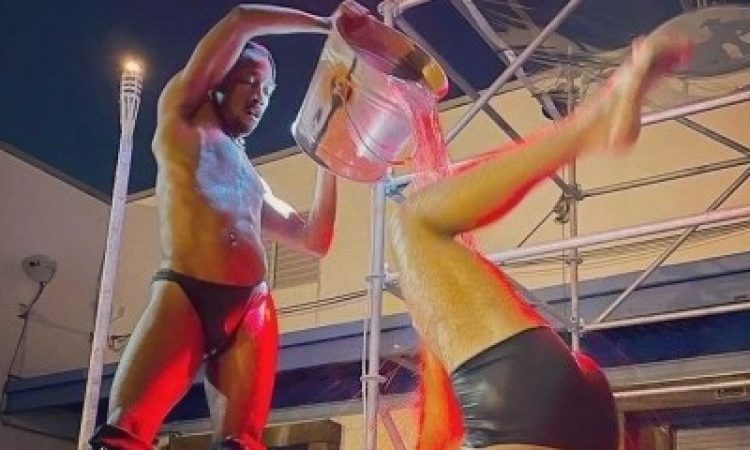
Audience members of all genders and sexualities gather on a warm late summer night around a set consisting of tall metal scaffolding with a walk-up bar at its base. Above, performer Will Brazdzionis can be seen striking various poses, wearing not very much. After a year of pandemic isolation, it feels like a welcome return to a setting with a club feel on a weekend night.
There’s always an extra risk in a show promising eroticism in performance, especially in an era in which so much sex is readily available online in pre-packaged, digitized format, from advertising to music video to outright pornography. But RUB HARDER pulls it off, largely due to the mad dance training and athleticism of the three cast members (Brazdzionis, Taheem Mack, and Mitchell Tannis).
For this show, Zieroff presents an all-male cast, creating homoerotic pairings in a series of solo, duet and ensemble pieces with a great deal of range, often using water as a prop. In an opening simulated bondage scene, we watch Tannis dip a towel in a barrel of water and proceed to flog Brazdzionis and Mack as they stand bound to poles on either side of him. The barrel then becomes the center of the scene as he dominates and dunks Brazdzionis in the water.
Later, Mack ascends to the top of the scaffolding to perform an astonishing solo characterized as “open air bathing,” suspended high above us on a thick sheet of transparent plastic simulating a puddle of water. The result is something vaguely embryonic, as his body folds, slides and sloshes in the contained space; we see outlines of his limbs as he moves and gravity presses him against the material.
RUB HARDER is a mix of burlesque, trapeze arts, and audience participation. Some elements work better than others – a duet performed by Mack and Brazdzionis suspended in the frame of a metal box, for example, is surprisingly tender in exploring the intimate embrace of male bodies so rarely seen in dance. The show takes a much bawdier turn in the audience participation elements, inviting volunteers to twerk on stage, and later cajoling a ticketholder to participate in a wet T-shirt event in which fellow onlookers turn on water cannons to soak him for the entertainment of all.
Refreshingly unapologetic in its exploration of eroticism and embodiment, RUB HARDER succeeds largely due to the level of energy brought to it by the cast. Tannis in particular flies high on a trampoline, clad only in a kilt, and later closes the show with an irreverent duet with Brazdzionis on and around a water-filled toilet. With a range of soundtracks from club music to Nine Inch Nails to Flashdance, the show takes Fringe audiences through a remarkable range of (homo)erotic experience in under an hour, no small feat for a pandemic parking lot performance.
RUB HARDER, Jasmine Zieroff, creator, Fringe Festival, Sept. 3-Oct.3. An additional benefit performance has been added for this Saturday, Oct. 16, party 8pm, performance 9pm.