In a quest to reach new audiences for performing arts in Philadelphia, Theatre Philadelphia and thINKingDANCE are joining forces and exploring how dance writing and discourse can provide new perspectives on theatre. Beginning May 2018, tD writers will be lending their varied backgrounds, interests, and approaches to criticism to professional works of theatre in Philadelphia. Let us know what you think in the comments!
As I walk into the Kimmel Center’s SEI Innovation Studio, I am acutely aware that The Fever involves audience participation, a performance tool of which I am often skeptical. Personally, I prefer to assume one role: either performer or audience member, but not both. In the past, I have found it challenging and awkward to traverse the boundary between observer and observed. I am tentative and even a little nervous as I take my seat.
“Picture a town.”
An actor in a loose, mustard-colored sweater addresses the audience from her seat among us. 600 HIGHWAYMEN start small: they invite us to participate by directing our thoughts.
“I hope it is okay that we are telling a story this way.”
As another actor rises from his seat, I wonder how many more cast members are camouflaged among us. The actor narrates a simple story about a town, a party, and its attendees, and as they do, they requesting randomly selected audience members to stand with them and assume a position. The audiences’ bodies are visual props.
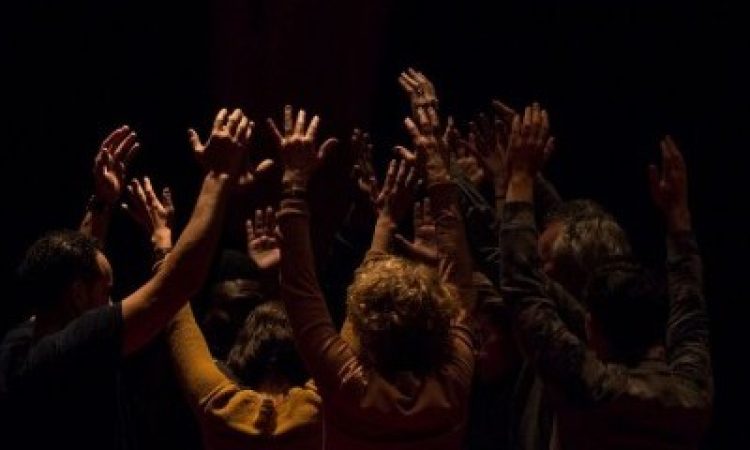
“Will you stand? Will you put out your arms like this?” the actor suggests kindly. The man tentatively rises and extends his arm. “He brought a six pack of beer,” the actor narrates, giving the man context. The original plot is simple and vague, but it coaxes the audience into participation. As the show continues, the actors shift from soliciting specific people to requesting volunteers. A physical and sometimes vocal dialog between actor and observer begins: although the actors continue to moderate the performance, everyone is gradually becoming part of the ensemble.
“Will you catch me when I fall?”
The story of the town has fallen away. A tall, slight, older man assumes the role of moderator. He requests that someone stand next to him and be responsible for his body as he tumbles to the ground. As he lies prone on the red tile floor, his silence cuts through the space. I feel uncomfortable, vulnerable. I want to call out, “Are you okay?” or run to his aid. Another woman, who does not appear to be a cast member, eventually stands and helps him to his feet. We follow the actors in simple, accessible movement phrases. The company members vocally and physically curate the experience.
At this point in the show, I forget that I entered as an observer. I feel part of this ensemble of strangers. There are moments when sweeping statements of “wholeness” or “togetherness” register as clichéd, but I am impressed by the actors’ skills in creating tender, physical moments within this group of people who have never met.
When we enter a performance, regardless of the genre, we agree to be part of a short-term community. As an audience member, we are often only responsible for witnessing. Those sitting around us may be familiar or they may be strangers. The Fever blurs the boundaries of being a stranger or an audience member and I leave no longer hesitant or uncomfortable. As I enter the elevator, coasting back to reality, I smile at the woman next to me who also attended the show. She smiles back. A small acknowledgement of our mutual experience as we exit this ephemeral community.
To join the conversation, follow thINKingDANCE and Theatre Philadelphia online and on social media to read, share, and comment.
The Fever, 600 HIGHWAYMEN, Kimmel Center SEI Innovation Center, Jun 6-10.