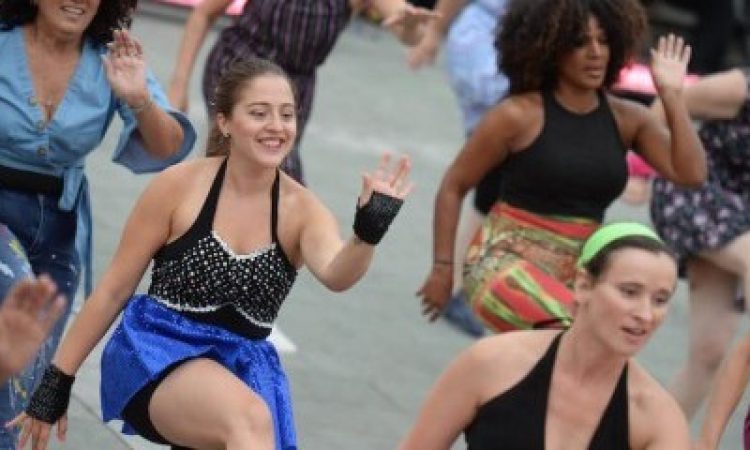
Think line dance meets flash mob, and what do you get? It’s Sylvain Émard’s infectious Le Super Grand Continental, back this year after its original appearance in the 2012 Fringe Festival. The concept: an outdoor dance performance performed by the public for the public, featuring approximately 175 people at the foot of the steps of the Art Museum, to club-style music with a heavy beat.
Amateur dancers dressed in colorful clothing of all styles lined up in rows, enthusiastically stepping, jumping, and turning in unison for an audience that grew organically as the spectacle unfolded. Ah! Something is happening here! A seated Fringe audience on risers grew larger with the addition of bystanders and passersby, who were drawn to the large ensemble and the pulsing sounds emerging from the speakers mounted on the sides of the performance area. Soon the steps of the Art Museum were packed with people captured by the sound and movement below.
Rainbow-colored lights marked the border of the “stage,” giving the performance a nightclub feel, though it was performed in daylight and early evening. As with other flashmob performances, Le Super Grand Continental seized the moment, bracketing this otherwise pedestrian public space in a exuberant display of choreographed energy. The enthusiasm of participants was so high that heavy rain on the second day of the run did not deter them or stop the show.
As the dancers pivoted and turned, stepping forward and back again in a patterned repetition of steps, the distance between performer and audience did not seem enormous. Perhaps that was Émard’s idea, a celebration of movement on a grand scale, demonstrating that yes, everyone can (and should!) dance. After continuous movement accompanied by several musical tracks, the dancers sank to the ground, perhaps spent from their efforts. Anticipating the end, I was surprised when a slew of children ran out into the performance space, skipping and stepping over the prone adult dancers. Bringing a renewal of energy with them, they reanimated the group, bringing them back to life in the finale.
This tribute to public engagement with the arts was capped off with an invitation to spectators to join performers in a spontaneous dance party at the end of the show. Le Super Grand Continental showed us why people love to move to music, capturing some of the magic of what it means to be caught up together in the moment of a performance we can all relate to.
Le Super Grand Continental, Sylvain Émard, Philadelphia Museum of Art Steps, Sept. 8-9, https://fringearts.com/event/le-super-grand-continental-2/