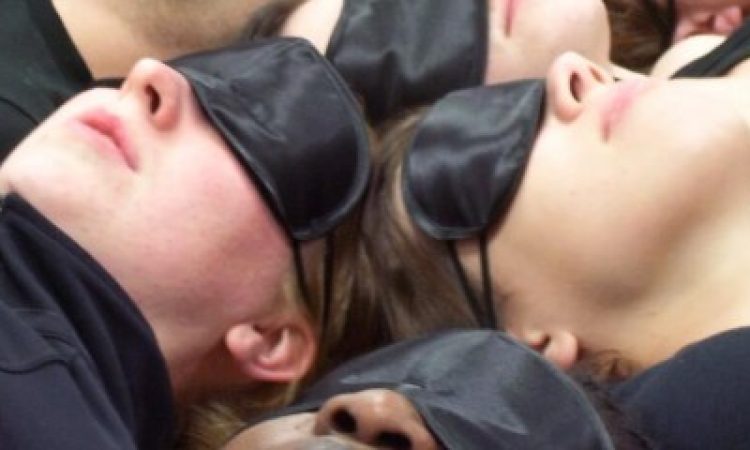
In the Latvian Society’s lobby, a crowd of eager theatregoers awaited EgoPo’s revival of their text-illuminating staging of Samuel Beckett’s Company. Blindfolded and shoeless, each audience member was guided one at a time by an “angel,” a Rowan University student and pupil of the director Lane Savadove, into the auditorium. After being gently guided to a yoga mat and pillow, each audience member was given a custom experience by their angel through light and pressured touch, bodily manipulation, and voice, while Maria Konstantinidis, Davey Strattan White, Zach Valdez, and Aidan McDonald performed Beckett’s text.
Throughout Company, composer and musician Jay Ansil offered earthy, rhapsodic sound design on harp, dulcimer, and other strings. As Beckett’s novella unfurled, the heady, abstract text required these musical breaks. The production could have easily accommodated more rest from the text in order for the sense-deprived audience to fully digest the mid-century classic.
Repeatedly and at the most serendipitous moments, the angels whispered into their audience member’s ear the refrain, “you are on your back in the dark.” At times this unison whisper was unexpected and it sent a shiver down my spine. As I was manipulated by my angel into sitting up, learning to crawl, and finally cross-armed and covered with a blanket like a corpse, I experienced a slight Autonomous Sensory Meridian Response (ASMR).
The text began to vanish into the background and my sensory deprivation and subsequent relaxation dominated the very personal experience. Through the program notes and pre-performance spiel given by stage manager and Rowan student Abby Leyh, I felt at ease and trusting of the company. I could probably gain more social capital in writing about the experience if I were to deconstruct and question how exactly EgoPo communicated consent and the parameters of the touching, but I truly had no qualms. I let myself enjoy the show without the limitations of aspirational theatregoing and political correctness.
Upon being instructed to remove my blindfold at the conclusion of the show, my angel was right there waiting for me to come back from wherever I had just been. She appeared earnest and tired, but she smiled and asked if I was ready for milk and cookies. I asked how she was balancing school with the production, which she shared openly with me for maybe fifteen minutes. We parted ways as I collected my purse and shoes, and she headed back to Rowan in Glassboro, New Jersey.
Company, EgoPo Classic Theater, The Latvian Society, September 20 – 23.