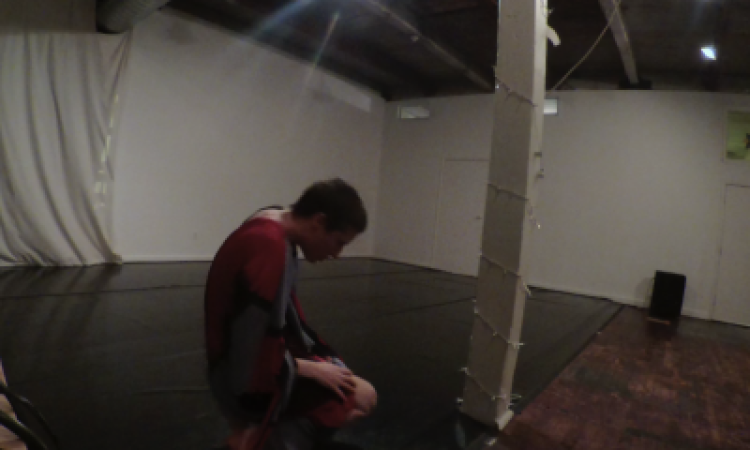
Evenings like fidget’s Process Project make me believe that the real innovation, the coming-up-to-the-edge experimentation in postmodern dance, is not happening on stage in theaters but in the quiet corners of Philadelphia. In a warehouse in Kensington, spectators sipping wine in the living room of fidget’s combined home and studio space. Megan Bridge* and Peter Price host this series once a year to expose their creative practice to the public as it’s happening; they perform the middle state between fledgling idea and final work. Before they launch into a 30-minute improvisation, Bridge notes that the project is a way for them to check in with one another aesthetically and for fresh interests to emerge.
For a spectator, Process Project is a beautiful rendering of the moment, and then the next one, into sculpted form. It’s a sinking into deep listening, both aurally and kinesthetically. It’s a reprieve from the urge to mine my own perceptions for a nugget of understanding; I can let each thing be.
Towards the end of the sketch, when Bridge turns on holiday lights in the space, Bridge’s and Price’s daughter Freya leans over to me and whispers, “That’s my light!”
Of the many moments I could choose to parse, some of the most fascinating (and simultaneously hardest to encapsulate in words) are the moments that aren’t meant for me. I don’t mean instances where Bridge or Price “check out” of the work (indeed, they never do that). They never say, “Ignore this for a second, it’s not part of it.” These moments are entirely of the work but feel as if they are choices made for the good of the instant without regard for potential interpretations of the audience. It’s whatever the work being made requires in the moment, irrespective of me and what I see or the performers and what they want to shape. It’s not careless; it’s selfless.
It’s also witty and delightful. There is a certain control and trust cultivated on the part of the performers to create a moment that is still “in” the performance but not up for consumption by the audience. Bridge’s facial expressions (a minute glance to Price’s sound board, a grin to the person seated on my left, folded in as part of the choreography of the body rather than as traditional character acting) feel as if they are being inhabited, divulged, for the benefit of her and her alone.
As for the sound, I would imagine there’s an equivalent phenomenon present in Price’s work, though I can’t equate sound and movement because I experience them, in some ways, quite differently. One beautiful sonic experience of note is when Price seems to turn up a deep base tone (he is working entirely in analog) and the sound becomes so all-encompassing that I feel it is emanating from inside me. I can hear it vibrating off the inside of my skull.
This duality between divulging and concealing feels fascinating rather than alienating. It’s a clever subverting of the performer-audience dynamic; rather than the performer creating something for the audience to take in, the performer creates something entirely for its own self. What happens when the performers are simultaneously aware of the presence of others and create a piece that only answers to itself and no one else, including its makers? For fidget, this is both the process and the project.
*Megan Bridge is a writer, editor, and former Executive Director for thINKingDANCE. The author has previously danced with fidget.
Process Project, fidget, The fidget Space, Dec 12.