A quartet of mostly white women, donning hazy nostalgia garb in crushed velour and polyester, enter the girl’s gym at the former Bok Technical High School. They shuffle in a tight line, pelvis to pelvis, breasts to shoulder blades. This approximate nod to Trisha Brown’s Spanish Dance quickly sets the tone and context for what will transpire over the next grueling hour.
Milka Djordjevich’s Anthem, as part of the inaugural Philadelphia Thing curatorial platform, is a historically referential meditation on white women’s dance labor, performed with unspecified urgency.
The dancers, Laurel Atwell, Devika Wickremesinghe, Jessica Cook, and Dorothy Dubrule execute tightly choreographed routines, spliced and pasted back together. Much of the individual movements originate from Black social and vernacular dances, either directly or as they were transmitted by Djordjevich’s artistic ancestors such as the aforementioned Brown or possibly Twyla Tharp. Specifically, moments of b-boying, voguing, skanking, disco, and jazz stand out as evidence of this history in Anthem’s movement vocabulary.
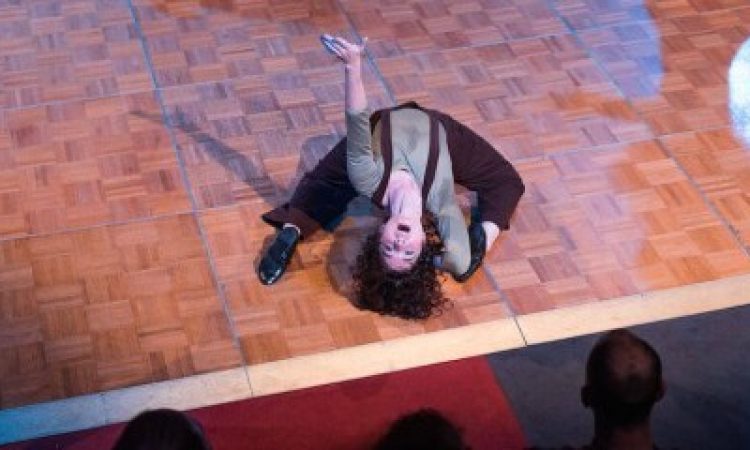
The women kick ball change in a shifting prism on the square stage, which the audience sits around. The small raised platform with parquet tile dance flooring, the kind one would find at a hotel wedding reception, offers the dancers just enough space. The quartet shuffles across the tiles and switches direction, forming a psychedelic kaleidoscope.
The interplay between Djordjevich’s phrasing and composer Chris Peck’s repetitive rhythmic provocations is at the crux of Anthem. Peck’s propulsive, driving score samples surf-rock guitar licks by Dick Dale, a few nods to Jethro Tull, and an eerie rendition of “Entry of the Gladiators,” while falling back on a droning minimalist thump. It all makes sense somehow, as postmodern gumbo usually does.
Peck establishes a recognizable pattern in a comfortable pop style, visibly counted by the dancers in an eight count. Djordjevich rolls with this at first, with accents on the second and fourth beats, but she soon cleverly disrupts it by accenting on just the five, then seven. This composer-choreographer collaboration messes with our expectations and keeps us engaged as the dancers descend further into sweat. They ferociously unleash huge sculptural expenditures of energy just for the sake of doing so.
A certain all-American athleticism kicks in. Atwell unleashes explosive straddle split jumps replete with toe touches, her dirty blonde curls fight the weight of her sweat. The group adds a variety of quicker vocabularies to their semi-unison. They country line dance, they perform a hypnotic hand clapping folk dance, they reference Michael Jackson videos, and they emanate Napoleon Dynamite in his infamous solo. Each dancer works hard, and refreshingly isn’t trying to mask it.
The women incrementally sink deeper into chaos, highlighting the impossibility of sustaining their performance. Atwell pulls a single errant breast out of her plush gold jumpsuit. Wickremesinghe douses herself in an entire bottle of water. Dubrule’s stunningly expressive face seems it couldn’t possibly become any more laboriously doe-like. Anthem as we knew it an hour ago is now very precarious.
Current white women choreographers exist within the frames that have been set by a legacy of intergenerational trauma, perpetuated by the impossible standards and underlying white supremacy of ballet and its related trainings.
In Anthem, Djordjevich might be commenting on this trauma through choreographing what she calls in a promotional video, “an alternative anthem” to the excessively serious white concert dance canon. She features “movement forms that are perhaps more accessible” for the average person to perform, yet she still employs professional dancers in this work.
I believe Djordjevich has taken on a worthwhile cause – to comment on the unjust positioning of girls and women in the dance industry. However, in practice, this choreographer ultimately appropriates black cultural dances—in the way that they unlock individuals’ joy—to quell white pain. Blackness is unacceptably invisible in this work.
Anthem, Milka Djordjevich, The Philadelphia Thing, Trade School: PHL/LAX at the Bok Building, June 6-8.