Jessica Warchal-King’s HOMEbody opens at Chi Movement Arts Center with a prompt for the audience: “Close your eyes, imagine a familiar place. Imagine sitting in a chair in that place. Imagine wiggling your toes. What do they feel?” Warchal-King guides us through a collective meditation: we visualize and then feel our individual definitions of “home” deeply in our bodies.
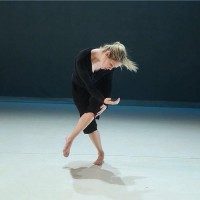
Warchal-King begins the first piece of the performance, a solo called Shed, on a stage bare except for a folding card table in the upper right corner. She navigates around, and then underneath, the table while her arms dart from one angular shape to the next. Jude Eden’s music, accented with deep cello strokes, inflects the quick changes in Warchal-King’s movement quality; in one moment of the piece, she flips the table over and, accompanied by staccato bowing, repeats a complex movement motif confined within the boundary of the overturned table, like a child playing house under the kitchen table. Warchal-King ends by folding each leg of the table with care, cradling the last leg like a baby.
Between dances, the audience is treated to a short documentary about the process behind the second piece, HOMEbody. The five women in the cast, including Warchal-King, articulate different understandings of the concept of home, representing a range of generations, and they offer a few words about how they used those differences in their creative processes. It becomes clear that HOMEbody is a piece that abstracts and distills its central concept. During the creation of the work, Warchal-King asked the dancers to find home in their bodies first. This context is helpful to me as I watch the performance; ideas behind the work are subtly referenced throughout, rather than shoved in my face. I too find a sense of home in unexpected places during the performance: in a breath, or a leg held in the air, or a supportive gaze.
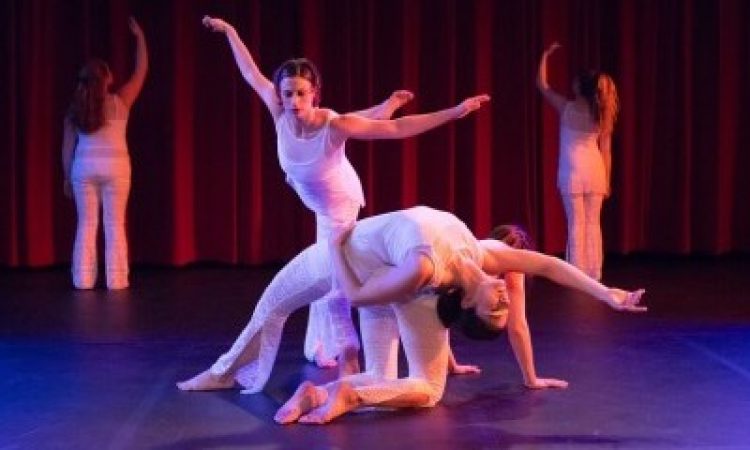
HOMEbody finds its rhythm slowly. The dancers enter the space individually; two younger dancers make their way from the audience. All are dressed in white lace pants and tops that reveal the strength of each dancer. At first, they watch each other. They take turns performing phrases that feel personal, as if they are embodying the meditation exercise from the beginning of the show. Phrases repeat, overlap, change spacing and facing. Over the atonal music, created by Paul Fejko, I hear each dancer exhale, her breath a unifying theme within the many arm and leg movements happening at once. HOMEbody is packed with a huge lexicon of movement. The ever-shifting floor patterns, solos that fluidly turn into trios for a brief moment, and the detail of each leg-raise and headstand might otherwise be overwhelming, but the generous use of repetition keeps the dance aesthetically cohesive. This is especially true with gestures that all the dancers execute: they stack their hands vertically, covering their torso, then neck, then face. There is a language in HOMEbody, even if I can’t decipher it. I’m okay with this; I know I’m seeing someone’s idea of home, and that is enough.
About halfway through the work, I notice a shift in energy. Each woman moves with a sense of sorrow or discomfort. One dancer holds another, and a third places a hand over her own neck, as if she is choking. I am reminded of a moment in the documentary when Warchal-King mentioned that home doesn’t always mean happy, and that in the process of making the piece, the dancers explored frustration, sadness, and discomfort as related to home. Then, one by one, each woman falls into her own movement phrase again. This time, though, a clear rhythm unifies the group. They breathily count 1,2,3,4 in a steady beat, each number a loud whisper that compounds in volume as each dancer joins in and syncopates her exhalations. I get the feeling that, even though the women have different definitions of home, they find unity and togetherness in breath. This moment lasts a long time but remains riveting. After the dancers break apart, they find togetherness by other means, like contact and weight-sharing. I see images of closeness and caring that perhaps represent a more shared feeling of home, an ending that brings the piece’s central theme from abstraction to familiarity.
HOMEbody, JCWK Dance Lab, KYL/D’s CHI Movement Arts Center, February 22.