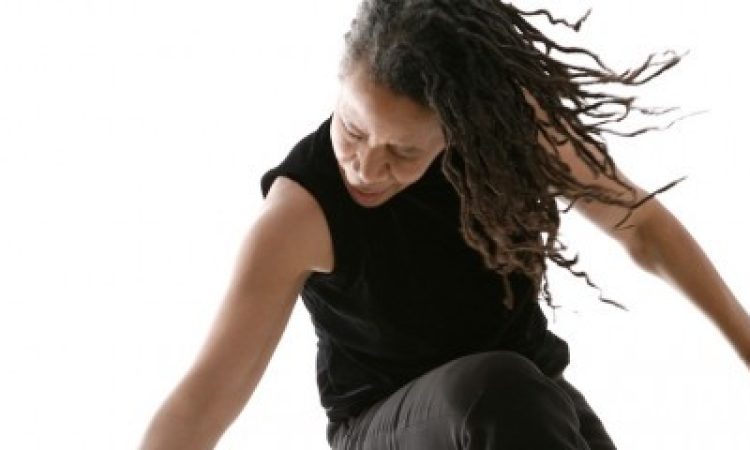
There is a pervasive and antiquated assumption in the field of dance that, once a dancer reaches a certain age, they will move into a different role; one less embodied and more directorial. And while that is the professional path of a good many dancers, the idea that the body will stop knowing what it knows has always felt, to me, absurd and harmful. The fact of a body dancing and the knowledge embedded in that body (about itself and it’s interaction with others) has proven to be timeless again and again by those that continue to move. However, timelessness is not immune to change, and The Poetics of Aging Festival hosted online by Freeskewl was a meditation on this matter.
The festival began with a panel discussion moderated by Rosemary Candelario with panelists Eiko Otake, Bebe Miller, Joe Bowie, and Chris Aiken. Addressing the inevitability of aging, the group unpacked what it felt like to continue to make from bodies no longer capable of the same things as before but who were still very much present with the work. It was clear that the fascination with movement and making had not left them; that it was their passion and there was always more to return to with fresh focus or new refinement.
They discussed making peace with time as much as they were using every drop of it and spoke about needing to choose what to remember and carry with them and what to allow to fade away. In their words, and later in the words and work of the artists in the festival, stories were told about how experience lands in the body and stays there; how it enriches the body over time. There are generations in this field, and as a result identities within the working community change over time. Virtuosity is not the sole function of dance; or I should say, it has been too narrowly defined as show stopping athleticism. There is a rich and masterful honesty in being exactly who you are in the body you have. As panelist Bebe Miller put it, “We are still dancing our fullest”.
Accumulated information is a form of wisdom. In the introduction to her work with collaborator Karen Kauffman, Anna Brown Massy asked the question, “What does it mean to be a future ancestor?” This question stuck with me as I continued to watch. What, as we are learning, are we also handing down? As a 39 year old past my “expiration date” but not yet “old,” these questions place me in a liminal ground; an intersection of the exchange I’d like to explore.
Poetics of Aging was a diverse array of artists and styles and spoke to growth and grace. If knowledge is power, which has long been said, then there is power in the dancing body no matter how old. The offerings were often centered around storytelling, ripe with both humour and gentleness. It was a combination of dance film, documentary style investigation, live streamed improvisation, and vignettes from past shows on the theme. In particular, the storytelling styles of Daniel Burkholder, David Dorfman, Janis Brenner, Kathryn Posin, and Anabella Lenzu stuck out to me for their level of honesty and exactitude in movement, framing and composition. The documentary approach Posin took gave us a glimpse into both past and present. When she addressed her age and her “ballet feet,” she said without shame, “There are a lot of stories in these feet.” Other pieces such as the work by Celeste Miller called “Accept the Poetics of Aging” were much quieter and held a very gentle peaceful place for aging, the body, and the subject at hand.
The dancing body is generous and honest. It is a researcher, and a living being. Dancing is a reminder to care for the body; to have a relationship with it. There remains an excitement, no matter how old, in the lives and work of those that took part in the panel and in the festival. They share a desire, an investigation, and a joy in the task at hand. To Joe Bowie, joy is broad and the play within that joy can take many different forms. Of his aging and the shifting values of his dance practice his words stuck with me, “I am always moving towards life.”
Poetics of Aging, Freeskewl, online festival, July 10 and 11