to feel
BOOM-BOOM
the removal of loved ones
to feel
BOOM-BOOM
the sound of the bars
to feel to feel
BOOM-BOOM
to feel
hope rise up
– Collaged from the responses at Write Back Atcha
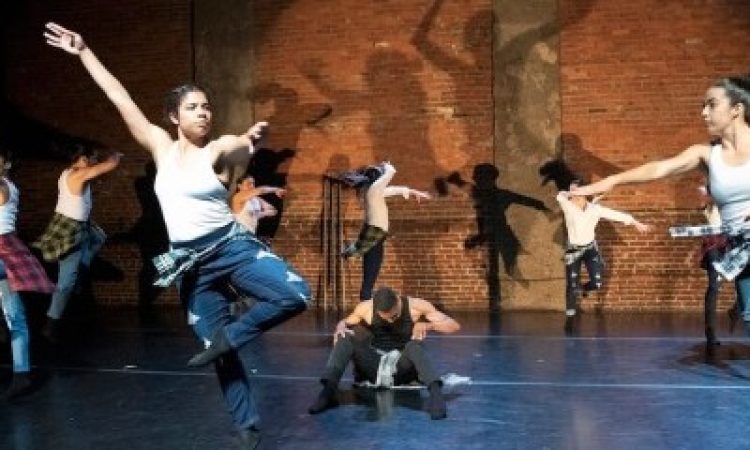
On Wednesday, May 23rd, a small group of audience members gathered after witnessing Joe González and Jo-Mé Dance Theater’s performance of Unbroken presented by Philadelphia Dance Projects at Christ Church Neighborhood House. The evening consisted of several pieces, all exploring the emotional journey of moving through grief and injustice. The longest dance, and the one that gripped our conversation and written responses, told the story of Sean Ellis, a Black resident of Boston who was incarcerated for 21 years after being wrongfully convicted in a case of police corruption.
González told the story through a mix of music, radio clips, and an adept fusion of movement genres set upon a cohesive ensemble of dancers. Moments of popular dance, like the kid n’ play, grounded us in the early 90s, while other moments of pedestrian movement evocatively told the story. For example, two of the ensemble members, acting as police officers walk the dancer playing Sean Ellis towards his jail cell, one hand on each of his shoulders. Throughout Unbroken, virtuosic sequences of contemporary balletic movement are interspersed with idiosyncratic gestures of distress and supplication:
A dancer holds his head, a fist driving into one side and open splayed fingers on the other.
In a pool of light another dancer jumps straight up, over and over, sternum reaching towards the ceiling.
In our post-show conversation, participants shared the moments that resonated with us and discussed how those moments revealed the value in witnessing Sean Ellis’s story through movement and not only as a news story. Here are some of the responses:
The mother’s solo stood out to me: I saw both her resilience and expression of grief in her fluid gestures that repeated. The jumps over and over again while she reached up to the sky spoke to me.
The police pointing and the sharp gestural work highlighted the manipulation and the rigidity of the rules; getting up on the table elevated their power over Sean in that moment.
Something that was highlighted so much more than in the news was community. Throughout the piece the ensemble work showed how the community witnesses and is affected by state violence, by the removal of loved ones.
– Zoe F.
Dance is liberty of expression, is an art form where you can create with your body movements and sounds.
Unbroken was a very beautiful and powerful dance evoking sadness, nerves, but also being stronger when you have somebody with you.
The Sean Ellis movement that impacted me was when he was behind the bars and then the sound of the bars against the floor—boom-boom.
– Sylvia Aramine
A duet takes place between the dancer portraying Sean Ellis and a dancer in pointe shoes and a blazer, acting as his lawyer. I have a stereotyped expectation that when I watch a woman in pointe shoes dance with a man, he will appear to take the lead. Instead, the lawyer en pointe took charge, moving across the space with quick steps and precise gestures reminiscent of the sharp rhythms of a court stenographer. As she confidently moved through space, Sean began to join her and as the duet progressed he became more animated. I saw hope rise up in his body.
– Ella-Gabriel Mason
Why make stories rather than just facts?
To feel the air rushing past when the accusers swirl around him
To see how facts can be twisted like arms wrapped around each other
Then locked together
No way out
Through the pointing fingers
To feel the pull of a mother reaching for her child
To feel
To feel
To feel
– Miryam C.
Unbroken, Joe González & Jo-Mé Dance Theater, Philadelphia Dance Projects, Christ Church Neighborhood House, May 23 & 24.
Join thINKingDANCE at our next Write Back Atcha on June 26th for DANCE UP CLOSE: Lily Kind.